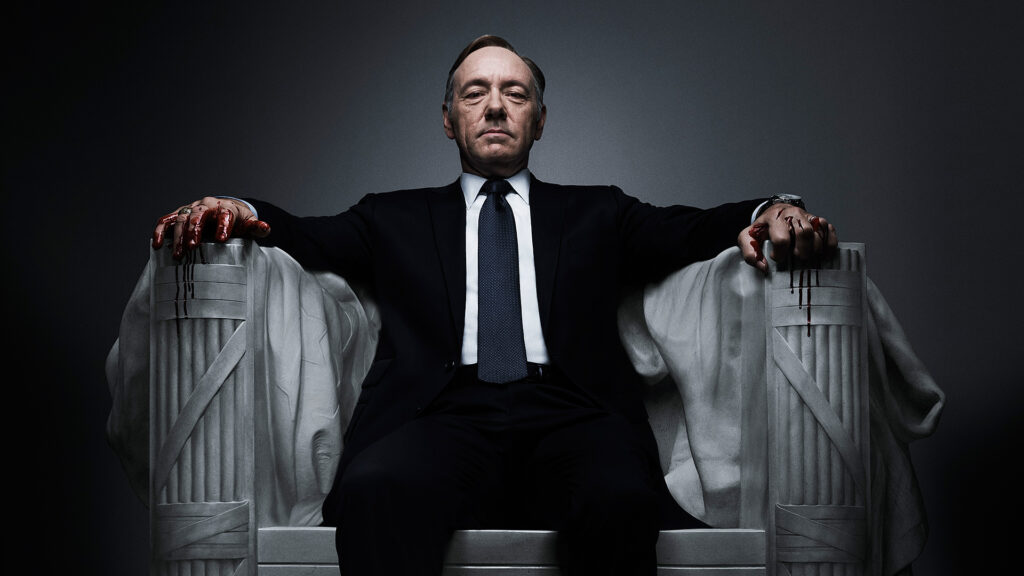
[Zhihu question] Why is Frank Underwood in House of Cards so compelling even though he does almost every evil thing imaginable?
Nine times out of ten, we find a character compelling because they possess some ability or quality we don’t have ourselves but wish we did.
The thing people admire about Frank Underwood in House of Cards is actually very simple: the psychopathic temperament (psychopathy).
Put simply, a psychopath is someone who, because they lack normal empathy (they have a hard time sensing other people’s pain), comes across as emotionally detached and ruthless.
The Underwood couple in House of Cards are both textbook psychopaths. They are utterly cold-blooded and indifferent to other people’s pain and misfortunes; in their eyes, everyone else is merely a tool or pawn for achieving their ends. They are also very good at using people: either they win followers with extraordinary personal charm, or they manipulate friends and enemies through all kinds of mind games. In the end, their success is built on a mountain of bones: many people are sacrificed by the couple and become stepping stones on their path to power. These are all classic methods of psychopaths.
Apart from this psychopathic couple in House of Cards, many popular villains and bad guys in film and television are psychopaths. Sherlock Holmes’s arch-enemy Professor Moriarty in Sherlock, the Joker played by Heath Ledger in The Dark Knight (the Joker in Joker isn’t a psychopath, but is more like someone with schizophrenia), the brain-eating Hannibal Lecter in The Silence of the Lambs, and the “godfather of the multilevel-marketing world,” Jordan Belfort, in The Wolf of Wall Street—all are fairly textbook psychopaths. And they all have tremendous charisma.
Actually, there are quite a few psychopaths among the protagonists of film and television, too. Sherlock Holmes in Sherlock is in fact just like his arch-enemy Professor Moriarty: he, too, is a psychopath. When it comes to lacking empathy and being cold-blooded and ruthless, Holmes isn’t much more normal than Professor Moriarty.
Of course, Sherlock Holmes is also an immensely charismatic, hugely popular character.
In the 007 films, James Bond may be the most famous heroic psychopath. He is ruthless with enemies and has just as little feeling for his own companions. In Quantum of Solace, his partner Marcus dies horribly right in front of him, and Bond’s eyes show perhaps one second of grief. Then what he does is actually take the cash from his partner’s wallet and casually dump the body in a trash can. The Bond girl beside him is left staring in shock, while Bond responds with a puzzled look, as if to say: “He’s already dead. What’s there to be sentimental about? Once you’re dead, aren’t you just a lump of human-shaped meat?”
And James Bond is obviously one of the most charismatic classic characters ever to appear on the big screen.
So the real question we’re asking is: Why does “psychopathy,” an apparently very dark personality trait, come across as so incredibly charismatic?
This may well be because, from an evolutionary perspective, psychopathy offers huge survival and reproductive advantages in many situations.
Psychopaths have at least the following advantages.
The advantages of psychopathy—
Advantage 1: Master performers
Psychopaths are often master performers.
A lot of the time, people have to put on a mask, hiding their true motives for doing something, in order to protect themselves. Psychopaths, however, are experts at concealing their true intentions. Because they have a hard time experiencing the emotions ordinary people feel, they don’t give themselves away as easily as ordinary people do when trying to hide their genuine feelings. Even when they’re saying something they don’t mean, they can keep a straight face and a steady heartbeat. They are the leading men and women of everyday life.
Advantage 2: Masters of emotional manipulation
Besides performing, psychopaths are also very good at manipulation. They can calmly observe other people’s weaknesses, and when they manipulate others into serving their own interests, they don’t feel much guilt.
Put those two advantages together, and psychopaths can thrive in social groups.
Of course, these advantages also show up in the dating arena, and many psychopaths are experts there too. When it comes to passing on their genes, psychopaths don’t lose out to ordinary people either.
Advantage 3: Good health
Psychopaths are very cold-blooded. This mind-and-body trait—their relative freedom from anxiety—also gives them an extra survival advantage: they are often healthier than ordinary people.
When normal people face stress, they have all kinds of stress responses, and these responses can reduce immune-system function to some extent. Psychopaths are less troubled by this.
Advantage 4: Powerful leaders
Psychopaths are often powerful leaders. They are calmer than ordinary people. Faced with danger, ordinary people are often at a loss, while psychopaths can make ruthless, decisive calls in the face of risk. That is exactly the kind of temperament leaders especially need. In fact, we can see psychopathic qualities in many political elites and business leaders. Steve Jobs, for example, was an extreme textbook psychopath: on one hand, he was exceptionally good at captivating people (just watch his product launches); on the other, he was also extremely cold and heartless, casually firing employees and even refusing to acknowledge his own daughter.
Advantage 5: Good companions
Psychopaths aren’t just good leaders; they can actually make good companions too (which feels a bit counterintuitive). If you have a psychopathic friend, they can take you on the kinds of risks you want to take but don’t dare pursue yourself. If something goes wrong, they can still help you clean up the mess when it matters. In fact, a lot of people secretly wish they had a friend like that.
Advantage 6: Powerful warriors
One obvious advantage of psychopathy is that psychopaths are often powerful warriors. The famous neuroscientist James Fallon discusses the advantages psychopaths have in war in his book The Psychopath Inside:
The most successful warriors are those who can separate emotion from behavior. In war, soldiers need to kill effectively; when they pull the trigger, they are neither nervous nor happy. Soldiers need to identify their targets and then calmly kill the other side without any bias or emotion. In a normal social environment, this behavior would be seen as psychopathic, but under wartime conditions it is extremely useful.
Human society as a whole has not yet experienced a long period of sustained peace, so part of the reason psychopathy genes may have persisted could be war.
To sum up, “psychopathy” is not absolutely a “liability” in a person’s personality. On the contrary, it is a personality trait that offers major survival advantages under the right conditions, so it’s hardly surprising that it looks attractive to many people.
That’s it.
Written by: Zhichao Wei
This article draws on the section “A Taxonomy of Psychopathic Killers” from my new book The 24-Frame Psychology Code.

Leave a Reply