
[Zhihu question]
From the perspectives of psychology, neuroscience, and philosophy, what’s the difference between pleasure and happiness?
Here’s a bit of crooked logic I came up with myself:
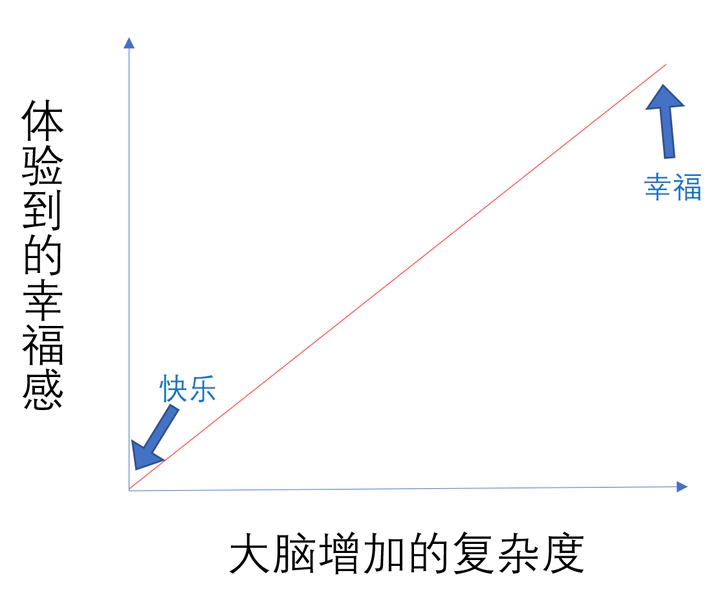
Happiness is a kind of pleasure that increases the complexity of the brain;
while pleasure is a kind of pleasure that doesn’t increase the complexity of the brain.
If you drew it as a diagram, it would look roughly like this:
Some people say that actively creating is happiness, while passively consuming something created by someone else is merely pleasure. Why is that?
Some people say that learning is happiness, while playing games is merely pleasure. Why is that?
Others say that sex with love is happiness, while sex without love is merely pleasure. Why is that?
I think that in all these examples, the essential difference between happiness and pleasure is whether the activity ultimately makes your brain more complex.
Why does creating make people happy? The process of creating sparks ideas you’ve never had before, forces you to sort out fuzzy viewpoints and make them clearer, and pushes you to gather scattered thoughts into coherent words… These changes aren’t castles in the air. Corresponding to them, entirely new neural connections and neural pathways form in the relevant areas of the brain; those altered neural structures record more complex information than they did before you began creating. Creating makes people happy because it significantly increases the complexity of the brain.
Compared with creating, why does passively consuming something created by someone else bring relatively little happiness? Because passively consuming other people’s creations increases the complexity of the brain only to a very limited extent. This is especially true when you repeatedly consume the same kind of work—for example, reading the same type of online novel over and over. After a while, the act of reading may do little more than briefly activate a certain neural pathway in your brain. That’s it. Your brain hasn’t gained any complexity from this reading, so what you experience is merely pleasure (if there’s any pleasure left in it).
But obviously, there’s no absolute “happiness boundary” between actively creating and passively appreciating. If this is your first-ever encounter with online fiction, and the reading opens up an entirely new world to you—making you realize that there’s actually a literary genre this wild—then after finishing the book, new neural connections may well be sprouting rapidly in your brain, new neural pathways snapping into place one after another, and huge amounts of brand-new information being recorded there. It’s hard to call that experience simple pleasure; it’s actually a powerful kind of happiness.
By the same logic, why is learning happiness? Because acquiring new knowledge and new skills significantly increases the complexity of the brain.
And why is playing games merely pleasure? Playing games isn’t only pleasure, actually. The stage from first encountering a game, to gradually getting the hang of it, all the way to mastering it, can absolutely be called happiness. That’s the process of opening up a new world and mastering a new skill; the complexity of your brain rises significantly during it. If you become addicted to a game only during this stage, that “addiction” will still feel very happy even in retrospect, and you won’t experience any “sense of emptiness after turning off the console.”
The problem comes after that stage: you’ve finished exploring the new world and learned the new skill, and you start mechanically repeating yourself in the game world. You’re still having a great time, but the sense of emptiness after turning off the console grows stronger and stronger, because the complexity of your brain is no longer increasing in any noticeable way. When I wrote this article, the last game I had played was Elden Ring. Months later, I still remember the experience of the first playthrough as very happy. But why did I spend so much time on the second, third, and fourth playthroughs? I regret it a little.
Why is sex with love happiness? Because sex with love strengthens your emotional connection with your partner and increases your anticipation of a beautiful life together in the future. The information contained in these emotional and social feelings and thoughts gets written into the brain, greatly increasing its complexity as well.
Why is sex without love merely pleasure? Because after that one moment of feeling good, you have no insight beyond “Wow, that felt good,” and your brain is basically the same as before. Of course, this isn’t absolute either. If this is your first taste of the forbidden fruit, then even without a trace of love, the exquisite flavor of that first taste may still stay with you for the rest of your life.
In short, there’s no absolute boundary between pleasure and happiness; what matters mainly is the extent to which an experience increases the complexity of the brain. Pleasure experiences that clearly increase the complexity of the brain are usually what we call “happiness”; those that don’t do much to increase it are usually just “simple pleasure.”
Let me make one more pseudo-scientific extrapolation:
Borrowing a concept from physics—entropy—if we equate “a reduction in complexity” with “an increase in entropy,” then happiness is precisely the kind of experience that reduces the brain’s entropy.
The brain’s ending is predetermined. With death, the complexity of the brain falls to zero and entropy rises to its maximum. Like everything else in the world, the brain will ultimately dissolve into the disintegration brought by increasing entropy.
But before rushing toward that destined, gloomy ending, there are brief moments when the brain, through learning, novel experiences, and love, temporarily reverses the fate of increasing entropy,
In those brief moments,
we experience,
happiness.
By: Zhichao Wei
p.s.:
This answer is just a personal reflection. I didn’t consult much of the literature, so please take it as a reference. If you know of any relevant studies, I’d be grateful if you left a comment and added to it.
After all that, the final conclusion is actually an old cliché: do fewer repetitive things and explore the unknown more. Happiness may not be within arm’s reach; it may lie in the distant places full of the unknown—whether those places are physical or mental.
Leave a Reply