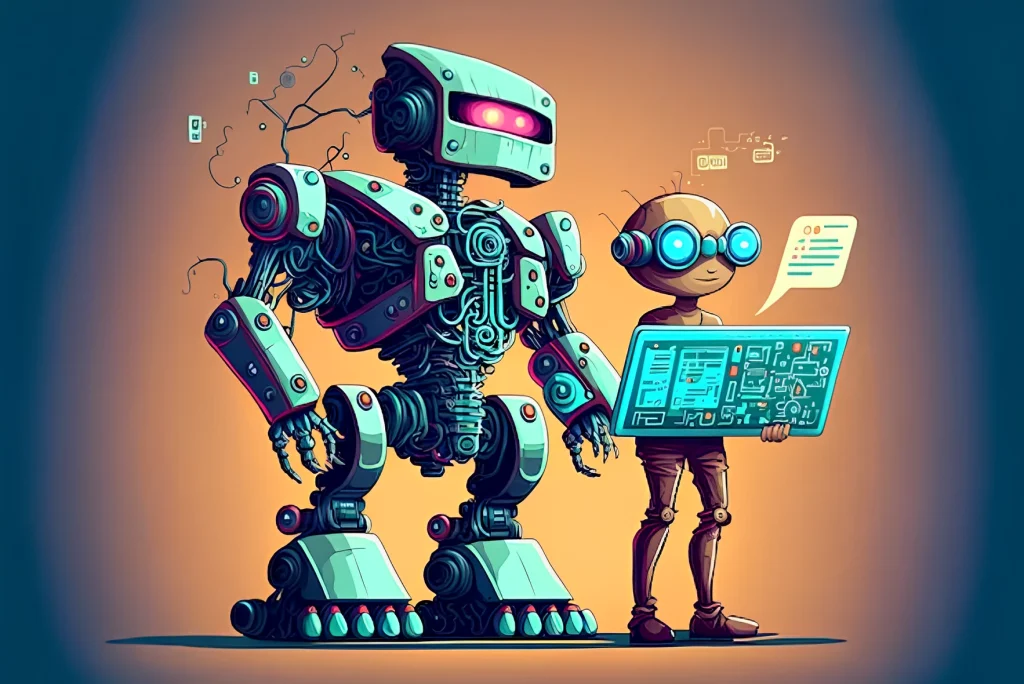
In the century’s great human–machine Go battle, Google’s artificial intelligence AlphaGo won three games in a row and defeated Lee Sedol before the match was over. To be honest, what I care more about is the technology of artificial intelligence + humanoid robots—or, more precisely, when we can build a lifelike Cang laoshi~(@^_^@)~. Still, witnessing history is pretty darn exciting!

Artificial intelligence has been charging ahead these past few years, and today it has raised yet another milestone. Which inevitably makes you worry a little: Will human beings be enslaved by artificial intelligence in the future?
After all, countless science-fiction films have already taught us that if we let AI develop unchecked, humanity will be beaten into the ground by AI:

Even the X-Men get beaten into the ground by AI:

In all those science-fiction films, I treat AI like my first love: AI beats me a thousand times, and I still love it.
1. What Are We Actually Afraid Of?
But if you think it through, you can’t help asking the next question: what kind of artificial intelligence are we really afraid of?
If future artificial intelligence were merely like today’s AlphaGo, only several hundred times more powerful—for instance, even 100 human world champions stacked together couldn’t beat it—would we be afraid of such AI?
Probably not. We’re not really afraid that artificial intelligence will be “smart”; we’re afraid it will “get ideas.” What we’re actually afraid of is a “mind” eventually emerging inside artificial intelligence. Being able to compute is no big deal; being able to scheme is frightening. We’re not afraid of AI becoming smarter. We’re afraid of it becoming human. Humans can be good or bad, and we have no idea whether artificial intelligence will be good or bad.
2. The Question: Will a “Mind” Emerge from Artificial Intelligence?
So here is the question: will a “mind” eventually emerge from artificial intelligence? In the future, will AI possess self-awareness like human beings? Will it, like the wisest among us, one day suddenly look up at the stars and recite a poem: “The vastness cannot be understood; it leaves me sighing”?
I think the answer is: one day, yes. Right now, AlphaGo’s specific algorithm for producing intelligence is worlds apart from the way the human brain does the same thing. But at the most fundamental level, the route it takes to produce intelligence is actually the same as the human brain’s! If machines continue developing along this route, the emergence of a machine “mind” is only a matter of time.

So what is this route to intelligence?
Let’s take a look at ourselves. How does human intelligence arise?
3. How Can Macro-Level Wisdom Emerge from Micro-Level Stupidity?
Here is something that looks rather paradoxical: the human brain unquestionably possesses the most powerful intelligence on this planet. Yet if you opened up the brain and looked inside, you’d find that its main components—neurons—are actually capable of doing remarkably stupid things. Basically, they release a few chemicals to transmit signals of activation or inhibition, making them more or less like generators that can produce only two signals: 0 and 1.
And so we have a paradox: how does macro-level intelligence emerge from micro-level “stupidity”?
4. Where Is the CPU in the Liquid-Metal Robot?
In the science-fiction classic Terminator 2: Judgment Day, Arnold Schwarzenegger’s T-800 and his opponent, the T-1000, represent two completely different kinds of intelligent robots.

There is a CPU in the T-800’s head. It is equivalent to the human brain, and it directs all of the T-800’s movements and reactions. In an extended version of Terminator 2: Judgment Day, there is a scene cut from the theatrical release: distrusting the T-800, Sarah Connor tricks him into taking out the CPU, intending to destroy it. In the scene, once the CPU is removed, the T-800 becomes completely paralyzed.

Clearly, the T-800 is a centrally controlled system, with the CPU as its center. Once the center fails, the entire system collapses.
Its opponent, the T-1000, is completely different. Its entire body is made of a clay-like liquid metal. If you cut open its head, you won’t find a CPU or any other functional components inside. Even when the T-800 punches its head to pieces, it doesn’t collapse at all; it simply grows a new head from another part of its body.

So if the T-1000 has a CPU, where is it?
The answer is hidden in James Cameron’s other film, Avatar.
5. The Tree Spirit in Avatar
Avatar has an interesting premise: scientists discover that all the trees on Pandora are connected through their roots, and that they transmit information through chemical signals in those roots.


The strange thing is that this enormous network of trees somehow generates intelligence—Eywa. (Huh? Isn’t that just a tree that has become a spirit?)
This is remarkably similar to what happens in our brains.
A single tree is relatively simple in structure. Even if it can produce some chemical signals, their complexity should be extremely low—perhaps just electrical signals like 0 and 1, either activating or switching off, just like our neurons.
But when these simplest 0-and-1 signals are connected in the form of a network, they form a gigantic matrix, like this:

If you know even a little linear algebra, you know that a matrix has computational power:
Input × matrix = output
This means that when you present an input signal to the matrix, the matrix computes an output signal that is different from your input signal.
In other words, the matrix responds to stimuli.
What is this?
This is intelligence.
The intelligence of Eywa, the “tree spirit” in Avatar, arises in exactly this way. As long as countless incredibly stupid trees are connected through a sufficiently large network, intelligence hundreds or thousands of times smarter than any individual tree will emerge within that network.
6. The Whole Body Is a CPU
So if the T-1000 in The Terminator has a CPU, its CPU is not located in any particular part of its body; it is distributed throughout the entire body. As long as every metal particle in it can produce simple 0-and-1 signals, an enormous number of interconnected metal particles will generate powerful computational ability.

Seen this way, unlike the T-800’s centrally managed system, the T-1000 has no central management system. Each unit contributes only a tiny fraction of the system’s total computational ability; it is the network formed by their parallel connections that constitutes the system’s overall computational ability.
This kind of decentralized system is called a parallel distributed system.
7. There Is Actually Nothing Inside the Brain
Remarkably, human wisdom arises in exactly this way too. The human brain is a parallel distributed system. American philosopher and cognitive scientist Daniel Dennett said: “If you look carefully inside the brain, you find that there is actually nothing there.”[i]
Just as he said, each neuron in the human brain may be hundreds of times stupider than a tree on Pandora. Neurons really can do no more than send the simplest 0-and-1 electrical signals—activation or inhibition—to the other neurons connected to them.
8. A Wise Person Is Millions of Blind Drifters Connected Together
If every neuron is this stupid, how can highly developed intelligence possibly be attached to them?
The secret is that although each neuron is individually too stupid for words, there are simply an enormous number of them. The brain contains approximately 86 billion such neurons. Even more astonishingly, the connections between neurons may number as many as 100 trillion[ii]!
The 0-and-1 signals emitted by countless neurons therefore form a matrix of almost unimaginable size. In such a huge matrix, it is entirely possible for astonishing computational power to emerge. This computational power emerging from massive connectivity is human intelligence. A wise person is really millions of blind drifters connected together.
9. Why You Are Still You Even After Getting Your Head Caught in a Door
A huge advantage of a parallel distributed system is its robustness—it is especially good[iii]. Robust means sturdy: in other words, whether the system is sufficiently tough.
A centrally controlled system is extremely fragile. As soon as the center makes a mistake, the entire system collapses. That is what happens when the T-800’s CPU is removed in Terminator 2: Judgment Day. The T-1000, with its parallel distributed system, isn’t nearly so fragile. It is an exceptionally tough robot; a small change in any tiny part of its body does not affect its survival.

The same is true of the human brain. Cells in the brain are constantly dying and being replaced, and they can also be damaged by illness and injury. But as long as the damage is not extensive, the brain’s functions do not collapse as a whole. As a parallel distributed system, it has remarkably good robustness.
That is because most brain functions are not contributed by just a few highly concentrated neurons, but are distributed across connections made up of a very large group of neurons. Damage to a few members of this group does not greatly change the group’s overall function. When a matrix is large enough, changing one or two of its values does not change its computational ability. That is why even if your head occasionally gets caught in a door, you are still you.
10. “You” Are a Matrix
Taken as a whole, Arnold Schwarzenegger’s T-800 in Terminator 2: Judgment Day obviously looks more like a human, since its body appears to contain all sorts of humanlike organs and tissues. But if we look only at the brain, the human brain is actually more like the T-1000. The T-1000’s ability to think does not exist in any individual metal particle; it exists in the network of connections among them.
Likewise, the human soul does not exist in any single neuron. The soul exists in the network connecting countless neurons.
Where are “you”? You are in the enormous matrix formed by the neural impulses of your brain cells.
Do you sometimes wonder whether you might be living in a matrix like the humans in The Matrix? You don’t have to think that far. “You” are a matrix yourself.
11. Machine Consciousness: The Brain Is Not the Only Vessel for a Mind
So we can now answer the question posed at the beginning of this article. From the analysis above, it is not difficult to infer that the vessel of consciousness should not be limited to biological brains. In theory, it can emerge from any sufficiently large parallel distributed system.
Since intelligence exists in neural networks, a parallel distributed system resembling a neural network should be able to simulate intelligence. In fact, AlphaGo is a kind of artificial neural networkmodel.

This “artificial neural network model” simulates simple computational units resembling brain neurons inside a computer, and then defines a network that connects them[iv]. It has long been widely used to solve all kinds of practical problems intelligently across many fields. The deep neural network behind AlphaGo is one of its most novel achievements.
What will happen as it develops further?
In The Matrix Revolutions, the third film in The Matrix trilogy, Neo—the Chosen One—begins to realize that the programs inside the Matrix also possess human-like thoughts and emotions. He even discovers that the Oracle, who has been helping humanity all along, is merely a program herself. This makes him start wondering whether the soul belongs only to humans.

This is really the question posed at the beginning of this article: Must the soul’s vessel be an organic being?
Judging from the analysis above, if these systems designed to simulate the human brain are eventually realized one day in the future, then the emergence of so-called “machine consciousness” will be inevitable. One day, the soul’s vessel will no longer be limited to organic beings.
12. The Galactic Thinker
Cixin Liu wrote an outstanding short story called The Thinker, in which he offered the most poetic and grandest vision I have ever encountered of the “substrate of consciousness”.
The astronomers in the story accidentally discover that the stars in the universe can respond to light emitted by other stars: they can copy a certain flicker in another star’s light and then emit it again. This is much like the way neurons in our brains transmit information through electrical discharges.
And there are hundreds of billions of stars in the Milky Way. Even if each star were merely a stupid little thing like a neuron, knowing only how to activate or inhibit through electrical discharges, as long as they could transmit signals to one another in this way, those hundreds of billions of stars could form a system vast and complex enough—yes, just like our brains.
So the Milky Way is actually conscious!
The only trouble is that even the nearest stars are often several light-years apart. A signal that a human neuron can transmit in an instant takes years to travel on the scale of the Milky Way.
Near the end of The Thinker, Cixin Liu writes:
The starry sky remained above them.
“What is ‘he’ thinking about?” she suddenly asked.
“Now?”
“During these 34 years.”
“That flicker originating from the sun may have been no more than a primitive neural impulse. Such impulses are happening every moment, most of them like tiny ripples made by mosquitoes touching down on a pond, vanishing in an instant. Only an impulse that travels across the entire universe can become a complete sensation.”
“We spent our whole lives and saw only one momentary impulse of ‘his’—one he could not even feel himself?” she said in confusion, as if she were still dreaming.
“Even the entire lifespan of human civilization may not be long enough to witness one complete sensation of ‘his.’”
“Life is so short.”
“Yes, life is so short…”
“A truly lonely being.” She suddenly said it, with no apparent connection to anything.
“What?” He looked at her, puzzled.
“Oh, I mean, outside of ‘him’ there is nothingness. ‘He’ is everything, still thinking, perhaps even dreaming. What does he dream about…”
Those gazing up at the stars,
may not be the only ones:
perhaps the stars are gazing at themselves, too.
References
[i] Kevin Kelly. (2011). Out of Control: The New Biology of Machines, Social Systems, and the Economic World (pp. 63). New Star Press.
[ii] Jonathon Keats. The $1.3B Quest to Build a Supercomputer Replica of a Human Brain. The $1.3B Quest to Build a Supercomputer Replica of a Human Brain
[iii] Guo Xiuyan, Tang Jinghua, & Yang Na. (2007). Application of artificial neural network models in psychological research. Applied Psychology, 12(4), 333-339.
[iv] Guo Xiuyan, Zhu Lei, & Zhichao Wei. (2006). An artificial neural network model of implicit learning. Advances in Psychological Science, 14(6): 837-843
Included in
This article is adapted from the chapter “Quantum Mind” in my 2014 popular psychology book The Alluring Illusion.

Leave a Reply