
[Zhihu Question] What kinds of games are there in romantic relationships?
The struggle for sexual control—and the resulting “domestication of men by women.”
Over the course of human evolution, there may well have been a major event in which women domesticated men. The modern men we see today may have been domesticated by ancient women in much the same way that dogs and chickens were domesticated.
There is a hypothesis called the “Lysistrata Effect” that sums up this issue rather nicely. I’ll unpack it in a moment. Once you’ve heard the hypothesis, you may understand why the men of today’s world are all so—refined.
Lysistrata
Let’s start with the story. The oddly named “Lysistrata Effect” comes from Lysistrata (Lysistrata), the famous play by Aristophanes, the father of ancient Greek comedy.
The story is set during the famous Peloponnesian War between Athens and Sparta.
At the time, the war between Athens and Sparta dragged on year after year, and the men who had the final say over city-state policy didn’t seem interested in ending it. But the women of both city-states couldn’t sit around any longer. They felt life had become impossible if this kept up. But how could they persuade the war-loving men beside them to lay down their weapons? For a while, they had no idea.
Then an Athenian housewife named Lysistrata stepped forward. She came up with two killer moves.
First, she traveled back and forth between Athens and Sparta, bringing together the women of the two enemy city-states. Together they issued a declaration: until the men of both city-states agreed to peace talks and ended the war, the women would firmly refuse to have sex with their husbands or lovers.
That was Lysistrata’s first move—using an alliance among women to deprive men of sexual opportunity. The details mattered. Lysistrata knew that if her fellow women fought separately, each issuing her own refusal, men might simply ignore them. But if a large number of women joined forces and made a great show of it, the situation could change dramatically. That’s what an alliance is for.
After issuing this refusal to have sex, Lysistrata quickly unveiled her second move. She asked the women: what if their husbands ignored the declaration and forced sex on them? Then they should make sure those rotten men felt none of the pleasures of the bed, finding ways to reduce the sexual pleasure men got as much as possible. Lysistrata said, “Trust me: men will soon grow terribly tired of dull, joyless sex, and start longing for the perfect experience of mutually desired sex.”
The first move: women unite to deprive men of sexual opportunity. The second: control men’s sexual pleasure. Used together, these two moves were devastating. Under this two-pronged pressure, the men of both city-states went crazy. Their sexual frustration made them question their entire lives: We’re fighting so we can live happier lives, right? But now the war has directly taken away my happiness—so what are we still fighting for?
So the men of both city-states decided to surrender to the women. They reined in their violence and ended the Peloponnesian War.
That’s the story of Lysistrata.
The Battle for “Sexual Control”
Richard Prum, the author of The Evolution of Beauty and a Yale biologist, was ecstatic after reading the story. He believes that, in human evolutionary history, a battle of the sexes very much like this story’s logic may well have taken place. He argues that there must have been a struggle between our male and female ancestors over “sexual control.” Sexual control means who gets a voice, the initiative, and the final say in choosing a mate and reproducing.
So who holds “sexual control” among humans today—men or women?
The answer is that each side holds part of it. Neither side can call the shots 100% when it comes to whom to pair up with or whom to have children with. In traditional societies, men may have had the main say in marriage arrangements, but that had more complicated social and cultural causes. Look at more primitive hunter-gatherer societies and you’ll find that both men and women had a voice in marriage; more often, they chose each other mutually. That’s even more true in today’s mainstream civilized societies.
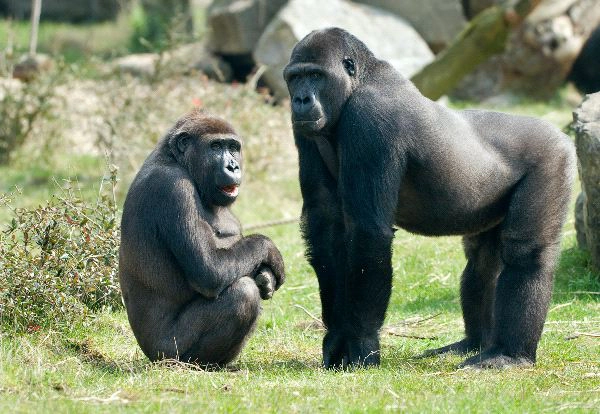
But this arrangement is actually pretty unusual among primates. Take gorillas and chimpanzees, our closest relatives: sexual control is almost entirely in the hands of the males. Whenever the females enter estrus, the males in the troop often engage in extremely bloody fights for mating rights. In the end, the winner takes all—the one with the hardest fists gets the females of the entire group. The big boss in a gorilla or chimpanzee troop is basically its boxing champion.
And after winning mating rights, this hardest-fisted boss turns his violence on the females. He threatens and coerces the females in the troop, forcing them to mate with him on the one hand, and intimidating them over infidelity on the other.
Throughout this process, the females are basically completely passive. Sexual control is firmly in male hands. That’s very different from the human situation.
And you’ve surely noticed that male gorillas and chimpanzees monopolize sexual control for one crucial reason: they possess—violence, especially male violence against females.
For example, male gorillas can easily coerce females because the difference in fighting ability between the sexes is so enormous. Male gorillas are more than twice the size of females.
Besides using their bodies, male gorillas and chimpanzees can also bite. They are all very good at tearing things apart with their teeth. Look at the male gorillas and chimpanzees in the picture below, mouths gaping like bloody caves, those fangs on display—and tell me, aren’t you scared?
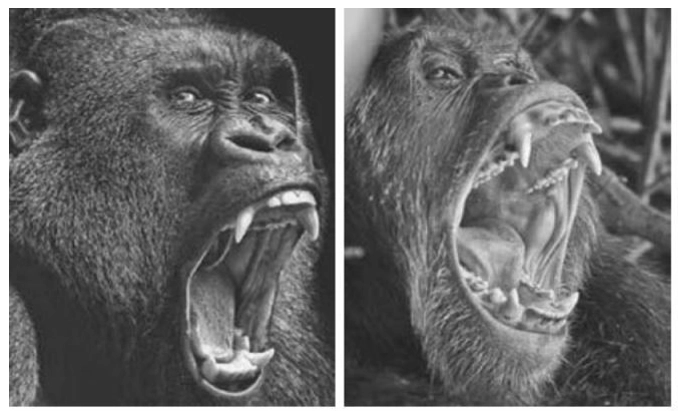
In short, male gorillas and chimpanzees overwhelm females when it comes to fighting power.
Violence: the core of male-monopolized sexual control.
So if, in the distant past, our human ancestors’ sexual control was also in men’s hands, as it is among chimpanzees and gorillas, women would have needed to find a way to control male violence in order to take back part of that sexual control. Only by controlling male violence could the balance between men and women avoid tipping completely to one side.
How do you control male violence?
Professor Prum speculates that human female ancestors may well have thought of the same two killer moves as Lysistrata. Those two moves pressed hard on men’s most vulnerable spot.
First, use an alliance of women to collectively deprive men of sexual opportunity. Second, even if a man obtained sexual opportunity by forcing himself on a woman, she could settle for the next-best option and reduce his sexual pleasure.
Why would these two moves work?
I think there were two conditions behind them.
The first condition was “the recreationalization of sex.” This is a highly distinctive feature of human sexual behavior: humans really enjoy the process of sex. For many animals, there is mating, but no sex as such. Gorillas and chimpanzees have an extremely strong desire to mate, but the act itself is practically perfunctory. Humans are different. Sex is one of our greatest sources of pleasure. Precisely because men treated sex as the most wonderful form of entertainment, depriving them of sexual opportunity and sexual pleasure could hit them so hard. As for why human sex became a form of entertainment, I’ll leave that as a loose thread and talk about it another time if I get the chance.
The second condition behind these two moves was even more hidden. Professor Prum never mentioned it, but I think it was indispensable: “language.” Why couldn’t female gorillas and chimpanzees band together to deprive males of sexual opportunity and sexual pleasure? Why could only our human female ancestors use this move? Obviously, because humans have language—and apes don’t.
How did Lysistrata get so many women in two city-states to act together? Through the thing she had in her mouth, of course.
So I think it was precisely the recreationalization of sex, combined with the mobilizing power of language, that allowed our female ancestors to seize men’s biggest vulnerability.
Domestication of Men
Once women had that bargaining chip, they could negotiate with men: “Want to get into my tender bed? Fine—but first rein in your violence. We’re not interested in violent men.”
Exactly. Professor Prum speculates that once human female ancestors had seized men’s weak spot, what they demanded was exactly what the women in Lysistrata demanded: they wanted men to give up violence.
Once women set a condition like “we don’t like violent men,” that was tantamount to starting the process of domesticating men.
You’ve certainly heard the concept of “domestication”: shaping animals according to a standard. In a flock of chickens, the ones whose monthly weight gain exceeds a certain standard are kept to reproduce, while the rest are killed. After several generations, ordinary chickens become broiler chickens.
By the time Lysistrata played those two moves, men had already become broiler chickens, to some extent.
Under this kind of “aesthetic standard” selection, men with higher levels of violence were naturally weeded out, while men with weaker violent impulses were lucky enough to be accepted by women and leave descendants.
The result was that the men living in the world today are not quite so violent. On the whole, they’re pretty refined.
Where are men refined? The vast majority of violent crimes in society are committed by men. From traffic offenses and street fights to domestic violence and murder, the perpetrators of these violent crimes are mostly men. Even the male-to-female ratio among serial killers is severely lopsided.
That’s right: compared with women, men are undoubtedly far more violent. But we also have to compare them with our gorilla and chimpanzee relatives. Once we do, we find that human males are actually quite remarkably refined.
Take the violence men inflict on women. Regardless of whether men want to coerce women, let’s first ask whether they can actually do it.
As I said earlier, male gorillas are twice the size of females, whereas human men are on average only 16% larger than women. So even if men want to use violence to coerce women, their physical advantage isn’t nearly as great.
Now look at biting ability. Put humans into that earlier picture of the bloody gaping mouths and compare us side by side. Don’t you suddenly feel, more than ever, that human men are so clean-cut and so impeccably well-mannered?

Beyond this drastic weakening of the physical hardware behind that capacity for violence, men are also far less psychologically prone to violence than their gorilla relatives. Human males are gentler and more even-tempered, and more inclined to cooperate with others than to settle things through violent confrontation.
If a relatively gentle and even-tempered nature is a typically feminine trait, then we can actually say that domesticated men, both physically and psychologically, have become more “feminine”.
This also helps explain why, although standards of beauty change from one era to another, in most eras the male stars and idols whose target audience is women have almost never been the sort with especially extreme “masculine traits.”
The male idols most popular with women are usually a blend of masculine and feminine qualities: they are fit, handsome, and dashing, while also being fine-featured, gentle, and as tender as water.
Women domesticate men into becoming less violent through sexual control. This mechanism is the Lysistrata Effect.
In the film Farewell My Concubine, when the Fourth Master Yuan, played by Ge You, invites Cheng Dieyi home and they pass a statue of Guanyin, Yuan gazes at Cheng with total devotion and says, “In this mortal world, the male body is yang and soiled; the female body is yin and impure. Only Guanyin gathers the essence of both in one body – what immeasurable joy.”
Bringing both sexes together in one body – what immeasurable joy. Turning the person you love into the bodhisattva Guanyin: when a man of culture starts acting lewd, it really is something else.
But in fact, based on our analysis above, this “androgynous” quality found in Cheng Dieyi exists in the physiology and minds of all human males.
I was born a strapping young man, but you women compatriots used the “Lysistrata Effect” to turn me into something like a delicate young maiden.
Still, having a touch of the delicate young maiden in a strapping young man is actually a good thing.
It greatly eases violent conflicts between men and women. Men and women living together in peace and harmony – that is what immeasurable joy looks like.
Written by: Zhichao Wei
References:
Richard O. Prum. The Evolution of Beauty. CITIC Press.
Leave a Reply