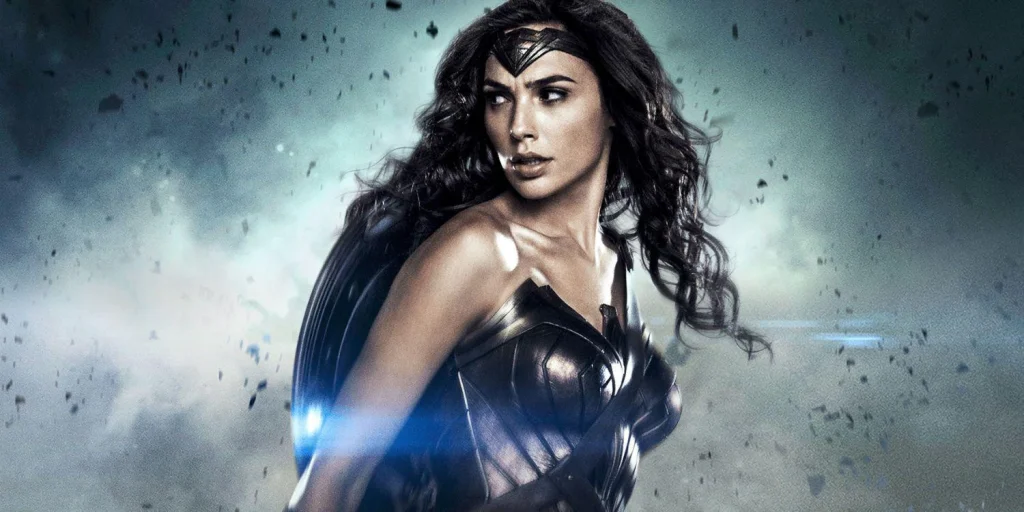
The Most Split-Personality Theory in Batman v Superman: Reading the “Spirit of the Age” Through Wonder Woman’s Changing Breast Size!
These days, everyone’s talking about how Batman beats up Superman. As a film critic who is not entirely right in the head, I thought I’d talk about the woman standing beside them… or rather, her breasts.
When Batman, Superman, and Wonder Woman—the so-called DC Trinity—stood together, I suddenly noticed that Wonder Woman’s breast size was the smallest of the three.
Batman and Superman are supposedly both a D cup:

And Wonder Woman, to my eye, is a B cup: 
This is not scientific!
The star playing Wonder Woman is Gal Gadot—the same Gisele from the Fast & Furious films, whom everyone should know pretty well. When it was announced that she would play Wonder Woman, the production released a costume-test photo. It looked like this:

The moment I saw that photo, I had a bad feeling. Because as a nerdy guy who grew up on the comics, the Wonder Woman I remembered from them looked like this:

And like this:

When I was little, I also watched a 1975 American TV version of Wonder Woman that looks absolutely bonkers today. The heroine looked like this—take a moment to absorb it:

Obviously, what has always attracted nerdy guys like us most about Wonder Woman is that magnificent bust. And now the new Wonder Woman’s breasts have actually shrunk to the point that they’re smaller than the male lead’s. What is going on?
Does this mean the full-figured body type we liked as kids has now become uncool? For nerdy guys like us, keeping up with changing trends is genuinely difficult.
But once my “nerd resentment” had been stirred up, I embarked on a formidable research project. I wanted to see how aesthetic trends concerning women’s breasts had evolved from antiquity to the present. The result got completely out of hand: I traced the subject all the way from ancient Greece to the modern day.
My conclusion was this: standards of breast beauty really have kept changing throughout history. You could say they’ve been “big and small,” hard to pin down. But if you think about it carefully, you can also spot some interesting little patterns.
Sometimes, the trends in “breast aesthetics” even let us glimpse the “spirit of the age”!
Yes, I know. This perspective is obviously peak “straight-man chauvinism.” My female friends probably won’t be big fans.
Still, the shape of women’s breasts is certainly related to the male gaze. On the one hand, it is a result of the mutual selection of men and women over the course of human evolution. (Actually, men also have some organs that look the way they do because of women’s “gaze,” so in that sense, equality.) On the other hand, in the long eras when patriarchy held power, the shaping of women’s bodies could also reflect certain collective male intentions.
(I was only recently given the label of racist anyway, so I might as well let them slap on one more label—male chauvinist—and be done with it.)
So here are the fruits of my research. (Of course I’m not going to post everything at once. How many installments there are will depend mainly on my mood and schedule. Heh heh heh~~~)—
One Big, One Small: The Mysterious Legend of Amazon Warriors’ Breasts
Wonder Woman’s image comes from the Amazon warriors. Interestingly, there has long been a mysterious legend about the breasts of the Amazon warriors.
The Amazon Tribe in the Comics
In DC Comics lore, Wonder Woman comes from a place called Paradise Island, home to an immortal people known as the Amazons. Wonder Woman herself was originally an Amazon princess.
Interestingly, the Amazons are a man-free kingdom of women. But if there are no men, how on earth did Wonder Woman come into existence?
We live by the weather; the Amazons give birth by divine intervention. One day, the Amazon queen wanted a child, so she molded a baby girl out of clay and asked the gods to give the clay doll life. Sure enough, the clay doll came alive and became a princess.

When the princess grew up, certain twists of fate brought her to the United States. She began using her superpowers to fight for justice, and thus became the Wonder Woman we know.
The Amazon Tribe in Reality
In reality, there really was an Amazon tribe.
But this “Amazon” was not the South American Amazon rainforest familiar to everyone today. It was a tribe that often appeared in ancient Greek legends, located in Asia Minor, across the Aegean Sea to the east of Athens.

And in ancient Greek legend, this Amazon tribe really was a kingdom of women—and a particularly fierce kingdom of women at that. The tribe supposedly consisted entirely of women, but they were highly warlike and frequently attacked neighboring tribes.

The Mysterious Legend of Amazon Warriors’ Breasts
The legend about the Amazon warriors’ breasts was connected to their weapons. Supposedly, their favorite weapon in battle was the bow and arrow. (Diablo II has a character who is an Amazon warrior, and her main weapon is the bow and arrow. That detail comes from this legend.)

As everyone knows, you generally draw a bow with your right hand, pulling the string toward the right side of your chest. The legend says that, to make drawing the bow easier, Amazon women, once they reached puberty, would actually burn off their right breast.
Of course, some historians suspect this was simply a distortion.
The truth may have been that:
In battle, Amazon warriors wore a kind of tight-fitting garment that flattened the right breast completely. So from the enemy’s perspective, an Amazon warrior’s breasts were one big and one small.
As the story passed from enemy to enemy, it was exaggerated into “one side with a breast, one side without.” Then, through repeated distortions, it evolved into the mysterious tale of burning off the right breast.

Actually, in the word “amazon,” the first letter, a, means lacking, while mazo refers to a breast. So amazon literally means “without a breast”.
If today’s Amazon company were translated according to the original meaning, it should be called a company without breasts: “Flat-Chested Incorporated.”

You see, the Amazon warrior of historical legend was neither a big-busted Wonder Woman from the comics nor a flat-chested female tough guy like the new Wonder Woman. She was one big and one small—a very strange image indeed.
So what does such an image mean?
The keyword is: asymmetry.
Sexy Symmetry
Asymmetry in a work of art can sometimes create a sense of beauty, but asymmetry in the human body rarely does.
Take the human face. Using handsome men as an example, the standards of handsomeness are all over the place: stylish men, muscle-bound men, cute men—everyone has their type. But one standard is pretty much universal: symmetry between the left and right sides of the face.

In the picture above, the middle image is a front-facing portrait of the very handsome David Beckham. The faces on either side are made by mirroring and joining Beckham’s left half and right half respectively.
The three faces differ only slightly. Clearly, Beckham’s left and right sides are highly symmetrical. A face like that is unlikely to be ugly.
When a symmetrical face is placed beside a face that looks like a crooked melon, we instinctively feel that the symmetrical face is more beautiful.
That is because “symmetry” is a sign of strong genes.
If a person is harmed by parasites, pathogens, or toxins while growing and developing, their skeleton can easily develop improperly and become somewhat crooked. So a balanced, symmetrical skeleton means its owner withstood all kinds of harm during development—a sign of good health and strong genetic resistance to disease.
Obviously, if you can pair up with a partner who has a symmetrical face, your children are more likely to grow up in a hostile environment and reach adulthood. Thus, through a long process of evolution, our ancestors gradually acquired genes for “looking for partners with symmetrical faces.”
And that is how symmetry became sexy.

Symmetrical faces, symmetrical breasts… symmetry is beautiful. Asymmetry, usually, is ugly. Instinct drives us to dislike human bodies that are insufficiently symmetrical.
The image of an Amazon warrior with “one breast bigger than the other” is off-putting. It is a negative image, almost certainly created by the Greeks, their enemies, to slander them—using an asymmetrical body to trigger people’s, mainly men’s, disgust.
So unexpectedly, the source of Wonder Woman’s image—the Amazon warriors—was not sexy at all in the beginning. In fact, it was the opposite of sexy.
Thus, at the source of Wonder Woman’s image, we can summarize the first small rule of breast aesthetics: symmetry matters more than size.
In short: the Law of Symmetry.
[Fun Fact: The Asymmetrical Venus de Milo]
On the subject of “symmetry,” there is another mystery involving an enemy of the Amazons—the ancient Greeks—which is equally mysterious.
“One big, one small” is asymmetrical. “Two big, one small” is an even stranger kind of asymmetry.
I wonder if anyone has noticed that the most famous ancient Greek sculpture, the armless Venus de Milo in the Louvre, has a very obvious protrusion above her right breast, near the armpit—

Anyone who studied medicine will understand at a glance: judging by its shape, this is an accessory breast (an incompletely developed breast). In other words, this goddess Venus actually has three breasts.
Whether this was intentional on the sculptor’s part, we simply cannot know. The sculpture was dug out of the ground centuries later, and we no longer know its origins especially well.
Anti-Gravity: Wonder Woman’s Eagle-Wing Breastplate
For ease of battle, the ancestors of Wonder Woman flattened their breasts with tight-fitting garments. Wonder Woman’s costume is almost their exact opposite.
Let’s take a look at Wonder Woman’s battle suit.
To make it feel more grounded, Wonder Woman’s armor in Batman v Superman was changed to a dark metallic palette, and everything from her breasts down to her abdomen was made of metal:

In the early comics and television series, Wonder Woman, like Captain America from the neighboring Marvel universe, simply wore the American flag on her body:

And it was primarily made of cloth. The metal parts were mainly the belt and a very eye-catching golden, eagle-wing-shaped breastplate:

What is a metal breastplate for? Shaping, of course. Rather than flattening the breasts like a real Amazon warrior, it creates the effect of high, upright breasts defying Earth’s gravity.
The Mother of Bras
Interestingly, the earliest figure in myth and legend to use clothing to shape the breasts was none other than Wonder Woman’s dad Zeus…’s wife—Hera, queen of the gods.

Huh? Didn’t we just say that Wonder Woman was given life directly by the gods? Why has she suddenly acquired a dad?
Because in another version of her origin, Wonder Woman does have a father: she is the illegitimate daughter of Zeus and the Amazon queen.
The two versions of the story actually aren’t contradictory. We’re all too familiar with stories like this. Aren’t our ancestor, the Yellow Emperor, supposedly the result of his mother being struck by lightning while out walking in the wild, becoming pregnant by divine inspiration, and giving birth to him?
But do you really believe such a ridiculous origin story? Wouldn’t it make more sense that the Yellow Emperor’s mom ran into the Old Wang next door while out in the wild, went home and discovered an accidental pregnancy, then came up with this story in a panic?
Aren’t Wonder Woman’s two origin stories basically a remake of this one?
Legend has it that once, Wonder Woman’s mother’s rival, Hera, wanted to seduce her husband Zeus, so she asked Aphrodite, the goddess of love, for advice. Aphrodite gave her a band and said that if she tied it below her breasts, every man in heaven and on earth would fall for her. Hera did as instructed, and sure enough, Zeus was completely enchanted.
This is Hera and Zeus, painted by the Baroque artist Annibale Carracci (1560-1609):

In the story above, what Hera wore was probably something like the band wrapped around her ribs in this painting.
Ancient Greek breast-binding
This band, used to accentuate the curves of the breasts, really did exist in ancient Greece. It was called a breast-binding (strophium), part of ancient Greek women’s everyday underwear (though it wasn’t tied below the breasts; it wrapped the breasts directly):

It later continued into the Roman era and became part of Roman women’s underwear too. Here’s a mural from ancient Rome:

Doesn’t it feel like time travel? It’s basically a modern bandeau bra.
The modern bra wasn’t invented until the late nineteenth or early twentieth century, but ancient Greek women were wearing something similar more than 2,000 years ago. We know that many things in ancient Greece look as if they were sent back from the modern world—city-states, democracy, commercial civilization. Who would’ve thought underwear made the trip too?
According to some written sources, this breast-binding had two functions:
1. Lifting
The main function of breast-binding was to wrap the breasts and lift them upward, making the chest look high and perky—in other words, preventing sagging.
2. Reducing
Its second function was to make the breasts a little smaller.
A shut-in guy like me probably finds this second function hard to understand, right? Ancient Greeks apparently weren’t big fans of large breasts. One ancient Greek book put it this way: breast-binding could be used to restrain excessive breast growth, so that “we might be able to cover the whole thing with one hand.”
See? What they were after was a one-hand handful!
So the function of breast-binding, this ancient magical bra, wasn’t to make the breasts look bigger. Its main purpose was to make them stand up straight.
Let’s make a bold guess based on what breast-binding did: perhaps in the eyes of ancient Greek men, the “shape” of the breasts mattered more than their “size.”
This guess does have some supporting evidence. Look at the sculptures left behind by ancient Greece: some, like the Venus de Milo, are fairly statuesque:

And of course, there are flatter ones too:
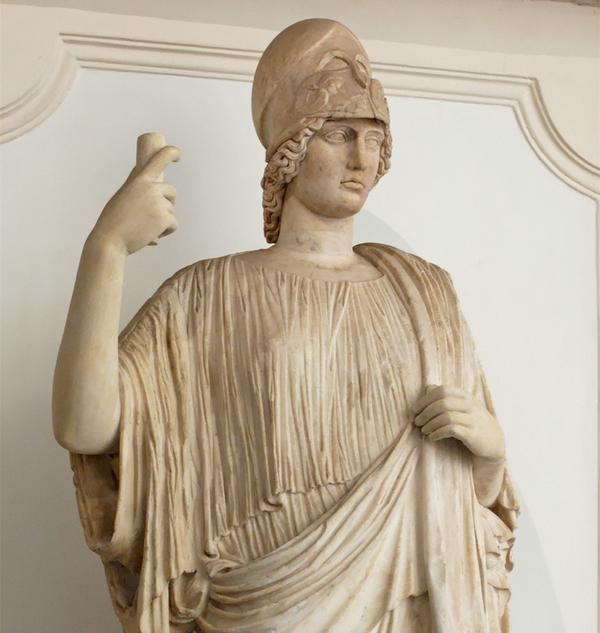
You could say every cup size is represented. But in the sculptures where the shape of the breasts can be seen, the contours are always beautiful—athletic and upright.
I think this reflects the second little rule of breast aesthetics: the Law of Uprightness.
The rule is that although history has sometimes favored large breasts and sometimes small ones, it has absolutely never favored sagging breasts. Big or small, the upright, high, anti-gravity look ancient Greek men liked was non-negotiable.
In short: the Law of Uprightness.
Why does this law exist? Because breast shape is a sexual signal about a woman’s age (just one of many hypotheses about breast shape).
Men are attracted to youth. The younger a woman is, the greater her fertility. So in most men’s subconscious, younger women are preferred:

And the size and shape of breasts can actually transmit a signal about a woman’s age.
Breast uprightness depends mainly on connective tissue, and connective tissue gradually loosens with age. Therefore—
If the chest is completely flat, that indicates a little girl;
If it projects and is firm, that indicates youth;
If it sags, then she’s already old.
More importantly, the looseness of connective tissue isn’t easily affected by other factors; it is mainly related to age.
So “are the breasts upright?” is an especially reliable age signal—more reliable than checking whether the skin is smooth or whether there are wrinkles on the face. Those things are affected by all sorts of factors. Take two women the same age: one gets sun every day, while the other lives somewhere cold, damp, and gloomy. Their skin is bound to look very different.
And there’s one more important point: before civilization was born, over that long stretch of evolutionary history, there was no particularly good way to hide sagging breasts.
Skin was different. Even in a primitive society, we can imagine women finding some paint or cosmetic-like substance to somewhat conceal aging skin. Smearing on a big white face probably wouldn’t have been too difficult, right?

But breasts were different. Specialized women’s clothing was invented only after humans entered civilized society, so sagging breasts seem to have been hard to fake in ancient times.
So whether breasts were upright became, at least for men in ancient times, a perfect signal for judging a woman’s age. That’s the evolutionary psychological mechanism behind the Law of Uprightness.
A disguised signal
This signal actually isn’t nearly as reliable anymore.
Because clothing invented after the rise of civilization—like the breast-binding worn by ancient Greek women and Wonder Woman’s eagle-wing breastplate—can completely conceal sagging.
But men’s eyes can’t resist this disguise. The genes in their bodies are ancient, and evolution hasn’t had time to give them eyes that can see through it.
To men, the female breasts under such clothing still transmit the signal “I’m young and highly fertile,” even when that signal is manufactured.

Breasts and the “Sea Ape Theory”
While we’re here, the Law of Uprightness can also explain why women’s nipples are located near the center of the breast.
This seemingly minor question once puzzled some scientists, because that position actually isn’t very suitable for nursing babies.
Below is a photo of a chimpanzee nursing:

In the photo, the chimp mother’s sagging breasts, with the nipples pointing downward, are actually better suited to nursing.
Why aren’t human women’s breasts like that?
Some people speculate that it may be because our ancestors lived by the sea: humanity’s ancestors were sea apes, monkeys of the ocean.

If the Sea Ape Theory is correct, and a mother’s nipples were on the underside of her breasts, a baby could easily end up submerged and drown while nursing. So the nipples had to be positioned a little higher.
But actually, if we understand it through the Law of Uprightness, it’s easy to see—
If the nipples pointed downward, that would send men the wrong signal, making them think the breasts had already sagged. Then they wouldn’t find you sexually interesting anymore. And obviously, that wouldn’t do.
So between making it easier to nurse babies and making it easier to attract men, evolution seems to have chosen the latter, putting the nipples in the middle of the breasts so the breasts would look more upright.
Now we know what the metal eagle-wing breastplate on Wonder Woman’s chest means. It is shouting on her behalf:
“I’m no ancient hag who’s been alive forever—I’m still young as hell!”

All right, that wraps up our discussion of Wonder Woman’s prototype—the ancient Greek era in which Amazon warriors lived. Next time, we’ll move on to ancient Rome and the Middle Ages.
Further reading and references
Jennei S. Bev, author. Power of Boobs (The Past and Present of Breasts). Power of Boobs
Marilyn Yalom, author. A History of the Breast. Hualing Publishing House. 2001.
Leave a Reply