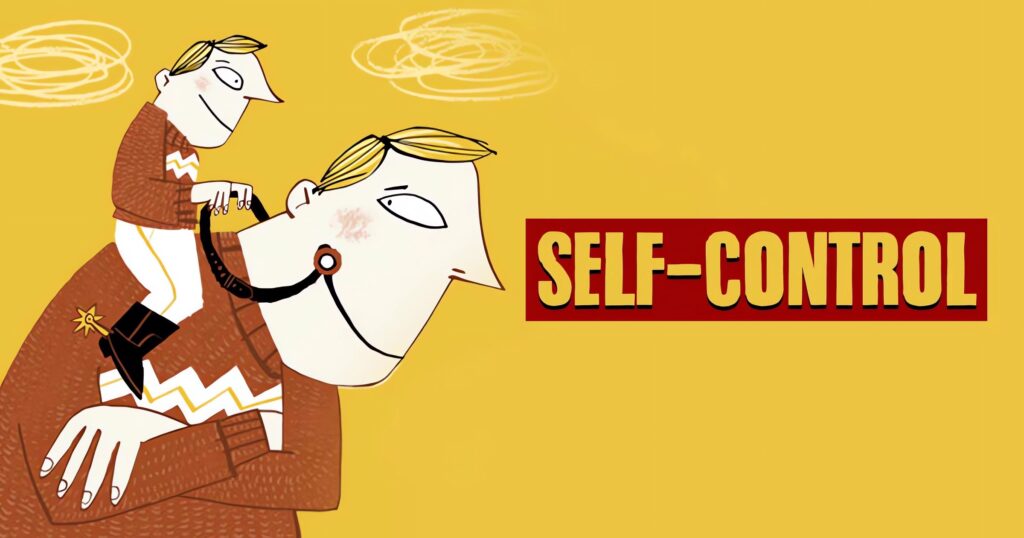
In The Better Angels of Our Nature, Steven Pinker sums up six ways to build self-control. Four are behavioral patterns individuals can cultivate, while the other two are social factors individuals have little control over. I’ve organized them separately and paraphrase them below—
Let’s start with the four ways individuals can control.
1. Way One: The Ulysses Strategy
In Homer’s epic, there’s a famous story about the Greek hero Odysseus—also called Ulysses. On one voyage, he learned that his route would take him through the Sirens’ waters. The Sirens used their songs to bewitch people, luring sailors to crash their ships into the rocks; once they fell into the water, they became the Sirens’ dinner. To keep from being seduced by the Sirens’ song, Odysseus had himself tied to the mast and ordered his men not to untie him under any circumstances. His sailors, meanwhile, plugged their ears, so they couldn’t hear the song and wouldn’t be tempted. And so they made it safely through the danger zone.
Odysseus’s behavior—restraining himself in advance because he foresaw that his future self might surrender to temptation—is called the “Ulysses strategy.”
The Ulysses strategy is a great way to resist temptation and build self-control: don’t shop on an empty stomach; throw out the chocolate cake before you’re ravenous; put the alarm clock at the farthest point from your bed, so that when it rings you can’t simply reach out, turn it off, and fall back asleep; authorize your employer to deduct a sum from every paycheck and deposit it directly into a long-term savings account.
2. Way Two: Psychological Strategies
Self-control can also be supported by all kinds of psychological strategies. In the famous marshmallow experiment, for instance, the children who managed to resist temptation and get two marshmallows were often good at using mental tactics to fight it: covering up the tempting marshmallow in front of them, turning their heads away, singing to distract themselves, or mentally reconstructing the marshmallow as a tiny white cloud rather than a delicious candy, and so on.
You can see something similar in violent conflicts. Take cognitive reframing: an opponent’s provocation can be seen either as an attack on your honor and dignity or as evidence of the other person’s childish ignorance. If you attribute it to the latter, you can suppress the urge to punch them in the face.
3. Way Three: Improve Nutrition
Self-control depends to a great extent on the frontal lobes’ ability to inhibit impulses. The frontal lobes are highly metabolically active tissue, with enormous demands for glucose and other nutrients. Roy Baumeister’s classic research found that when people perform tasks requiring willpower, their blood sugar drops sharply. If they drink some sugar water to replenish the glucose in their bodies, they show greater perseverance in the work that follows.
Improving your nutrition in everyday life and replenishing your energy appropriately during demanding work can also help build self-control.
4. Way Four: Exercise Self-Control
Self-control can be trained. Baumeister once used methods like these to train participants’ inhibitory control:
Ask participants to keep a running record of every bite of food they swallow;
Take part in programs involving physical exercise, financial management, or learning a skill;
Brush their teeth or use a mouse with the hand they don’t normally use;
Avoid profanity when speaking, use complete sentences, and don’t start sentences with “I.”
After several weeks of training, the participants performed better on experiments requiring self-control.
***
The following two ways of building self-control depend on the social level:
5. Way Five: Stable Expectations for the Future
“If tomorrow were never going to come, no one would be willing to save for it; and if people lived in a world of chaos, they would have no confidence that they could get their savings back.”
When society is stable, steady expectations about the future can shift people away from pursuing short-term gains and toward thinking about long-term interests—and the latter often amounts to living with restraint.
6. Way Six: Make Self-Control Fashionable
In the United States, body weight is almost inversely related to people’s income and social status: the rich are slim, while the poor are obese. This may be largely because, among the wealthy, self-control is a fashionable quality that earns admiration: “Self-control is a virtue of a respectable person: it shows that someone is mature, dignified, a lady or gentleman, a person of refined character.”
People are easily tempted to give in, but they’re also afraid of falling behind. The vanity of keeping up with fashion can sometimes defeat temptation.
p.s.:
Several of my past articles were inspired by The Better Angels of Our Nature because I’ve recently been reviewing my notes on the book. That work is now done, so this should be the last short piece spun off from the book for a while.
References:
Steven Pinker. (2015). The Better Angels of Our Nature. CITIC Press.
Note
- This article in the “Psychology New Knowledge Mini-Course” series was written at the time as a popular-science essay/rambling short piece related to Zhichao Wei: Psychology New Knowledge Course. It was published on the now-closed platform “Fantuan,” and the original link no longer exists.
Leave a Reply