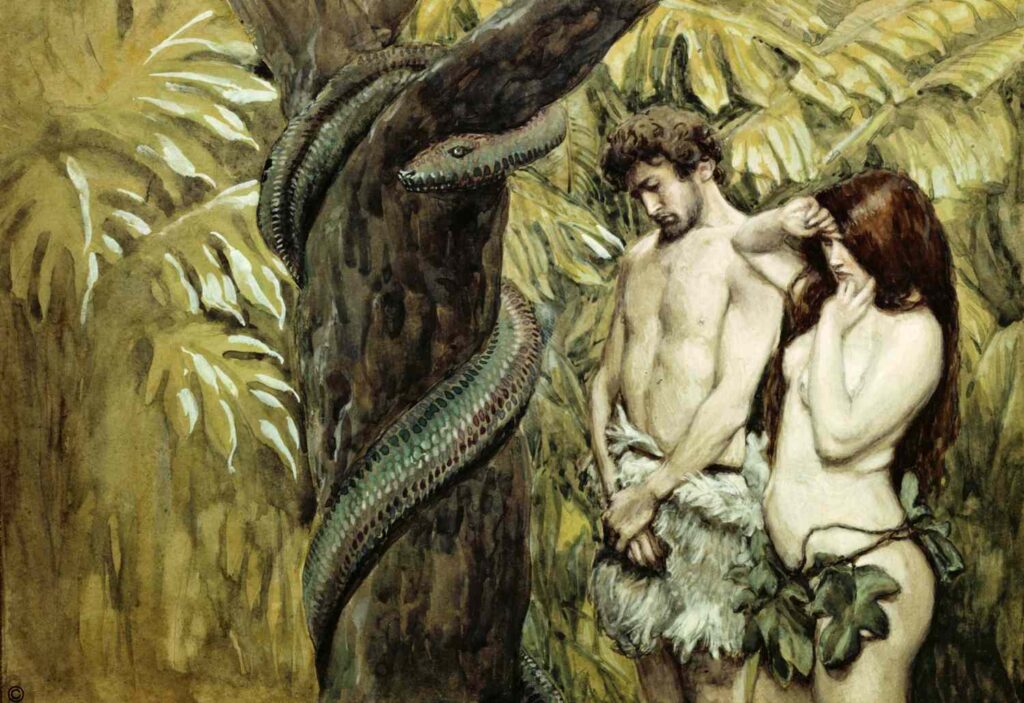
[Zhihu question] God used Adam's rib to create Eve, so why do men and women today have the same number of ribs? Does this imply that humanity "lost" its "baculum"?
Here’s the problem: God used Adam’s rib to create Eve, but men and women have the same number of ribs →_→ So where did that rib go? Was the Creator being careless? →_→
This topic comes from Xiang Feng’s Faith and Forgetting: The Gospel of Job and Other Essays. In essence: Dr. Ziony Zevit wanted to fit Adam in the Bible with a “soft bone.” He argued that God taking one of Adam’s ribs to create Eve in Genesis, chapter 2, implied an explanation for why humanity had lost its “baculum.”
A lot of people explain it this way: if someone loses an arm, his son can still be born with both arms.
I think you misunderstood what I meant.
Before creating Eve, God had not asked Adam to have children—in other words, He had not planned for Adam to have descendants. It was only after creating Adam that God said, “It is not good for him to be alone,” and created Eve.
I wonder whether I’ve made myself clear now.
My answer:
Adam’s Baculum → Eve
Professor Xiang Feng was right: God used Adam’s baculum (not a rib) to create Eve.
The Mystery of Human Creation
Follow the logic for a moment, and the claim in the Bible’s Genesis that “God took one of Adam’s ribs to create Eve” starts to look highly suspicious:
Because men and women plainly have the same number of ribs, with equal numbers on the left and right. If “taking a rib” were literally true, Adam must originally have grown one extra rib.
Whether that extra rib was on the left or the right, it would mean Adam’s skeleton was originally asymmetrical. That is aesthetically impossible to accept! After all, God made Adam in His own image.
So the more reasonable guess is that the ancient people who invented the biblical story noticed that human males lacked a bone that seemed as though it ought to be there. Where had it gone? They used their imagination and said: God took it out and made a woman.
Putting all this together, we can infer that the bone missing in human males should have the following features:
1. It should appear on the body’s midline. Only a bone missing from the midline would leave left-right symmetry intact; otherwise, both the left and right sides would have to be missing a bone.
2. This bone was probably present in many male animals, which is why the ancient authors of the biblical story found it strange that men lacked it.
3. The bone’s location was probably related to reproduction and procreation, which is why the ancients connected it with the union of the sexes.
Then the answer is practically shouting at us—
The bone human males lost is the baculum.
Human penises really do not contain a bone. In fact, only two kinds of primates lost the baculum in the course of evolution: spider monkeys and humans. All the other primates, including the familiar gorillas, chimpanzees, and various monkeys, have one. Their penises contain a hard bone that helps ensure an erection. Human males, by contrast, get erect through blood filling the erectile tissue in the penis—an impressive case of “physically disadvantaged but fiercely determined.”
What’s more, the baculum sits right on the body’s midline, so adding or removing one would not affect bodily symmetry.
So if we ask which bone God actually used from Adam to create Eve, the baculum is unquestionably a more suitable answer than the rib.
That is the deduction I made from logic. But the idea that “God used Adam’s baculum to create Eve” is not only logically plausible; it also has support from the Bible’s etymology and textual evidence.
This idea was actually first proposed by two American scholars on the basis of textual evidence.
Textual Evidence
Scott Gilbert, a developmental biologist at Swarthmore College, and Ziony Zevit, a biblical scholar at the University of California, Los Angeles, published a paper in 2001:
Gilbert, S. F., & Zevit, Z. (2001). Congenital human baculum deficiency: The generative bone of Genesis 2: 21–23.American Journal of Medical Genetics,101(3), 284-285.[i]
In the paper, the scholars pointed out that the word translated as “rib” in the English Bible is tzela in the older Hebrew Bible. The word can indeed mean a rib, but in the Bible it can also mean a “ridge,” a “side chamber” (a house surrounding another building), or “a pillar made of pine and fir, or the framework of a building.” So its original meaning was quite possibly a general term for various—structural support beams.
“Structural support beam” is almost absurdly apt as a description of the baculum. Male animals with a baculum rely on it to support the structure—and to support the act of erection.
The two scholars also found anatomical evidence in the biblical text:
After Adam’s “rib” was removed, the Bible immediately adds: “And closed up the flesh again.” (The Lord God closed up the flesh).
[The complete sentence is: “While he slept, He took out one of his ribs and closed up the flesh again.” (Translated by Xiang Feng)]
In Gilbert and Zevit’s view, this detail actually reflects a unique anatomical feature of the human male penis and scrotum—the median raphe, the folded seam extending from the scrotum all the way to the urethral opening. This fold looks remarkably like a wound that has been stitched shut.
A stitched-up wound, with a bone that ought to be there missing inside it—and a part of the body connected with reproduction. If you were an ancient person who noticed all these features, how would you explain them? If it were me, I’d let my imagination run like this:
Once upon a time there was a God. God created man, but worried that man would be lonely, so He removed the man’s baculum and created woman.
—Isn’t that the Book of Genesis?
Why Human Males Lost the Baculum
One last question: why did human males lose the baculum in the course of evolution?
There are two explanations[ii].
1. The Health-Signal Hypothesis
Richard Dawkins, author of The Selfish Gene, says that a penis with a baculum never encounters erection problems, whereas for a penis without one to become rigid, the man has to be healthy enough and strong enough. So whether a baculum-less penis can become rigid became a reliable signal of male physical health, which women could use when choosing a mate.
—That hypothesis already takes a pretty wild leap, but the next one goes ten times further.
2. The Aesthetic Hypothesis
Richard Prum, author of The Evolution of Beauty and a zoologist at Yale, thinks Dawkins’s argument completely falls apart. Almost all men after puberty can get erections, while erection problems occur almost exclusively in middle-aged and older men. In prehistoric times, men probably died long before erection problems appeared, so how could the ability to get hard signal physical health?
Richard Prum considers the “aesthetic hypothesis” more convincing. He proposes that the penis’s loss of the baculum actually satisfied human females’ aesthetic preferences.
First, relative to the body, the human male penis is astonishingly large—far larger than those of other primates. That may have evolved precisely to satisfy female aesthetic preferences.
Second, when male animals with a baculum are not erect, the penis usually retracts into the body and disappears from view. A penis without a baculum, however, hangs outside the body.
Put these two points together. Before clothing that covered the lower body and the corresponding culture of modesty were invented, a penis that hung below the body, swung back and forth, and was shockingly large compared with those of other primates would have been a gorgeous spectacle for women to enjoy anytime, anywhere. How beautiful that spectacle was would have had a huge influence on women’s assessments of a given man, and thus on mate choice. So a penis without a baculum was not a display of physical health at all, but a display of aesthetic appeal.
I can’t help thinking of that wonderfully filthy poem by Wang Xiaobo:
Walking in silence,
Walking in the sky,
while the penis hangs upside down.
Written by: Zhichao Wei
[i] Gilbert, S. F., & Zevit, Z. (2001). Congenital human baculum deficiency: The generative bone of Genesis 2: 21–23.American Journal of Medical Genetics,101(3), 284-285.
[ii] Richard O. Prum. (2019). The Evolution of Beauty: Darwin’s Forgotten Theory of Mate Choice—and How It Shapes the Animal World and Us. CITIC Press.
Leave a Reply