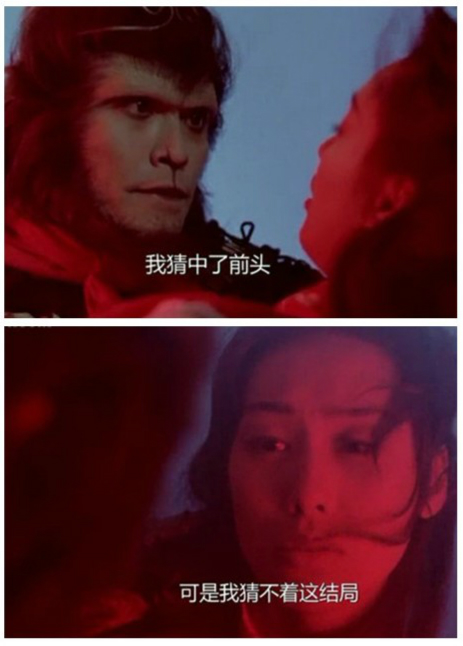
I have obsessive-compulsive tendencies from time to time, and when I watch movies I often can’t help thinking about painfully pointless questions, such as: between Stephen Chow’s From Beijing with Love and Spielberg’s Schindler’s List, which one is actually better?

The reason this question is so painfully pointless is that the two films aren’t even the same type. In principle, movies that differ so radically in content and method can’t be compared within a single evaluation system.
But please forgive the stubbornness of someone with OCD: I still can’t stop wondering how wonderfully comforting it would be if every film in the world could be placed within one evaluation system.
As someone who works in psychology, I thought we could look for this all-purpose evaluation system at the psychological level of the audience’s “movie-watching experience.” I want this “psychological standard” to detach itself from any particular film’s content or methods, so that it might encompass every film in the world.
So what are the “psychological standards” we use when watching movies?
First, the emotions stirred up by a film seem like they should count. The problem is that the emotions a movie evokes vary with its content. Can the “joy” you feel watching From Beijing with Love be compared with the “emotion” you feel watching Schindler’s List? If we strip away the specific emotional content and keep only emotional intensity, perhaps we can. Say the joy index of From Beijing with Love is 6, while the emotion index of Schindler’s List is 7; then Schindler’s List wins. But many films evoke multiple feelings. After watching A Chinese Odyssey, are you moved or joyful? Both. Do we really have to score every emotion and then weight the scores? Too much trouble. I don’t like it.
So is there an emotional dimension that almost every movie ought to involve? For me, there really is one: the feeling of surprise produced when a film exceeds or departs from my expectations. In other words, whatever the genre, I usually care a lot about whether a film is unexpected.
So whether a film is unexpected becomes the first dimension of my “psychological standard.”
The second dimension concerns a film’s content. I stubbornly believe that a logically self-consistent story is the foundation of any film. Even art films with almost no plot should have a complete logical thread. There are many movies that look as if the director got high and then started filming—apparently chaotic and unbearable—but if you engage with them carefully, you can still discover the internal logic hidden inside.
Therefore, whether a film’s story is internally coherent (meaning coherent according to the film’s own internal logic, not the logic of the real world) is the second dimension of my “psychological standard.” I also think this standard applies universally to every kind of film.
“Whether it is unexpected” and “whether it is internally coherent” together form the following coordinate system:

In the diagram above, the higher up a film is, the more reasonable its content; the farther right it is, the more unexpected it is.
The coordinate system creates four quadrants. I personally think reasonable internal logic is a basic requirement for every movie, so “good movies” are generally in the two upper quadrants, while the two lower quadrants contain more “bad movies.” Of course, there are exceptions.
I added a clock face to the coordinate system and divided each quadrant into three sections. That gives us 12 types of films. I feel these 12 types cover almost all the “good movies” and “bad movies” in my mind. For now, let’s call this evaluation system the “12-Hour” Film Classification System.
Here are the 12 film types (this article was written in 2015. My memory isn’t great, so many examples are films I watched around 2015 or works I know particularly well. The examples are merely convenient ones to “pull off the shelf” and aren’t necessarily the most appropriate):
0:00-1:00 Spectacular Expansion

Near the very top of the vertical axis, and on the right side of the horizontal axis, close to the origin.
These films give you the sense that the plot breaks through the expected framework, while at the same time being completely internally coherent on the basis of that breakthrough.
At the beginning, you think, “So that’s all it is?” Then the plot develops and makes you realize, “It’s far more than that”—what I call a spectacular expansion.
The examples that happen to float into my mind are two American TV dramas. Although this is supposed to be a standard for evaluating movies, in an age when American TV casually outdoes movies, putting two TV dramas on display first isn’t exactly off topic. They are:
Lost and Breaking Bad.

Every time I recommend Lost, this legendary show, I’m in a difficult position. Out of respect for the “morality” of avoiding spoilers, when talking to someone who hasn’t seen it I can naturally mention only the opening. But Lost begins like this: a passenger plane crashes on a deserted island; dozens of people survive and begin trying to save themselves. Nothing unusual. After hearing that opening, how do you think the plot will develop? Usually the response I get is: “Isn’t it just ‘survival on a deserted island’? Sounds a little boring.” In reality, the later plot has almost nothing to do with surviving on an island; it unfolds within another astonishingly grand framework.
Likewise, simply watching the opening of Breaking Bad—a timid high-school chemistry teacher with cancer takes the risk of making drugs so he can leave some money to his wife and child—makes it very hard to imagine how thrilling the later showdown between Walt and the Chicken Man could become.
Both of these legendary shows are classic examples of spectacular expansion.
1:00-2:00 Spectacular Twists and Endings

This type stands out evenly on both axes. In other words, it feels both unexpected and internally coherent: you can guess the opening, but not the ending. The plot often contains a spectacular twist or a spectacular ending. And although it surprises you, looking back you discover that the film planted all kinds of foreshadowing and hints early on; the twist or ending turns out to be perfectly reasonable.
In terms of plot structure, this may be the hardest kind of story to write. Usually its script has to contain a double logic: one surface logic tells a story that makes sense on the surface and tells it compellingly, while also misleading the audience’s expectations; the other hidden logic plants all kinds of foreshadowing and clues until the truth is revealed. These two logics must each be self-consistent and also weave together seamlessly. That takes a lot of intelligence from the screenwriter.
Examples include The Sixth Sense, Mulholland Drive, and Fight Club.
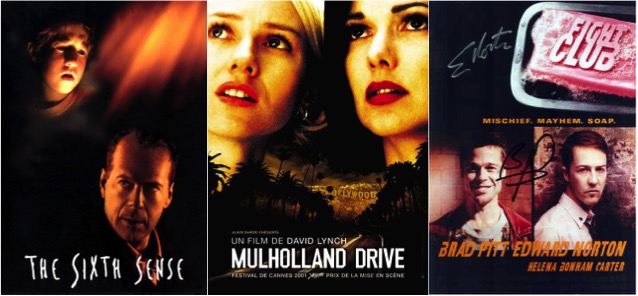
The Sixth Sense: the byword for a spectacular ending. It inspired a pile of copycats around 2000, each one acting as if it would “eat shit” if its ending didn’t scare you to death, yet not one came even remotely close to the original.
Mulholland Drive: a classic case of double logic. Only after watching the whole film do you realize that almost every shot in its first 3/4 carries a double meaning.
Fight Club: “This is probably what they mean by a plot that takes a sudden turn for the worse.”—Those are the character’s own words in the film.
2:00-3:00 Cult Cinema

Like the previous type, these films have spectacular twists and endings, but the audience’s attention is focused less on whether the twist is reasonable than on the fun brought by not following the usual path and saying things that stop just short of shocking you to death.
So-called Cult cinema (cult film) is usually easy to put in this category. The feeling it gives you is generally: “Holy shit! They can film it like this!?”
The obvious representative figure of this type is Quentin Tarantino, because almost every one of his movies is basically saying, “Holy shit, they can film it like this.”

Take Inglourious Basterds. A movie about assassinating Hitler—what else could the ending be? Did they really assassinate Hitler? Everyone knows Hitler wasn’t stabbed to death. Heh heh heh, naive.
Or Django Unchained. After 3/4 of the film passes in “calm waters,” the final half-hour suddenly switches into carnival mode. It feels as if the director snorted too many tranquilizers for the first 3/4, then suddenly switched to stimulants.
Summary: The above are the upper-right quadrant; everything that lands in this quadrant is a “good movie.”
3:00-4:00 The Knotted Films

The plot has obvious flaws, but also highlights that can’t be ignored and leave a deep impression, so the whole thing feels a little knotted.
Precisely because they are knotted, this is also the disaster zone for film critics tearing each other apart. Some people praise them, others call them garbage; it all depends on whether you’re staring at the highlights or the flaws.
One example is Interstellar. The emotional scenes are truly awful, and Matt Damon’s subplot is also a case of inventing drama where there wasn’t any. But the sequence after the protagonist falls into the black hole really does qualify as a “spectacular expansion” in terms of plot structure alone (setting aside scientific plausibility). So is it good or bad? I’m a little torn.

4:00-5:00 Camp Cinema

In this region, being outside internal coherence and being unexpected are equally strong experiences. That means the film has no shot that isn’t knotted, no plot point that isn’t idiotic, and no sequence that isn’t maddening.
The bad movies in this region are so bad they’ve developed style and so bad they’ve developed guts; they are the fighter jets of bad movies.
So when things reach an extreme, badness can turn around and become a kind of classic.
That kind of classic is what we call camp. In Chen Kuan-chung’s Camp, Trash, Kitsch—For People Who Have Had Too Much Humanities Education, he writes:
Camp refers to an aesthetic attitude that appreciates the unselfconsciously artificial behavior or artificial poses created by people.
Truly campy artificiality must be earnest, energetic, and ambitious—and preferably gorgeous, exaggerated, theatrical, passionate, excessively elaborate, even absurd—but somehow a little off, slightly flawed, and not quite fully accomplished.
Pure camp is innocent. It doesn’t know that it is camp; it is completely serious.
Unselfconscious camp is the finest form of camp pleasure.
The most classic example of camp is:
The 2015 Lunar New Year Gala (actually, the Lunar New Year Galas of every year). No explanation necessary.

Over the past several years, most “Chinese costume epics” have been camp cinema. Examples include Zhang Yimou’s Hero, Chen Kaige’s The Promise, and John Woo’s Red Cliff.

If you don’t simply curse or mock these bad movies, but find pleasure in them, then you are appreciating camp. Zhang Yimou wanted to earnestly call for peace through the mouth of Qin Shi Huang; John Woo wanted to turn Red Cliff into a Chinese-language epic that would go down in history; Chen Kaige even wanted The Promise to move the audience. Instead, they brought the whole Chinese people a joy more ferocious than anything in a Stephen Chow movie. That is the true essence of camp: the creators don’t know they are being affected and artificial, while the audience gets limitless pleasure from that very artificiality.
5:00-6:00 Bad Movies with Occasional Bright Spots

This region contains works with little to recommend them beyond a few isolated scenes—in other words, basically unreasonable films with occasional bright spots.
An example is Tsui Hark’s version of The Taking of Tiger Mountain.

The main plot of Tsui Hark’s The Taking of Tiger Mountain is completely unable to stand on its own. Yang Zirong goes through hell and high water to work undercover, and in the end the only genuinely useful piece of intelligence he gets out is the sentence “Attack from the north.” Never mind that this information could obviously have been obtained by reconnaissance from the northern ridge; the key point is that when our troops finally stormed Tiger Mountain, they didn’t use it at all. They simply attacked head-on and took the place. The undercover operation served no purpose whatsoever, and had nothing to do with any “taking by stratagem.” Tsui Hark probably realized that this lousy plot made no sense, so he threw in Shuanzi’s mother to give Yang Zirong’s undercover work something, however tenuous, to do.
Even so, as a die-hard Tsui Hark fan, I still got all fired up when Yang Zirong entered the bandits’ stronghold and traded secret code words. That jianghu atmosphere from Tsui Hark’s wuxia films of old flashed into view in this scene, becoming the only bright spot in an otherwise failed production.

In short: Films that fall into the lower-right quadrant are basically awkwardly put-together stinkers, but when the awkwardness reaches its extreme, the result can turn into an offbeat good movie.
6:00-7:00 “The Director Has Lost His Marbles” Stinkers

Plot holes everywhere, fake mysteries everywhere, inexplicable developments everywhere, and a general case of the crazies—with no redeeming flashes of brilliance.
“Were the director and screenwriter out of their minds?” That’s what people mean by the films in this zone.
Examples include Personal Tailor.

No matter how badly Feng Xiaogang’s previous films disappointed me, I would still go to the cinema when his next one came out. After Personal Tailor, I expect I’ll never go to a theater for Feng Xiaogang again.
7:00-8:00 “My IQ Is Begging for Mercy” Stinkers

Neither reasonable nor surprising. Almost every plot development is handled in the dumbest way you could possibly predict.
These films are just as rotten as the others, but compared with the try-hard quality of the 4:00-5:00 camp cult films, the main impression this zone leaves is that of being stupid. As you watch, you can’t help worrying about the filmmakers’ IQ: “I could shoot a better movie than this.” The feeling is roughly similar to watching the Chinese national soccer team play.
For an example from this zone, let’s invite my arch-enemy Dandan to the stage:

Dandan is exceptionally good at taking roles in dumb stinkers like Painted Skin and The Storm Riders, and his superb acting blends seamlessly with the films.
8:00-9:00 “Wasting a Great Premise” Stinkers

The stretch from 8:00 to 10:00 sits at the far left of the horizontal axis, which means the audience’s main impression is that the film is boring and blandly lukewarm.
The films most likely to land in 8:00-9:00 are those that waste a great premise. The premise may be excellent, or the hook may be irresistible, but the mediocrity of the director and screenwriter’s treatment turns it into something bland and lukewarm—or worse. The audience’s reaction is: “This could have been a good movie. What a shame.”
Examples from this zone include Abraham Lincoln: Vampire Hunter and The Hunger Games series.

Abraham Lincoln: Vampire Hunter: President Lincoln is a vampire hunter, and the American Civil War is actually a war between humans and vampires—what a hook. And yet, you probably forgot there was ever such a movie, didn’t you?
The Hunger Games series: It’s not so much about the films themselves as the fact that this premise inevitably brings to mind Japan’s Battle Royale. The themes are similar, so how did the Japanese turn them into something so cruel and twisted, while the Americans turned them into a teen idol movie? This is a textbook case of wasting a great premise.
In short: Films that fall into the lower-left quadrant are almost invariably stinkers.
9:00-10:00 Bland and Lukewarm Films

Compared with the previous type, these are even more uninteresting. At least the previous type can make viewers feel a little regret, or give them something to mock. With films in this time slot, the audience’s emotional involvement is zero.
“Money wasted making it, money wasted watching it.” “I’d rather watch a stinker with enough flaws to mock.”
Examples include the military songs on the CCTV New Year’s Gala.

I still have enough interest to sneak a glance and make a snarky comment when the other programs on the Gala are on. When the military songs come on, naturally I turn away and focus on my mahjong.
A film example is The Wolverine.
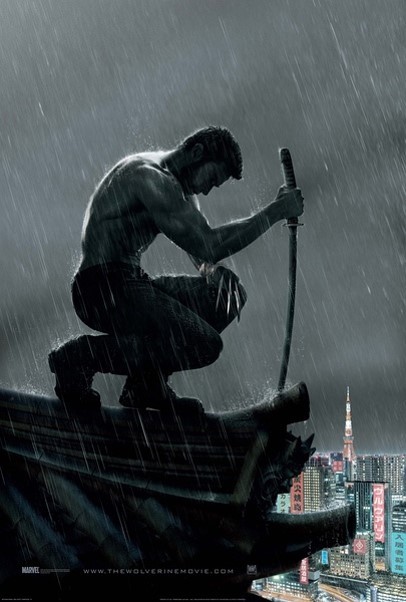
As a superpower and superhero movie, it has no formidable protagonist, no formidable antagonist, no memorable conspiracy, no memorable superpower, and no memorable action sequence.
Huh. Did I really watch this movie?
10:00-11:00 The Neighbor Wang Classic

The defining feature of this zone is that, when you think it over, everything makes sense—but you simply can’t drum up the interest to keep watching.
“Neighbor Wang slapped his thigh and recommended it to me. So why does it feel this boring?”
Like the “neighbor’s kid,” the films in this zone will always be nothing more than legends.
Examples include Rashomon.

I have to admit, shamefacedly, that Akira Kurosawa is that kind of legend for me. (I feel that “not liking Kurosawa” is practically politically incorrect in the world of film criticism, just like “discriminating against women” or “discriminating against homosexuals” in public discourse.) Rationally, I can understand that Rashomon reveals certain dark sides of human nature, and reveals them profoundly. But it really is so boring.
11:00-12:00 “Barefaced” Classics

The final type. Its score on the vertical axis is very high, while its horizontal position is close to the origin. In other words: although it may not seem particularly surprising, it expresses with near-perfection what the film is trying to say, and the audience is moved or shaken by it.
Borrowing the original meaning of the Chinese idiom “facing the sky with a plain face”—Lady Guo, Yang Guifei’s sister, was so confident in her beauty that she dared appear before the emperor without makeup—the films in this zone are beauties who need no makeup: without a speck of powder, they can still topple kingdoms. They rely on no gimmicks, yet strike straight into the heart through their plainness.
Examples include Boyhood.

“I just thought there would be more.”
All the off-screen gimmicks—the fact that it was filmed over 12 years, and so on—put together can’t match the impact of this one unassuming line in the film.
In short: Films that fall into the upper-left quadrant are a mixed bag.
That’s all.
Collected in
A revised version of this article has been included in my book The 24-Frame Psychology Code: Psychology in Film.

Leave a Reply