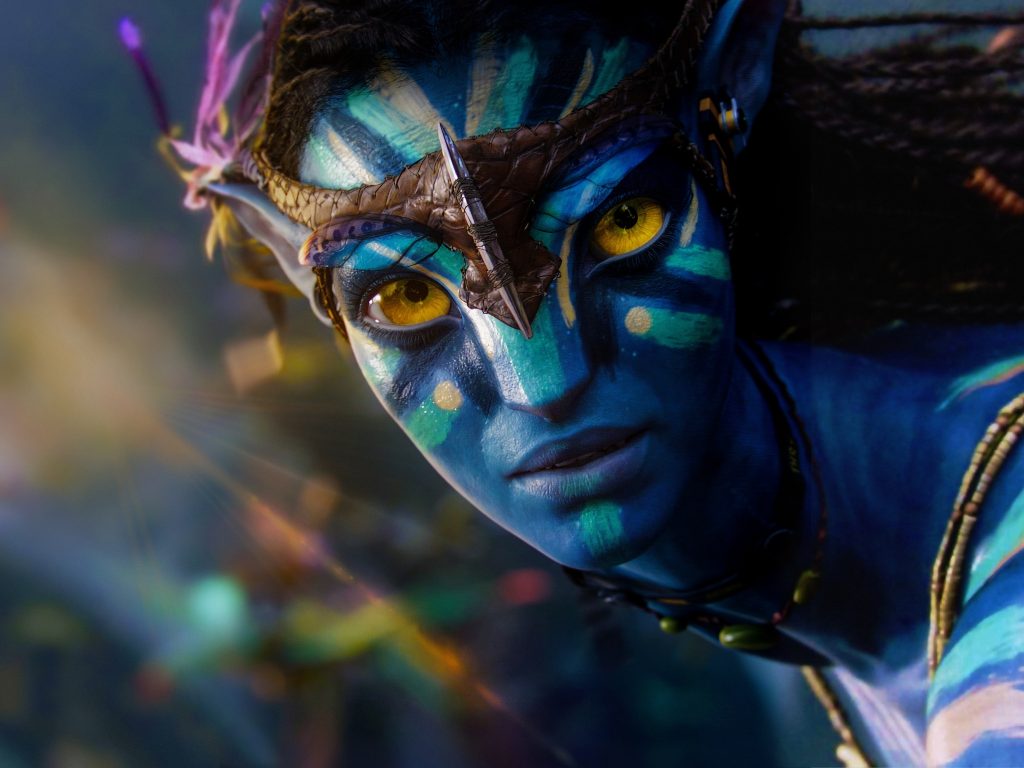
As someone who is half science-fiction-blind and completely fantasy-blind, I’m going to boldly—perhaps recklessly—talk a little about the relationship between Avatar and science fiction and fantasy. Everything I have to say is very simple, yet somehow terribly troublesome to explain. I offer this essay as a form of self-inflicted torture.
Avatar and Hard Science Fiction
In many contexts, Avatar was promoted as a blockbuster science-fiction film (the word “blockbuster” apparently wasn’t grand enough anymore). Avatar is unquestionably science fiction, but what happens if we interpret it purely from the perspective of science-fiction cinema? Surprisingly—and unfortunately—Han Song, a major figure in China’s science-fiction world, said: “The film is mainly worth watching for its special effects; everything else is terrible. The story is terrible, the theme is terrible, the dialogue is terrible (although I hear they spent five years designing the alien language), and most importantly, even the science-fiction elements are terrible. They’re all things Western science fiction had already repeated years ago: gene splicing, mind control, mecha warriors, networking the natural world, monsters. Aside from being dazzling and strange, the planet Pandora has little scientific content. That is why it also lacks sufficient estrangement and a sense of the unfamiliar. Anyone even slightly familiar with contemporary science fiction would find none of this fresh—not the designs or propulsion systems of the Earth colonists’ aircraft and weapons, either. There are problems everywhere in the details.”
Although I had never read Teacher Han Song’s work, I had always felt strongly fond of people in China’s science-fiction community, partly because I deeply admire another giant of the field, Cixin Liu, and tend to extend that affection by association. So this authoritative conclusion really startled me. Once the shock wore off, though, I felt that something seemed off, and nervously continued reading. Near the end of his piece, Teacher Han Song wrote: “When I left the theater, what delighted me was that if some Chinese science-fiction writers’ works—Da Liu, Old Wang, Pan Haitan, Jiang Bo, and Lala—were filmed by master directors, they would absolutely surpass Avatar.”
Only at this point did I begin to understand where my confusion came from:
Perhaps Teacher Han Song was judging a science-fiction film by the standards of science-fiction literature. In my view, science-fiction cinema and science-fiction literature are probably not the same thing, especially when it comes to hard science fiction. Based on my rather shallow experience reading science-fiction literature, if we judged all science-fiction films by the standards of hard science-fiction literature, probably very few films in the world would pass. That’s because the forms of hard science-fiction literature and cinema seem to have a certain innate conflict.
Wikipedia describes “hard science fiction” like this:
“A subgenre of science fiction that emphasizes scientific details and their plausibility within a work. The core idea of hard science fiction is respect for and admiration of the scientific spirit. In terms of technique, hard science fiction is characterized by its pursuit of scientific details that are accurate or at least possible, with its focus on the development of the natural sciences and technology.”
“In short, the shared characteristic of hard science fiction is that the plot is driven and resolved by technology. Authors also try to keep the technology in their stories consistent with the science known at the time of publication.”
The obvious counterpart is “soft science fiction”: “Compared with hard science fiction, it is a subgenre whose plots and subject matter center on philosophy, psychology, political science, sociology, and so on. The importance of science, technology, and physical laws is reduced in soft science fiction. Since its subject matter is often classified as a soft science or humanities field, it is called ‘soft’ science fiction.” (Many genres of literature probably have similar distinctions—for instance, detective fiction has the hard “orthodox school” and the softer “social school.”)
In soft science fiction, if a flying supercar appears, the author might spend five thousand words describing how cool it looks and how ferocious its performance is. But that is a single leap from fantasy to fantasy, with no process connecting science to imagination. Here, the scientific element is often merely background; remove it and the larger story is unaffected. In hard science fiction, by contrast, the author might add another five thousand words carefully explaining the principles that make the car fly, so readers believe it really could get off the ground. The first five thousand words connect to the wonder of imagination; the second five thousand connect to the rigor of science. Hard science-fiction prose is a chain linking science and fantasy. The end connected to imagination is often concrete, while the end connected to science is often abstract.
Here’s the problem: for concrete things, the power of images—with increasingly powerful special effects—now matches or even surpasses that of words. But what about scientific rigor? Some scientific statements can also be made concrete. Words can tell us that no matter how good this flying car’s performance is, it still has to obey gravity; images can actually create that “sense of gravity.” But how can images represent more abstract scientific statements? How do you put a law of quantum mechanics on screen, or depict a deduction from string theory?
People say film is a representational art. A film either represents some state of affairs (something Chinese directors are very good at) or presents a plot (something foreign commercial-film directors are very good at). Ultimately, what images represent on their own is concrete things. It is difficult to use images alone for abstract logical statements, analysis, or reasoning. Even films labeled philosophical, which seem as though they ought to contain abstract philosophical thought, mostly turn a philosophical conclusion or proposition into images supported by a plot—or merely present an atmosphere with a philosophical flavor. In those “philosophical films” by Theo Angelopoulos, have you ever seen dialectical thought as tightly reasoned as that of an ancient Greek philosopher, moving step by step from A to B to C to D?
This is the innate conflict between the forms of hard science-fiction literature and film. Words are good at abstract logical analysis, exposition, and reasoning, all of which are difficult to represent through images. Yet that is precisely the hardest part of hard science fiction, and often the most extraordinarily fascinating part of such works.
When images meet hard science fiction, they are born with a slight inability to be hard enough.
More seriously, if we judge hard science fiction from the perspective of literature in general, those long passages describing scientific details do somewhat disrupt the rhythm of the plot. Just as an interstellar battle is about to erupt, the author may suddenly stop to carefully analyze the propulsion principles of the spaceships. Hard-science-fiction fans may be intoxicated by this, while ordinary readers might wonder why you keep interrupting at the crucial moments, then simply skip the section and “read” it as soft science fiction with a coherent plot.
If you insist on directly converting hard science-fiction literature into images, the film’s narrative continuity will also be damaged. So most science-fiction films, apart from explaining the most important scientific details, won’t devote much space to them. Imagine that every time a slightly important science-fiction gadget appeared in Avatar, the characters launched into a dialogue about its scientific principles. I think the result would be a rather strange film. If this happened too many times, it might even create the feeling of Tang Bohu: To Catch a Thief, in which someone turns to the camera to explain “The Laughing Half-Step.”
So, in order to preserve the pacing and narrative continuity a narrative film ought to have, most science-fiction films probably have no choice but to cut away most of the “hard” material from science-fiction literature. Unless, that is, you intend to break all the rules.
Someone who really did break the rules was Kubrick.
Years ago, when I watched Kubrick’s 2001: A Space Odyssey, I was unbearably restless. My experience of film was still shallow then, and I could judge every movie only by the same unchanging standards, so afterward I unhesitatingly filed it under “pretentious nonsense.” Watching it again this year, I finally caught some of its flavor.

2001: A Space Odyssey is a work that seriously violates conventional narrative pacing. It spends far more time than seems proportionate on images of spaceships traveling, astronauts moving around inside them, and ships taking off and landing—all shots that should apparently serve merely as transitions. For example, one sequence showing a ship traveling from a space station to the Moon takes a full, lengthy 7 minutes, whereas an ordinary science-fiction film could almost finish it in 7 seconds.
For this technique—one that must have made film-school screenwriting teachers clutch their chests in despair—there have surely been many interpretations since the film was made. My current understanding is that Kubrick deliberately used a large number of what could be called lengthy shots presenting scientific details to chop the plot into pieces. The result, strangely enough, fit perfectly with the narrative rhythm hard science-fiction literature ought to have.
As I said earlier, many descriptions of science-fiction details in hard science-fiction literature do jump somewhat outside the rhythm the story ought to have. In a remarkably strange way, 2001: A Space Odyssey uses images to reproduce that hard-science-fiction narrative rhythm that slightly violates the demands of ordinary literature. In my view, that is precisely why it became the science-fiction film with the strongest hard-science-fiction feel.
Of course, most science-fiction films can neither copy nor need to copy the narrative method of 2001: A Space Odyssey. In fact, what people most often praise about its hard-science-fiction side is that many of the scientific details it presented still contain no major flaws today. Its presentation of scientific details was so precise that one Apollo Moon-landing conspiracy theory claims the footage was actually made by the U.S. government with Kubrick in a studio. Its narrative technique cannot be copied, but its dogged pursuit of scientific detail should be inherited by every science-fiction film. Since images cannot directly present large amounts of abstract description or logical argument the way words can, they should put even more effort into presenting the scientific details that can be made visually concrete.
After all, in my view, “respect for and admiration of the scientific spirit” should contain at least two layers. On the broadest level, the scientific spirit is faith in logic; on the smaller level, it is the willingness to wrestle stubbornly with details. Words can fully embody both. Images can go all in on the latter.
James Cameron is someone who wrestles stubbornly with details. Let me give a simple example. This detail is not new, and many films may have done the same thing. It is completely irrelevant to Avatar’s story, but perhaps it can illustrate several important points.
Avatar’s plot is strung together by the male lead Jake’s “research log”:

This image is probably best described as a “camera POV.” It can also be understood as the software interface of the “research log” program while it is recording—something like what happens when we enlarge a video-chat window to full screen.
Let’s look at the details:
In the upper-left corner is a tabbed task bar, with the following items in order: “main cam,” “past entries,” “submit,” and “task.” From this screenshot, “main cam” is highlighted, indicating that Jake is using the primary camera. The orange “task” may be a category tag. The area below the tabbed task bar can be understood as a status bar, currently displaying “REC,” indicating that the software is recording.
At the lower left of the interface, you could think of this as an information panel or a properties panel. First comes RDA, the abbreviation for the mining company’s name. The English text underneath RDA is too blurry to read, but I’d guess it’s the company’s full name. To the right of RDA is the company logo. Although these scientists are constantly at odds with the company in the film, they are, after all, employed by it, and even the equipment they use—including the software—seems to have been developed under RDA. Next comes Jake’s ID information, including his photo and security clearance. His clearance is Orange G2. This information is also displayed in orange, corresponding to “task,” which likewise indicates a category. Below that is “Log Entry: 01,” showing that this is Jake’s first log entry (the shot in the film is from when Jake records his first log). Below that is “Location: SCI MOD,” indicating where the computer terminal used to record the log is located. Below that is “Researcher (name): Sully, J ID: XX LST (local standard time): XX.” The bottom line reads “P.I. (Principal Investigator? Just a guess): Augustine, G (the name of Big Sis Grace). ID Date.”
All right, after looking carefully at this software interface, how do you feel? Does making a software interface this convincing serve any purpose for the story?
None whatsoever! Yet even when handling such a simple detail, one completely irrelevant to the big picture, James Cameron and all the artists and engineers behind him seem to have treated it as software that actually exists: it was developed by RDA, required a security clearance to access, accurately recorded the time a log was made, and used tabbed menus to organize things, among other details.
This is what it means to wrestle with the details to the bitter end!
Does this detail do anything extraordinary for the visual experience? Not at all. In American films that don’t wrestle with details quite so relentlessly, computer operating systems and software are as dazzling as they can possibly be. Most software interfaces are in 3D, for starters, and once you operate them, all sorts of flashy sound and visual effects appear (it’s even worse in Hong Kong films: running software looks practically like playing an animated cartoon). Compared with those magical programs, the log-recording software in Avatar is so plain it’s almost embarrassing. Yet it feels remarkably real, credible, and perfectly judged. The labor and rigor behind that plainness are nowhere near matched by all the flash. If you watch Avatar carefully, you’ll see that it is made up of countless details like this—details you could easily miss if you blink. How much work went into them? Behind this painstaking presentation of scientific detail lies, in fact, the creators’ respect for and admiration of the scientific spirit.
This is the “hard science fiction” of the moving image!
Our Zhang Yimou recently delivered a grand declaration about science fiction that left me completely dumbfounded:
Reporter: Curse of the Golden Flowers was another radical change of direction for you after your wuxia blockbusters. Is there a major film genre you’re especially fascinated by but have never made?
Zhang Yimou: …As for major film genres, there are still many I’d like to try; I just don’t have the means. For instance, I’d very much like to try science fiction. I have plenty of visual imagination myself, but the Chinese film market is regional, unlike Hollywood, which sells around the world, so we can’t make something on the scale of 2012. Those spectacular visual effects and stunning images really do take money and time. If it isn’t visually stunning, it doesn’t count as science fiction, and young people won’t want to watch it. You can’t just say your concept is good and your script is good—that won’t do. A lot of science-fiction scripts are as simple as cartoons, but visually they’re powerful. Science fiction is a film genre that truly competes on visuals: a hundred million dollars, ten million dollars, or one million dollars will obviously produce completely different quality. So we can only sigh that our ambitions exceed our resources. A Chinese film can’t possibly spend a hundred million, or even two hundred million, dollars on special effects unless you simply want to burn money. I’ve always found this rather frustrating. Science fiction is our weak spot, a huge blank space.
Reporter: Could one say that making a truly Chinese science-fiction blockbuster is your dream?
Zhang Yimou: Sure! I’d very much like to do it—give me two hundred million dollars to make a science-fiction film, all for postproduction, so I can let my imagination run wild and spend a year or even two on it. The actors would have it easy: show up, get hung from wires, work in front of green screens and blue screens, and finish shooting in two months. Everything else would be done in post. Honestly, science fiction comes closer than any other genre to all the new media young audiences currently encounter; it has the most room to run wild. But I probably won’t get the chance to spend two hundred million dollars on postproduction before I die (laughs). There simply isn’t that kind of investment.
What surprised me first about Zhang Yimou’s grand pronouncement was his astonishing ignorance of special-effects filmmaking. Even a layperson like me, after watching a few behind-the-scenes featurettes, knows that producing a special-effects sequence worthy of the name is not something you can accomplish by “showing up, getting hung up, shooting against green screens and blue screens for two months, and doing everything else in post.” I once watched a behind-the-scenes featurette about filming a scene in which a real actor interacts with a CG character. On set, the director, actors, cinematographer, gaffer, and visual-effects supervisor achieved the perfect result only after meticulous calculations and repeated tests. They had to account for every detail of the actor’s blocking, gaze, and movements once the CG character was added; the camera position and composition also required careful planning; and the lighting had to simulate what it would be like after the CG character entered the scene. Only through such close coordination among so many factors can you create a source shot suitable for postproduction.
What is even more astonishing, of course, is Zhang Yimou’s profound ignorance of “science fiction.” To Zhang Yimou, science fiction is merely “visually powerful.” In his eyes, this probably amounts to little more than fancy tricks and cheap sleight of hand: give me enough money and I can do it. Does he see the determination behind those fancy tricks—the determination to wrestle with scientific details? Does he know what kind of scientific spirit is needed to support such “visuals”?
If Zhang Yimou were given three hundred million dollars to make Avatar, he might well produce twice as many banshees. But there’s a very good chance that the research-log sequence would come out looking like one of those cheap TV shopping ads for an “Aptik NetEase” product.
To all those directors here at home shouting about wanting to throw big money at science fiction: don’t rush to lament that your ambitions exceed your resources. First learn how to respect science and cultivate a little scientific spirit. No one is asking you to master cutting-edge science and technology. If you could just stop having the leading man and woman in an urban romance earnestly chat through a Word document, we’d already be thanking heaven.
Of course, Avatar’s hard-science-fiction details are not flawless. The thing I’m least satisfied with is that the operating principle of the film’s most important prop, the avatar, is never clearly explained. In terms of how it is depicted, we can understand the avatar as a wireless, biochemical version of the proxy robots in Surrogates, starring Bruce Willis. But I still think such crucial background information deserved an official explanation in the plot.
Avatar and the Soul’s Final Home
After saying all this, I may still be unable to refute Teacher Han Song and the others. They may feel that getting the details right is merely a Hollywood blockbuster’s “basic competence,” hardly worth mentioning, while Avatar’s greatest weakness as a science-fiction film is still that it proposes no revolutionary science-fiction concept.
Indeed, many of Avatar’s science-fiction concepts are hardly novel. In fact, quite a few works that came before Avatar took the same concepts further. Within the limits of what I’ve read, some of Avatar’s ideas even resemble things I encountered in manga as a child.
For example, the idea that the Na’vi connect to animals through neural terminals and control them with their minds is very similar to the relationship between the Beast Gods and Zoanoids in Bio-Booster Armor Guyver. In both cases, one is a lower life-form and the other a higher one, with the higher animal controlling the lower through consciousness. The Beast Gods in Bio-Booster Armor Guyver can control Zoanoids with brain waves; compared with the Na’vi’s wired connection to animals, theirs is wireless.

Likewise, Pandora’s networked plants immediately reminded me of Tsukasa Hojo’s City Hunter: The Secret Service—though of course that isn’t science fiction. All the trees on Pandora are networked into a “brain,” and that “brain” is actually Eywa, the goddess worshipped by the Na’vi. The concept of a plant deity also appeared in Bio-Booster Armor Guyver, in an even more extreme form:


Science-fiction fans could certainly produce more evidence that Avatar is guilty of “plagiarism.” But as Hongxiu T wentong said in that magnificent essay: “A ‘masterpiece’ shouldn’t be hyped into something ethereal, floating above the clouds. It should instead be…solid, like the chest of the strongest man… In English, there is a wonderfully suitable word for this state—‘robust.’ Yes, I believe every ‘masterpiece’ should be robust.” (O(∩_∩)O)
A widely recognized science-fiction classic does not necessarily have to propose especially avant-garde concepts. On the contrary, it may simply present, with great force, the most original and fundamental questions in science fiction—and therefore the questions with the broadest human relevance and the most enduring value. The sages raised these questions long ago, and people will keep asking them. Perhaps they will never have answers, but we will think about them forever.
Does Avatar show this kind of concern? I think it does. It concerns the final home of the soul.
Science fiction has never been merely a pile of natural-science facts. The social sciences and humanities have always been important subjects of concern in science-fiction works, and the “scientific spirit” does not mean worshipping only the natural sciences. Isaac Asimov’s enthusiastic praise of the social sciences, for example, makes me, as someone who works in the social sciences, a little embarrassed—as if the old gentleman were being a bit too dismissive of the natural sciences. In The Ugly Little Boy, he made social scientists the “people above people”; in the Foundation series, he took a model that was plainly economics plus mathematics and named it “psychohistory,” which allowed this psychology worker a wonderfully self-indulgent fantasy. Brother Fengjian Jun said that after reading Cixin Liu’s The Three-Body Problem, he could proudly announce, “Studying sociology can at least help defend Earth and fight aliens.” Actually, we psychologists saved the Galactic Empire long ago. Hahaha. As for the ultimate philosophical concerns of science fiction, they are given brilliant expression in Asimov’s The Last Question and in the works of Arthur C. Clarke.
One of the most important philosophical questions in science fiction is what humanity’s ultimate destination will be—or, put another way, what form human life will eventually evolve into. The word “life” always makes people think of the birth and death of the body, so I think it is more fitting to frame the question as the final home of the “soul”: What will “I” ultimately become, and where will “I” ultimately go?
Within the limits of my reading and viewing experience, science fiction has two broad kinds of speculation about the final home of the soul:
First, the soul ultimately breaks free from the constraints of the body and becomes a form of pure energy. In Arthur C. Clarke’s Childhood’s End and 2001: A Space Odyssey, humanity eventually escapes the confines of organic bodies and evolves into a form of life made entirely of energy. In Liu Cixin’s novels Toward the Truth (Chao Wen Dao) and The Poetry Cloud (Shi Yun), those lives on the level of cosmic rulers likewise have no organic physical bodies.
Second, individual souls eventually merge with one another into a single whole. In Isaac Asimov’s The Last Question, people who begin as separate, concrete individuals ultimately evolve and merge into one unique consciousness: “humanity.” In the later Foundation books, the galaxy eventually “chooses” the Gaia model, and all its organic and inorganic matter merges into a single consciousness. In Neon Genesis Evangelion, a shut-in’s little universe explodes, destroying all human bodies; the souls of the entire human race enter a sea of LCL, and from then on there is no distinction between one person and another.
How should we understand these converging imaginings in science fiction? My interpretation is that what we truly long for is exactly what we fear. We fear that the body will decay and the soul will vanish with it like smoke, so we imagine the soul escaping the body and gaining eternal life. We also fear being abandoned in this world to suffer eternal loneliness, so we imagine a world in which you contain me and I contain you, “tangled together till the end of the world.”
The premise of Avatar fits this kind of imagining rather well. The souls of the Na’vi who die on Pandora will ultimately return to Eywa, merging within Eywa and gaining a kind of immortality. The scene in which Grace dies does carry a little of that sense of ultimate consolation. Grace ultimately returns to Eywa’s embrace, which faintly echoes Major Motoko Kusanagi ascending through the network in Ghost in the Shell.
One question raised by the merging of souls is this: once consciousness becomes a whole, does “self-consciousness” still exist? In Ghost in the Shell, when the Puppet Master proposes merging with Motoko, her most important worry is the loss of self-consciousness. You in me and me in you sounds nice enough, but how do you know whether there is still a “you” and an “I” after the merger? If returning to Eywa’s embrace means that there is, in reality, no longer any “you,” then what would be the point?

Self-consciousness is the core of the soul, and there is only one “I” in the world. I once discussed the uniqueness of self-consciousness in a post, so I won’t repeat it here. It is easy to object that your genes and upbringing differ from other people’s, so naturally your self-consciousness differs too. But that isn’t the level I was talking about. The problem is too abstract, and not easy to explain clearly. Later, I thought of a thought experiment that might make it a little clearer.
Here is my thought experiment. Suppose there is a machine – actually, the one in The Prestige – and never mind what its principle or mechanism is. What it can do is make a copy of you in an instant, a one-hundred-percent perfect copy. The copy has exactly the same genes as you; every cell in its body is exactly the same as yours at the instant copying is completed; the neural connections in your brains are exactly the same; you have exactly the same life history and exactly the same memories. In short, at the very moment the copy is complete, everything about the two of you is exactly the same. You could say that your souls are exactly the same too: there are no differences in genes, heredity, environment, or memory – no differences whatsoever. All right, so what happens then? Does “your” self-consciousness suddenly become two selves, observing the world from two bodies at once? Or are you still the “you” in your original body, while this person who should possess exactly the same soul as you is nevertheless a complete stranger? Even though everything about him is exactly the same as everything about you, you cannot enter his brain and see the world through his eyes. “You” are still only one.

That is the preciousness of self-consciousness. If you had the chance to merge with Eywa, would you hesitate?
The unfortunate thing is that, when it comes to these questions of ultimate consolation involving Eywa, Cameron only touches on them briefly, so they barely register amid the film’s other themes. But these questions have no answers in the first place. If they can let a meddlesome person like me run wild with associations for a while, that is quite enough. Whether to dig deeply into such questions is, to some extent, a directorial choice rather than a question of ability.
Avatar and “hard fantasy”
Han Song’s article also mentions: “Rather than calling Avatar a science-fiction film, it might be more accurate to say that it contains more fantasy. … The flying dragon-bird designs are exactly the sort of thing commonly found in Western fantasy novels. Floating mountains and the like are also difficult to explain scientifically, and feel more like Harry Potter. Those superconducting stones or whatever have something of Wesley’s flavor. And then there are still more things that can only be answered with magic, religion, parapsychology, and so on.”
I agree that, to some extent, Avatar feels more like a fantasy film. Cameron designed every plant and tree on Pandora, every animal, the planet’s environment and ecology, its magnificent natural scenery, and the social organization, customs, and religion of the Na’vi. He even designed a language specifically for Avatar. In fact, all this feels vaguely familiar: when Tolkien built the world of The Lord of the Rings, he did almost exactly the same things.
Inventing an entire world out of thin air, detached from reality, is what fantasy works most eagerly pursue and do best. You could call it fantasy’s signature skill. Take The Lord of the Rings series, for example. I have always felt that its main storyline contains plenty of logical flaws, but its greatness lies in the world structure it invented being so captivating that the story’s backdrop outlives the plot itself, with a more lasting vitality and broader influence.
The ability to invent a world is really also the ability to wrestle with details to the bitter end. Whether a fictional world is captivating enough depends to a great extent on whether its details are abundant, precise, emotionally convincing, and reasonable. The “Na’vi language” that appears in Avatar is not used very much, yet the creators were willing to design an entire language for it. If the film had been made by the sort of director who simply had the actors hung up and waving around in front of a blue screen, then called it a day, they might have fobbed us off with meaningless syllables. After all, you can’t understand Na’vi anyway.
Depending on whether the invented world exists merely as a backdrop or rises to become the story’s subject in its own right, perhaps we can divide fantasy into “hard fantasy” and “soft fantasy” (though this distinction does not seem especially common). By this definition, The Lord of the Rings belongs to hard fantasy, while Harry Potter belongs to soft fantasy. Rowling did design plenty of interesting details for Harry Potter, but she does not seem to have had the ambition to construct a complete worldview; in Harry Potter, the magical world exists mainly as the backdrop for the story.
I have an even harsher standard for distinguishing soft from hard. One standard for distinguishing erotic from pornographic works is to remove the pornographic passages and see whether the work remains broadly readable. By that standard, they say The Plum in the Golden Vase (Jin Ping Mei) is erotic, while The Carnal Prayer Mat (Rou Pu Tuan) is pornographic. Let’s borrow that standard in reverse: if you strip out the plot and a work’s appeal is still largely unaffected, then it is hard science fiction (or hard fantasy); if removing the plot causes its appeal to collapse, then it is soft science fiction (or soft fantasy). In the afterword to Ball Lightning, Liu Cixin modestly says that all his novels are clumsy imitations of Arthur C. Clarke. Only after reading Clarke’s Rendezvous with Rama did I understand what he meant. Rendezvous with Rama is a piece of “ultra-hard” science fiction whose appeal is completely unaffected even if the plot is removed – a work that meets the strictest standard. You could say it is a science-fiction concept that is, in itself, a science-fiction novel.
So is Avatar a work of “hard fantasy” in this sense? I think it is!
The thing people criticize most about Avatar at present is that its plot is too “predictable.” The story hangs together, but there does not seem to be much that really stirs the heart. I have a few complaints about Avatar’s story too. For example, Jake is accepted by the Na’vi tribe far too easily; the tough girl’s defection lacks a little setup; and the bright ending is based on humanity’s surrender, which makes it feel somewhat contrived. But even if you completely removed Avatar’s story, would that affect its appeal? My feeling is that it would hardly affect it at all. In fact, this invented world is designed so brilliantly that even if you replaced it with a completely different story, I believe I could still watch it with great enjoyment. Pandora is a stage on which any story can be performed. This is not the supposedly misguided case of putting the cart before the horse and making the story serve technology; it is that everything outside the story is so outstanding, and taken so far, that it redefines the rules governing the relationship between story and backdrop. It is like what I said before about Naoki Urasawa: the way he lays out suspense is so superb that it can ignore the iron rule that good mysteries must resolve themselves, thereby becoming an independent art of laying out suspense.
I think Avatar has that kind of strength too. It is the first truly “hard fantasy” on the big screen. Even the film adaptations of The Lord of the Rings do not count as truly hard fantasy, because Middle-earth in the films still cannot detach itself from that epic story and display its own charm independently.
I came across a similar idea in Feng Xiang’s Wide-Wide Mailbox and Exodus (Kuan Kuan Xinxiang yu Chushiji). In essence, it says that a classic such as the Bible actually contains quite a few contradictions in its text and does not avoid repetition. Classics often become classics not because they are perfect in themselves, but because they provide objects for later generations to interpret without limit. Avatar itself may not be perfect, but it provides a vehicle for limitless interpretation and extension.
So Avatar is Cameron’s Avatar, but it is everyone’s masterpiece.
Related articles
Collected in
- After revision, the core argument of this article was included in The Alluring Illusion: Psychological Secrets in Film and Light.

Leave a Reply