This once-a-year exercise in entertaining myself has somehow reached its fifth year. As usual, I’m going to get all the things I wanted to say but didn’t after reading books, watching movies and TV, and listening to music over the past year out in one go, and use them to sum up the year. The scope is limited to what I myself saw and heard last year, regardless of when the works were made. It’s the Chinese New Year, so unless I truly can’t stand something, whether these “awards” are praising or criticizing it, I’ll try to give them nice-sounding names whenever I can find the words.
Annual Grand Award for Epic Splendor
Winner: Roland Emmerich’s 2012

Emmerich’s three iron laws of disaster films:
1. Any supporting character with class, personality, and something to contribute is bound to die;
2. Any protagonist with no class, no personality, and nothing to contribute is bound to make it to the end;
3. No disaster, however huge, is ever irreversible.
I think a truly excellent disaster film should carry a whiff of despair. The point of a disaster film isn’t how big the spectacle is or how much it can destroy, but whether it can convey the despair of being inside a disaster and seeing no hope, no future. Emmerich, however, has never been stingy about adding a bright ending to his disaster movies. But if everything can simply start over, what meaning does the disaster have? So in Emmerich’s disaster films, disaster has no weight. Even when the sacrifices of those classy, distinctive supporting characters add the tiniest bit of weight to the movie, once the happy ending arrives, they’re sure to be forgotten completely by the protagonists celebrating their survival, and that little bit of weight evaporates. Emmerich’s movies look epic and magnificent, but underneath they’re actually rather small-minded. He doesn’t even have the courage to let his male lead die once.
Annual Grand Award for Clear-Cut Convictions
Winner: The Hurt Locker

Wasn’t Hollywood always supposed to be a paradise for antiwar liberals? Why did they lavish such praise this time on a movie extolling the “noble character” of American soldiers?
The Hurt Locker is a movie that seems deeply self-contradictory. First, the opening title says that war is an addiction, apparently trying to communicate an antiwar message. But what follows is the story of an American saintly do-gooder who does good deeds without asking for anything in return. So what exactly is addictive here: war, or doing good deeds? Is the director trying to say that even becoming addicted to a just war is fine?
Perhaps what the saintly do-gooder says to his son in the cradle when he goes home near the end is the director’s real intention:
“You like stuffed animals, you like Mommy, you like Daddy, you like your little pajamas—you like everything, don’t you? You know, when you grow up, the things you once liked may no longer seem special. Like this toy box: you’ll realize it’s just a piece of tin with a little doll in it. The things you loved will gradually be forgotten. By the time you reach my age, there may be only one or two things you still love.”
America was once so young, vigorous, and full of confidence—a simple young nation that embraced values and ideals. Now it has grown worldly and lost its way, gradually forgetting what those values and ideals ever were. So to me, this dialogue is really about America itself: a metaphor for the loss of the American spirit today, and an explanation of the real reason America’s saintly do-gooders are addicted to doing good deeds:
Maybe the “American saintly do-gooder” in the film really is addicted to doing good deeds, but it’s a pathological compulsion. Precisely because they’ve lost their own ideals and values, they want, almost obsessively, to recover them through “justice” in war. Their desperate search for justice on the battlefield is actually a pathological compensation for the absence of values in ordinary life.

Still, perhaps the theme is expressed too obliquely (or maybe I’m reading far too much into what the director intended), so the director doesn’t come across as quite so clear-cut after all, but somewhat equivocal. It’s no wonder the film has inspired all kinds of interpretations, even completely opposite ones.
Annual Grand Award for Bombastic Declarations
Winners: Zhang Yimou’s “It’s a New Year movie, anyway” & Chu Yen-ping’s “It’s just a video game”

Zhang Yimou:
“With dialogue, after making several costume dramas, we learned something. Starting with Hero, we tried to pursue that half-classical, half-colloquial, affectedly literary tone, and it didn’t win us any goodwill. Not only did it fail to win goodwill, people laughed at us. Later we thought, forget it—we wouldn’t parody anything, we’d just loosen up the dialogue and use plain modern speech. Once you set things up that way, people might actually accept it. So I think the dialogue in John Woo’s Red Cliff, for example, also tried to be half-colloquial and half-classical, but it missed the mark. They worked incredibly hard and still didn’t win any goodwill, so it’s really difficult. You can bring in experts to polish the dialogue, but honestly, it’s hard to say whether it will sound like something an ancient person would say. So later we thought, let’s liberate our thinking a little—it’s a New Year movie, anyway, so we might as well let the dialogue loose.”
Before 2009, I always thought certain major Chinese directors didn’t understand cinema so much as they hadn’t found the right path for themselves. But Zhang the Grandmaster’s series of clueless remarks in 2009 made me wonder whether they really don’t understand cinema after all. At the very least, their knowledge of film is remarkably narrow—narrower even than that of many seasoned movie fans (for Zhang Yimou’s clueless remarks about science-fiction films, see my post on Avatar: Avatar: Hard Science Fiction, the Soul’s Destination, and the Birth of “Hard Fantasy”).
In my view, our wuxia-novel tradition, along with the Shaw Brothers wuxia tradition and the New Wuxia tradition that Hong Kong has developed over the past several decades, has always used dialogue that is half-classical and half-colloquial. You could even say we’ve always made costume dramas with that kind of dialogue. But what Zhang Yimou means now is that his scrambled eggs taste bad, which proves eggs should be boiled instead. He seems not to know that people used to scramble eggs in the first place.

Chu Yen-ping:
“This (True Legend) was a video game to begin with.”
In recent years, foreign filmmakers seem increasingly inclined to take things that ought to be absurd and make them serious. Superhero comics, once mainly beloved by children and nerds, have been welcomed into the establishment, with increasingly serious themes and forms. They use a serious attitude to present the absurd. Our directors, by contrast, strike a deliberately unserious pose from the outset.
I’m just here to have fun—why are you taking me so seriously? Being shameless to the extreme is invincible. And when faced with this attitude, the most common response I see from audiences is: don’t take this kind of commercial movie seriously; if you do, you lose. In other words, since the director has announced that he’s being shameless, we should debase ourselves too, just to restore our psychological balance.
Well, I’m not playing along! You make lousy movies for “fun”; I can have fun cursing your lousy movies too. Enjoying a good movie is fun, but tearing into your lousy movies—that’s a whole other kind of pleasure!
Annual Grand Award for Long Live Faith
Winner: 24, Season 7
The production model for American TV dramas is highly commercialized. A crew often gets a contract only for the current season, or half of it, and filming usually runs only a few weeks ahead of broadcast. As a result, each episode’s ratings can affect whether a series lives or dies. Several episodes of poor ratings usually mean a new show is dead; persistently poor ratings for an established show usually mean it won’t get a contract for another season. This turns every episode’s ratings directly into pressure on the creators’ next move.
That pressure forces writers to do everything possible to keep viewers hooked. But it’s a double-edged sword. On the one hand, the desperate production attitude forced out by such pressure has created some of the finest television on Earth—I’m an American-TV addict myself. On the other hand, because the audience’s taste, as measured by ratings, intrudes so deeply into the creative process, creative independence suffers badly.
I believe that even the most commercial work of art needs to maintain a certain distance from its audience while it’s being created. This is especially true of film and television. When people watch a movie or TV show, they don’t actually want a sense of control, as they do when playing a game. Quite the opposite: they want the plot to manipulate them. They want to temporarily escape reality and inhabit another life. That’s why interactive movies in which audiences could choose how the story developed were once praised as the future of cinema, but have now almost vanished. If the purpose of film and television is to “make dreams,” then they should stay a little farther from reality.
But the way American TV dramas are made puts them too close to reality. The moment a few episodes’ ratings dip, writers may immediately resort to measures designed to grab eyeballs: invite a celebrity for a cameo, perhaps, or have the beautiful women on the show share a same-sex kiss. If those don’t work, they’ll try something drastic—kill off an important character. Surely that’ll bring you obediently back to the television to watch how he dies, right? If that still doesn’t work, there’s something even more drastic and shameless: resurrect the dead character. In this season of 24, poor Tony, dead for ages, got resurrected at full health, as if he’d received a blessing from Chun Ge in the underworld.
But once that happens, why should I ever agonize over the death of a character again? Even if the plot was originally weighty, everything happening outside the show constantly reminds me that it’s merely a show pandering to ratings. The writers kill him because they want him dead and revive him because they want him alive. It’s all about ratings, the advertising revenue ratings bring in, and a business deal. And so the weighty original plot suddenly becomes cheap.
This is the unbearable lightness of American TV drama.
Annual Grand Award for the Real Deal
Winner: Milkyway Image’s Vengeance

My overall impression of Milkyway Image in recent years is that its scripts have fewer and fewer original ideas, while it grows more and more obsessed with presenting certain forms. It’s not even quite formalism, because what Johnnie To is most obsessed with is simply striking poses. The poses in Exiled were cool, and the ones in Exiled were still pretty good too—but that was because they were supported by good stories. When a script has basic quality, stylized form elevates the story. But in Vengeance, bloated formalism makes the second half of the film completely childish.
From PTU and Breaking News to Vengeance, Milkyway Image has gone deeper and deeper down the dead end of formalism. I really hope they turn around and get out of that dead end soon, and make more genuine masterpieces like their early works. Surely Mad Detective, one of the few masterpieces they’ve made in recent years, isn’t Milkyway Image’s final flash of brilliance?
Annual Grand Award for the Genuine Original
Winner: Criss Angel Mindfreak (Street Magic by Criss Angel)

Watching this was how I learned that Liu Qian is merely the knockoff version.
Annual Grand Award for Mastery
Winner: Quentin Tarantino’s Inglourious Basterds

Tarantino’s signature tricks—all finally perfected here: dialogue that looks stupid on the surface but seethes underneath, sudden violence, and teasing, playing with film culture. My favorite of the year.
Annual Grand Award for Better Seen Than Heard Of
Winner: Watchmen

It’s a good movie with plenty of flaws, and the villain’s scheme, especially, and what comes of it are deeply poignant.
As for director Zack Snyder, he really is a hack. His films all have plenty of gimmicks, but the stories are told clumsily. The trailer for 300 was a hundred times more enjoyable than the actual movie, and all the best stuff in Watchmen is in the opening sequence. He should switch careers and make music videos—or devote himself full-time to making trailers.
Annual China Unhappy Award
Winner: McDull, Kung Fu Ding Ding Dong

“Facing the sea, with spring blossoms in full bloom.”
Haizi’s poetry actually turns up in a story about a pig. Not only does it turn up, somehow it also moves me this much. Is it because I think McDull’s dad is a stubbornly single-minded guy, just like me? Is it because I think my mom, like Mrs. Mc, also carries the burden of the family on her own? Or is it simply because I love artsy affectation?
Winner: The Adventures of Li Xianji (animated version)

I’m hopelessly in love with artsy affectation, even when it’s delivered in an extremely greasy Beijing accent.
Annual Award for Technological Progress
Winner: The Lives of Others

Times have moved on. Wiretapping and opening other people’s letters are as outdated as Cao Cao. These days… just [redacted] will do.
Annual Bittersweet Award
Winners: Like Shadows Following & A Grain of Sand on That Distant Planet

Starting with Secret Love in Peach Blossom Land, Lai Sheng-chuan seems to have pursued a blend of serious drama and comedy. His later, hugely successful cross-talk plays also tend to mean more than they say. But the sorrow and joy in Secret Love in Peach Blossom Land still feel like a rather deliberate mash-up, and the comic element in the cross-talk plays far outweighs the serious drama. Whenever Lai tries to put real force into the serious parts, he often pushes too hard, overdoes the sentiment, and ends up missing the mark. Works like Red Sky and Me and Me and Him and Her contain these carefully manufactured sad moments; every scene strains to make you feel something, and ends up making it hard to feel genuinely moved.
It wasn’t until Like Shadows Following and A Grain of Sand on That Distant Planet that sorrow and joy finally became completely seamless. If tears in laughter are comedy’s highest achievement, then Lai Sheng-chuan finally pulled it off.

Annual Like-Shadows-Following Award
Winners: Naoki Urasawa’s Pluto & Giddens Ko’s The Poetry of Post-Adolescence

I’ve always said that Naoki Urasawa’s suspense-building sections can be enjoyed independently from the revelations that follow, but this time I still felt the story was a little too contrived. Every character seems to be carrying a deep vendetta, yet by the end all we have are faces desperate to cry but unable to shed a tear, with no suitable plot to give those faces a place.
The Naoki Urasawa I encountered this year seemed less like Naoki Urasawa, while Giddens Ko, who idolizes him, increasingly began to resemble his own idol. While reading The Poetry of Post-Adolescence (which borrows quite a few of Urasawa’s plotlines almost wholesale), there was a moment when I was shaken to the core and flooded with tears. And I knew that, in writing that moment, Giddens Ko had been possessed by Naoki Urasawa. In Giddens Ko’s work, the Great Urasawa is always there, following like a shadow.

Annual Sleazy-and-Trashy Award
Winner: Giddens Ko’s Don’t Read Novels in Class

I was moved by the auntie who blows herself up in the story. Maybe because I’m becoming more and more stubbornly single-minded myself, I’ve recently found it very easy to be moved by stories about stubbornly single-minded people.
This Wang Daming story can hold its own against Ha Bang. And besides the sleaze and trash, it has just a little bit of hot-blooded spirit and heartfelt emotion. Don’t Read Novels in Class and The Legend of Ha Bang are the twin jewels of Giddens Ko’s sleazy fiction!
Annual People’s Choice Award
(200 words deleted here)
Annual Keep-to-Yourself Award
Winner: Liang Wendao’s Common Knowledge
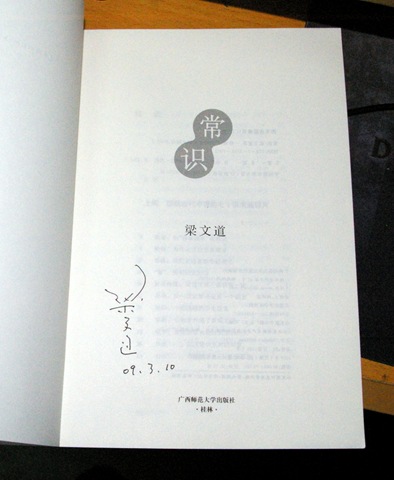
If Linda is China’s Alexis de Tocqueville, then Liang Wendao might as well generously be China’s Thomas Paine.
Annual Pear Blossoms in the Rain Award
Winner: Misuzu Kaneko’s Toward the Bright Side

This year my tear threshold was absurdly low. I cried through so many movies and books. Have I been possessed by some director?
I even cried while watching nursery rhymes. This was a nursery rhyme written by a Japanese woman named Misuzu Kaneko (is this really a nursery rhyme?).
Silkworms and the Grave
Silkworm babies want to go
into their cocoons,
small and narrow.
Into their cocoons.
But silkworm babies
must be very happy:
they turn into butterflies
and can fly away.
People want to go
into the grave,
dark and all alone.
Into the grave.
Yet good children
will grow wings,
turn into angels,
and can fly away.
Annual Lingering Echoes Award
Winner: World’s end girlfriend, Air Doll O.S.T.
I didn’t listen to much music this year, but I can’t not recommend this album. World’s end girlfriend has finally gone completely quiet. It’s really beautiful.
Annual Worried-for-the-Nation Award
(200 words deleted here)
The End.
Version history
Times change. When I reposted this piece from early 2010, I discovered that I could no longer understand many of the jokes. It took me half a day to realize that the “Long Live Faith Award” was riffing on the meme “Believe in Chun-ge and gain eternal life” (Li Yuchun). The joke behind the “China Unhappy Award” was that Song Xiaojun, author of the book China Is Unhappy, once appeared on Qiang Qiang San Ren Xing and went on an enormous rant attacking artsy affectation, only to get absolutely roasted by Ms. Zha Jianying.
Leave a Reply