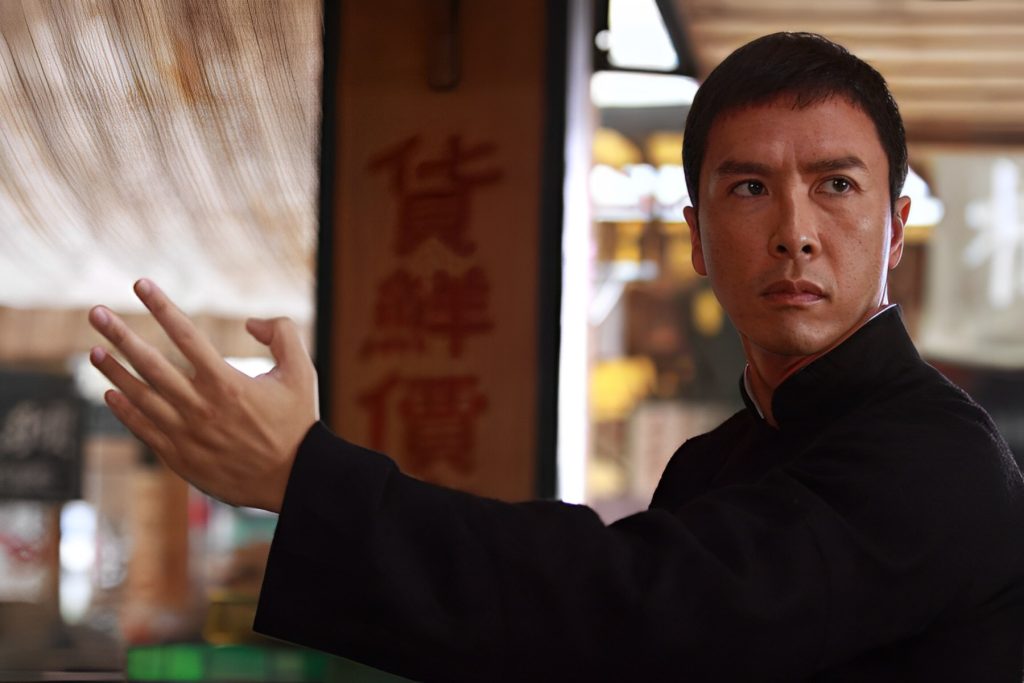
Before watching Ip Man 2, I had already burned the line ‘Donnie Yen handles Ip Man, Huang Xiaoming handles the stupidity’ into my brain, so I went in fully prepared to be struck by Huang Xiaoming’s stupidity. But the result was quite ‘disappointing.’ Huang Xiaoming tries desperately to look cool and handsome, but as far as being an idiot goes, that is also what the role requires. This troublemaking senior disciple is supposed to be a bit of an idiot in the first place, and Huang Xiaoming’s performance is really neither here nor there. Huang Xiaoming is indeed pretending.
The real idiot in Ip Man 2 is actually the British boxing champion. Ip Man 2 should really be called ‘Donnie Yen handles Ip Man, the British boxing champion handles the stupidity.’
Donnie Yen handles Ip Man
One of the most successful elements of the Ip Man series is that it created the image of a low-key grandmaster with the temperament of a homebody. Homebodies are all secretly showy: they look very quiet in everyday life, but their potential for flamboyance is enormous. Ip Man usually enjoys staying home with his wife when nothing is happening, but when pushed too far, he blows up. I think Donnie Yen captures this image with greater ease in Ip Man 2 than in the first film. Of course, some of the credit also goes to the script’s nice little details.
As a homebody, being out in the spotlight is quite a trial for Ip Man. So at the rooftop martial-arts school, even when there is nothing embarrassing going on, his smile always carries a little awkwardness beneath its shyness. He is like this with the auntie hanging laundry, and even in front of disciples who ought to be standing at attention before their teacher—almost as if teaching them kung fu meant he was somehow indebted to them. As a fellow homebody, I felt this very deeply. What Ip Man displays is the homebody’s signature combination of a shy, awkward smile: homebodies hate being in the spotlight, so they act shy (which is really just embarrassment); and because they do not meet people often, they overreact to everything around them, always feeling they must have done something wrong, which makes them awkward. I never expected Donnie Yen to play a homebody so convincingly.
A homebody’s mind is simple. One detail is especially telling: after recruiting his first batch of disciples, Ip Man finally breaks into a broad smile, then blurts out, ‘Pay your tuition first.’ There is not a shred of calculation in him; you could almost describe him as adorable.
A homebody is also very afraid of trouble. Appearing in public is already a trial; if trouble requires negotiating with someone, he is ten thousand times less willing. There is a revealing detail: after learning that his senior disciple had been taken away by Uncle Hung’s men, Ip Man’s first reaction is to pick up the cigarette butt from the coffee table and take a few drags. He says nothing. If Wong Fei-hung or Huo Yuanjia faced the same scene, how would they react? Deep down, a homebody does not want to face problems; the less trouble, the better. That smoking detail captures the state of mind perfectly. Fortunately, anxiety is one thing, but stepping forward is a responsibility he ought to shoulder. So after finishing that cigarette, Ip Man goes to face the matter alone. A homebody can be a responsible man too.
Now, the martial-arts action. It is generally considered that the best sequence is the round-table showdown between Donnie Yen and Sammo Hung. I will not discuss the choreography—I have only watched it once, and there are too many movement details to remember. But I found the overuse of doubles in this scene very uncomfortable. My rough impression is that whenever his face was not visible, Donnie Yen used a double! Even several shots filmed from the side or rear, almost close-ups, used one. It is very obvious that the person trading blows with Sammo Hung has a different face shape from Donnie Yen. Quite a few spectacularly difficult moves were not performed by Donnie Yen either (see my other analysis post: How Many Shots in Ip Man 2 Used Donnie Yen Doubles?). In fact, there was already an extremely obvious double continuity error in the first Ip Man: in the fight with Hiroyuki Ikeuchi, Ip Man nearly falls off the platform; in the next shot, he braces himself against the edge with both hands and kicks Hiroyuki Ikeuchi, then climbs back onto the platform. That move was done by a double.
Doubles are not forbidden, but please do not use them so shamelessly. I really wonder how many of the action scenes in the two Ip Man films Donnie Yen actually completed himself. Compared with Donnie Yen, Sammo Hung does not seem to use many doubles in Ip Man 2. In fact, later, during his fight with the boxing champion, even the move where he takes a heavy punch and crashes hard onto the platform was performed by Sammo Hung himself. Though perhaps my eyes are simply too poor to spot it.
The British boxing champion handles the stupidity
The first half of the film is much like the first Ip Man, built out of lots of entertaining little details. But the second half, like the second half of the previous film, takes a sharp turn in atmosphere and raises the banner of nationalism. The only difference is that this installment’s intention to stir up nationalist sentiment is so naked, and its methods so deliberate, that the previous film cannot hold a candle to it.
In the previous film, Hiroyuki Ikeuchi’s Japanese officer is both an invader and a martial-arts enthusiast. During the occupation, he suppresses the occupied people’s spirit while indulging his hobby. His behavior is not mere troublemaking; it follows the invader’s position and logic, and constitutes deliberate humiliation and provocation. In that situation, raising the banner of nationalism and fighting back is righteous, justified, and beyond reproach. Nationalism has legitimacy when one nation’s humiliation of another becomes widespread.
But what about Ip Man 2? It is entirely possible that in 1950s and 1960s Hong Kong, British people bullying Chinese people was widespread. But in Ip Man 2, the filmmakers do not let the audience see that wider pattern. In fact, what the audience sees is not the Chinese people as a whole being bullied by the British as a nation, but two British idiots—the police chief and the boxing champion—bullying them.
The British police chief extorts without restraint, struts without bothering to buy off his subordinates, and knows only coercion, never incentives. In reality, he is at most a brainless, short-sighted, stupid corrupt official. His eventual fate is to be reported over his superiors’ heads and dealt with by the upright grand official above him. If he had not been so insatiably greedy, if he had consistently shared enough benefits with subordinates like Ronald Cheng, who knows how things might have ended? But how much of this stupid corrupt official’s behavior is specifically national? If we replaced the British corrupt official with an equally overbearing yellow-skinned corrupt official, or made him a Chinese official bullying ordinary Chinese people, would the situation really be any different? In a colonial setting, this pigheaded corrupt official happens to be British, so it becomes British people bullying Chinese people? Imagine replacing all the Chinese people in Hong Kong at that time with British people. Under a system full of loopholes to exploit and opportunities for one man to cover the sky, would this British officer suddenly become a law-abiding, incorruptible official when facing poor people of the same skin color? I doubt it. Those he meant to bully would still be bullied; what he meant to steal would still be stolen. Ethnic difference certainly adds fuel to the fire, making ugliness more extreme, but it is not the fundamental cause.
Now, the British boxing champion. If the British police chief is merely an insatiably greedy, unrestrained idiot, then the British boxing champion is a complete moron. The Japanese villain’s conduct in the previous film at least follows a logic discernible from the invader’s position; this installment simply manufactures a British boxing champion who is a moron for the sake of causing trouble. First he disrupts a martial-arts demonstration by Chinese masters. He certainly insults Chinese martial arts and injures someone, but this kind of disruption also shows a basic lack of respect for the competition organizers and for his own opponent (the film seems to show only one opponent, also a foreigner; the boxing match is a match between foreigners in the first place, and has nothing to do with Chinese martial arts). Beyond looking down on Chinese martial arts, he does not actually respect the organizers or his opponent either.
Later, Uncle Hung’s death enrages the police leadership, who order the moronic officer to restore the situation. The British side therefore holds a press conference. Although the host continues to make offensive remarks, the purpose of the press conference is still to ease tensions and placate the Chinese. The higher-ups must also have instructed the boxing champion to show a little sadness and mourning, for the sake of reassurance. So for the first minute, we see the champion indeed perform several sad expressions. But as soon as he opens his mouth, this pighead makes a 180-degree turn, resumes his moronic posture, and continues provoking the Chinese, inflaming their anger instead of calming things down. If I were the enraged superior, I would have flipped the table at that sight.
So what the British boxing champion presents is the image of a reckless brute who cares about absolutely nothing. Is his arrogance directed only at Chinese martial arts? Judging from his behavior, this moron probably lacks even the minimum respect for all weak people and anyone he dislikes. If some rural part of Britain had a combat style that looked like dancing and flailing around with fancy punches and kicks, this man would not go up and provoke it?
A nation being bullied by another nation is not the same thing as some groups within a nation being bullied by a few foreigners. If I, as someone from Zhejiang, were beaten up by a loser in Shanghai, could I say, ‘Shanghai people bully Zhejiang people’? Of course, this analogy is not quite appropriate either.
Let me stress this once more: in reality, British people may well have bullied Chinese people as a general phenomenon at the time. But the two culprits bullying Chinese people in the film are defined more by their moronic nature than by their foreignness. These two morons would be scum even by British standards. In fact, the one who ultimately arrests the moronic corrupt official is Britain’s own upright grand official. The upright grand official may have a need to preserve the stability of his rule, but if this happened in Britain and the corrupt official’s ugly deeds were exposed, would he really stand by and watch? And the people who finally stand up to applaud Ip Man are the British audience members who originally came to watch the boxing champion’s match. At least in these two details, the British people in the film recognize right and wrong rather than judging by identity.
At its core, Ip Man 2 is the story of a cultured, educated civilized man teaching a lesson to an uncultured, uneducated thug. The story of Ip Man 2 still works perfectly if you strip out the nationalist elements. For example, turn it into a version about a conflict among Chinese people: Ip Man is a Guangdong martial-arts master who arrives in Shanghai to open a school, only to clash with a group of local masters led by Huo Fangjia. Later, it turns out that Huo Fangjia is actually a man with a broad perspective who is acting against his own wishes; by bribing the local corrupt official, he protects all the martial-arts schools. The corrupt official happens to be from the north and likes Shaolin boxing. He organizes a platform match, at which point a Shaolin monk arrives and declares that southern boxing is all garbage and Shaolin boxing is number one under heaven. Huo Fangjia says, ‘For the sake of making a living, I can endure it. For the dignity of southern martial arts, I cannot.’ So the monk beats him to death. In the end, Ip Man fights the monk and defeats northern boxing. At the same time, the corrupt official is also punished by an imperial commissioner sent from the capital.
If Ip Man in Ip Man 2 is considered to have promoted national righteousness, then what would this version about an internal conflict be?
Some people will say that the British bullying the Chinese in Ip Man 2 has one more piece of ironclad evidence: the British referee changed the rules halfway through and forbade Ip Man from using his feet. But don’t forget that the British boxing champion spent the entire fight wearing gloves while fighting Ip Man’s bare fists. That’s just showing off—it’s like letting your opponent have the chariot, horse, and cannon in a game of Chinese chess. Who was bullying whom is suddenly hard to say. If the champion had fought bare-knuckled, Ip Man would have been beaten to death long before, just like Master Hung. So was it really that unfair for the referee to forbid Ip Man from using his legs?
In short, what I saw in Ip Man 2 wasn’t one ethnicity bullying another. It was a nitwit corrupt official and a nitwit thug bullying ordinary people and the weak; it just so happened that the official and the thug were British, while the ordinary people and the weak happened to be Chinese. So the filmmakers pulled every trick they could to whip up nationalist sentiment. But I don’t think this thick layer of nationalism has much of a foundation.
Of course, the filmmakers’ melodramatic whipping-up of nationalist sentiment may also have been a matter of necessity. In that sense, Ip Man is a slightly “at-the-mercy-of-circumstances” hero, both in the film and outside it. The filmmakers actually knew quite clearly what they wanted to say. After the fight, Ip Man said, I am not trying to prove that Chinese martial arts are stronger than Western boxing. I just want to say that although our identities may be different, everyone should respect one another as equals. Jet Li’s Fearless turns Huo Yuanjia into a saint who uses saintly morality to win over the world. Ip Man, by contrast, is an ordinary man with no sense of moral superiority; he simply hopes people will follow a few universal principles that anyone can live by. In that respect, Ip Man is more lovable—and more valuable—than the likes of Fearless.
It’s just that after all the emotional overkill that came before, this post-match speech, which should have been the finishing touch, looks feeble and faint amid the roar of nationalist sentiment. The audience won’t remember those words. They’ll only remember that yet another foreigner got taught a lesson by Chinese martial arts.
As for the way nationalism is played up, if Ip Man was still wearing the stern expression of China Can Say No, then Ip Man 2 has turned into the coquettish China Is Unhappy. What about Ip Man 3? I hope it doesn’t turn into China Has Risen.
Leave a Reply