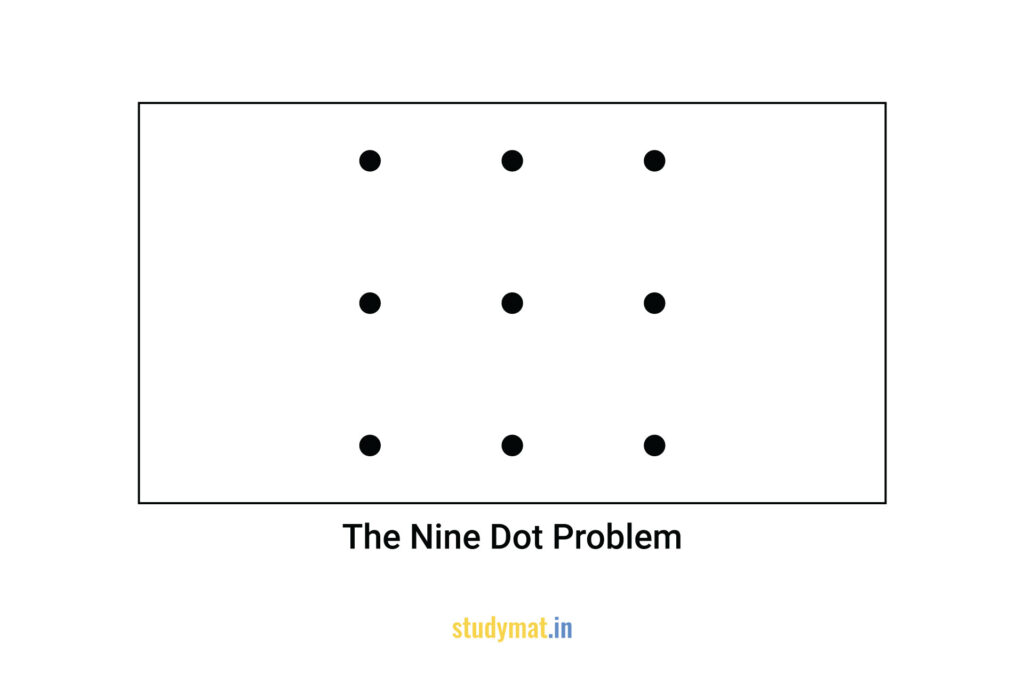
Let’s use the “Nine-Dot Problem” to think about how to break out of fixed mental frameworks when solving problems.
The so-called “Nine-Dot Problem” asks you to connect nine dots using four continuous straight lines. “Continuous straight lines” means that your pen cannot leave the paper while drawing: in one uninterrupted motion, use four lines to connect all nine dots (see the figure below).

Here’s the solution to the “Nine-Dot Problem.”
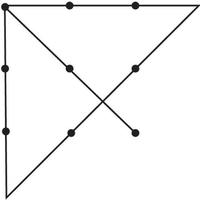
For most people encountering the “Nine-Dot Problem” for the first time, finding the correct solution is quite difficult. That’s because when we look at the nine dots in the diagram, we unconsciously treat the square formed by them as a “frame,” and then unconsciously search for a solution within that “frame.”
But the correct solution to the “Nine-Dot Problem” happens to require stepping outside the “frame.”
So is there any way to make the “Nine-Dot Problem” easier?
Yes. One way is to give the problem-solver a few hints about “stepping outside the frame.”
For example, in the figure below, place two additional dots outside the nine dots.

Or, as in the figure below, draw a large square outside the nine dots.
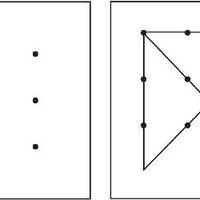
Both of these tricks hint to the problem-solver that the square formed by the nine dots is not some naturally given frame. In fact, once either hint is provided, the problem becomes much easier.
This suggests that when facing a difficult problem, it may help to ask yourself: “Where is the ‘frame’ of this problem in my mind?” After answering that, ask yourself again: “Is this ‘frame’ really inevitable? Is there a way to get outside it?” Creative solutions often come from thinking after stepping outside the frame.
References:
Mlodinow, L. (2018). Elastic: Flexible Thinking in a Time of Change. Pantheon.
Note
- This article in the “Psychology Bites” series was written for the “Fanshu” platform, which has since shut down, to accompany relevant content from the Zhichao Wei: Psychology Bites project. The original link is no longer available.
Leave a Reply