Yesterday, I talked at some event about what I’d learned from reading on the subject of “consciousness.” It’s a pretty rough-and-ready understanding, but here it is, organized a bit:
Looking at what I’ve been reading lately, I feel that the field of consciousness research is split into two great mountain strongholds. The gods on each mountain have produced a lot of astonishing work, but there’s a ravine between the peaks, and the two sides seem to be acting as if they’ll never speak to each other again.
The leading figures on the first mountain include Christof Koch, Francis Crick, Giulio Tononi, and Max Tegmark. The representative works from this school include—
Koch’s The Quest for Consciousness: book.douban.com/subject/6…
Koch’s Consciousness and the Brain: book.douban.com/subject/2…
Tononi’s PHI: book.douban.com/subject/2…
The final chapter of Tegmark’s Life 3.0: book.douban.com/subject/3…
The great figure on the other mountain is Stanislas Dehaene.
Dehaene’s representative work is Brain and Consciousness: book.douban.com/subject/3…
Over there you have Consciousness and the Brain; over here you have Brain and Consciousness. The titles even look like mirror images, yet neither side seems very interested in citing the other mountain’s research. Dehaene cares about the neural basis of conscious access—that is, the neural basis that produces conscious experience. Koch also studies the neural basis of consciousness, but he and Tononi, among others, are also more concerned with the question of what consciousness fundamentally is: Why does consciousness exist?
In books from Koch’s school, Dehaene is barely a footnote. But open Dehaene’s book and you might get quite a shock: this man has clearly done an enormous amount of groundbreaking research. In fact, Dehaene’s Brain and Consciousness is extremely hardcore. It takes real swagger for a top scholar like him to write a book whose groundbreaking and landmark studies are almost all his own. And yet Dehaene barely cites the research from the other mountain either. For example, when discussing objective ways to measure consciousness, his book doesn’t even mention Giulio Tononi’s consciousness detector.
My crude “Twin Peaks” division also leaves out a major figure in the field of consciousness: the philosopher Daniel Dennett. If Dennett were to climb one of these mountains, he would definitely be on Dehaene’s.
Dennett insists that consciousness is an illusion, so in his eyes, all those people on Koch’s side spending their days puzzling over the fundamental nature of consciousness are simply chasing nonsense. Koch and the others are villains in Dennett’s books. Of course, in Koch and the others’ papers, Dennett is a villain too.
But Dennett is a good guy in Dehaene’s book, because Dehaene also opposes digging endlessly into the fundamental nature of consciousness. He thinks that if we simply buckle down and understand the nervous system, the nature of consciousness will naturally rise to the surface. He probably also thinks that Tononi and company are just fooling around with Integrated Information Theory.
So the great figures on these two mountains seem to look down on each other, and the main reason may be a difference in research level: they care about different layers of the consciousness problem.
In Life 3.0, Tegmark drew a diagram showing several layers of the consciousness problem, arranged from bottom to top in order of increasing difficulty (see below).
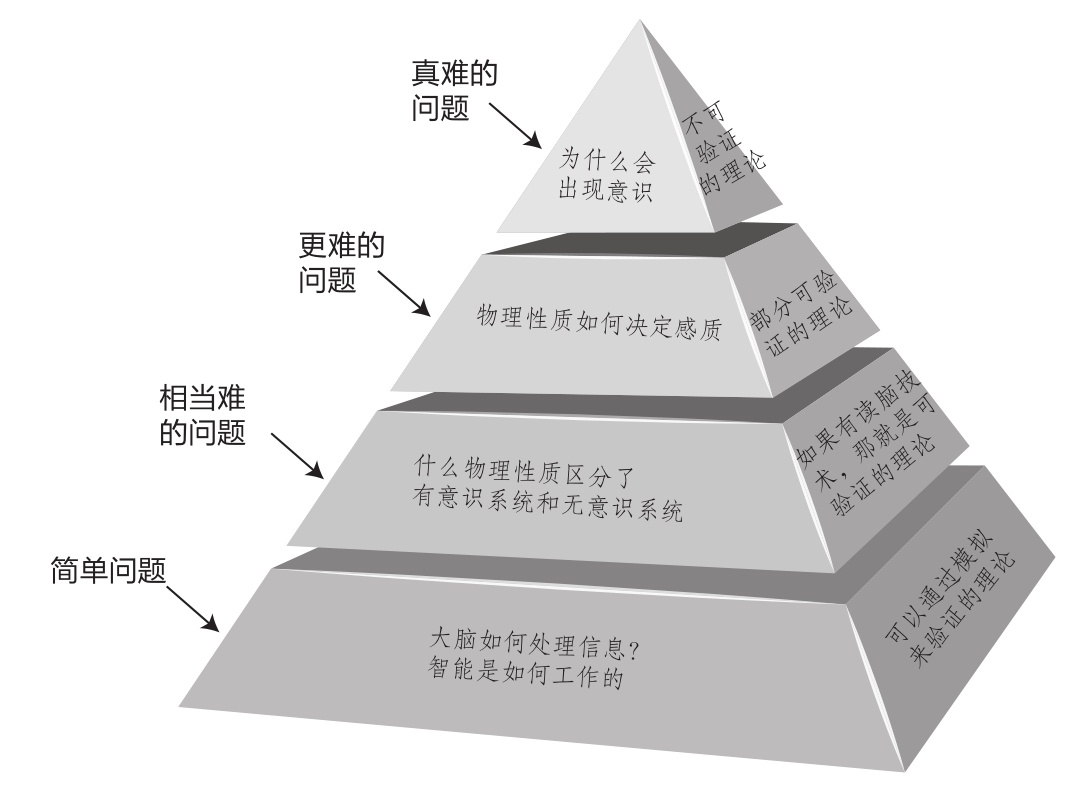
Dehaene mainly works on the bottom two layers. Of course, even the very bottom layer is already extremely difficult—the words “easy problem” on the diagram are Tegmark’s joke.
The least controversial, most widely accepted research by Koch and his colleagues was also done in those bottom two layers. But they always seem to be “not quite honest,” constantly trying to sneak up into the top two layers. Take Giulio Tononi’s earth-shaking Integrated Information Theory, for example. That’s practically an attempt to puzzle out God’s thoughts while creating the universe!
Dehaene would say: You’re messing around. Dennett would say: Those top two problems don’t exist at all.
But Tegmark might push back: The fundamental nature of consciousness may be the only truly important ultimate question in the world.
Personally, I’m awestruck by the research done by the great figures on both sides—though of course I’m not terribly fond of the superiority complex some philosophers, Dennett included, seem to have.
My experience is this: When you see gods fighting, there’s a good chance that each side has grasped part of the truth, while neither side has grasped the whole truth. In other words, above these two lofty peaks, an even grander Mount Everest is still waiting for the gods to climb it.
I hope I’ll get a glimpse of the Mount Everest of consciousness research in my lifetime.
Note
- This series, “New Findings in Psychology,” consisted of short popular-science pieces and rambling reflections written back then to accompany the related content of Zhichao Wei: New Findings in Psychology. They were published on the now-shuttered platform Fàntuán, and the original link no longer exists.
Leave a Reply