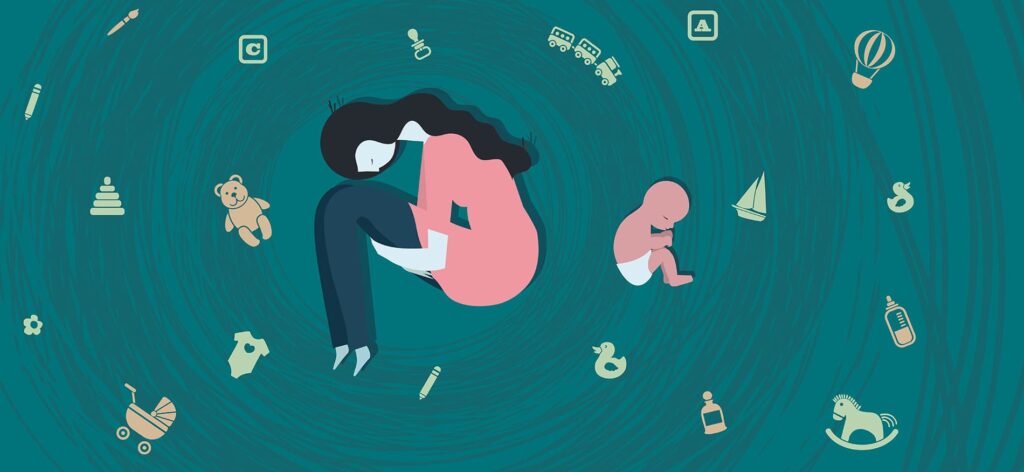
Postpartum depression refers to the period of severe, persistent depression that 10% to 15% of mothers experience after giving birth.
What causes it?
At first, many doctors assumed that postpartum depression was caused by hormonal changes after childbirth. Yet years of research have found no connection between extreme hormonal fluctuations and postpartum depression. In fact, many fathers fall into a state almost identical to postpartum depression after having a child, and fathers’ “postpartum depression” obviously can’t be explained by dramatic hormonal swings.
Biologists Randy Thornhill and F. Bryant Furlow, along with anthropologist Edward H. Hagen, independently proposed a hypothesis: postpartum depression actually serves an evolutionary function—and that function is infanticide.
If an animal abandons its offspring when food or childcare conditions are inadequate and instead invests in offspring more likely to survive and reproduce, its genes have a better chance of being passed on. And as a matter of fact, our species has a long history of infanticide.
In ancient times, infanticide was extremely common!
In fact, this “parental investment theory” applies especially well to humans. Raising human children is “very expensive”: human children need years of care before they can survive independently. When a mother lacks support from the father or other family members, she may unconsciously conclude that she cannot successfully raise her baby.
Research confirms that mothers with postpartum depression do significantly less childcare, and often have thoughts of harming their babies!
However, this “infanticide hypothesis” doesn’t seem to explain why parents with postpartum depression rarely actually abandon their newborns. Anthropologist Edward H. Hagen speculated that this may mean postpartum depression is more like a strike: by becoming less interested in the child, the mother may prompt others to help. In other words, it is a warning signal from the mother. And research has indeed shown that the more severe a mother’s postpartum depression symptoms are, the more likely the father is to take on additional childcare.
Still, I personally think that, given the fact that every human civilization without exception has a long history of infanticide, the phenomenon described in the previous paragraph may have appeared only in modern societies relatively close to the present day. In ancient times, when infanticide was commonplace, postpartum depression may well have led to actual abandonment and infanticide. It was the dramatic improvement in living conditions today that turned postpartum depression into an evolutionary “leftover.”
Whatever its exact mechanism, if you or someone you love has postpartum depression, contact a doctor immediately for treatment. Antidepressants and talk therapy are both effective ways to relieve it.
Note
- This article in the “New Insights in Psychology” series was a short popular-science essay/ramble written back in the day to accompany content from Zhichao Wei: A Course on New Insights in Psychology. It was published on the now-shuttered platform Fanduan, and the original link no longer exists.
Leave a Reply