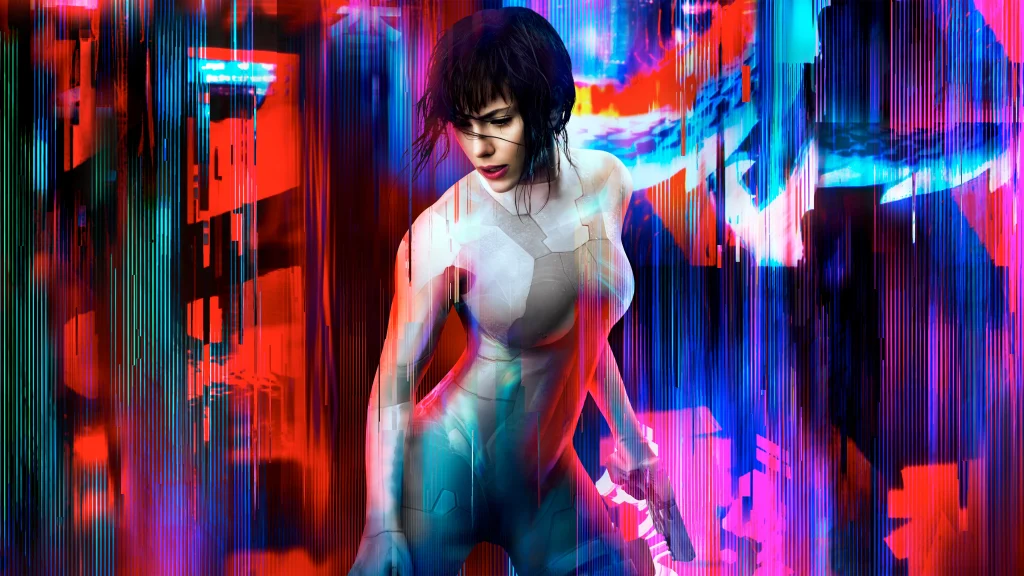
At the level of its spiritual core, the live-action Ghost in the Shell goes completely against Mamoru Oshii's original.
A few days ago, I gave my first one-star rating of the year on Douban—to the live-action Ghost in the Shell that premiered last week.
I’m a shameless superfan of the two theatrical animated Ghost in the Shell films directed by the great Mamoru Oshii. I’ve watched those two Ghost in the Shell films at least a dozen times.

The first one especially is a ten-star masterpiece in my book—if five stars is a perfect score, I practically want to give it ten. So seeing the live-action version mangled into this sorry excuse for a film made me particularly angry and disappointed.

Let’s start by talking about why Mamoru Oshii’s theatrical Ghost in the Shell deserves ten stars. Then, by comparison, you’ll understand why I gave the live-action version one.
A Ten-Star Masterpiece
What exactly makes Mamoru Oshii’s theatrical Ghost in the Shell so great?
The fact that it’s a philosophical film.

Animated films are basically aimed at teenagers and younger children. Serious films made purely for adults are already rare, and ones that touch on philosophical questions are rarer still.
Of course, film as an audiovisual art form—including animation—is better suited to telling stories. In practice, it’s not especially good at expressing abstract philosophical thought.
Ghost in the Shell doesn’t actually give you a philosophy lecture. It—in Gao Xiaosong’s words—lets you catch a whiff of philosophy’s ‘flavor.’ And that alone is remarkable.

Ghost and Shell
So what philosophical question does it touch on? The answer is right there in the title—Ghost in the Shell.
In the film, Ghost means a person’s self-awareness—in other words, the soul. Shell means the physical casing, the vessel of the soul.
What Mamoru Oshii wants to explore through Ghost in the Shell is the relationship between the soul and its vessel.

Two ‘Questions for Heaven’
Within this theme, director Mamoru Oshii asks two questions.
In plain English, the first question is:
Can a soul exist only inside flesh—only inside a living, blood-and-bone body?

The second question follows from the first:
If a soul can escape the flesh and exist in other ways, then looking at it from the other direction, doesn’t this deeply flawed and heavily restricted shell become a bottleneck preventing the soul from further transcending?

More than twenty years later, the thoughts Mamoru Oshii offers in Ghost in the Shell on these two ‘Questions for Heaven’ remain remarkably thought-provoking.
Answer to Question One: The Puppet Master
In the film, a computer program called the Puppet Master grows increasingly complex after absorbing vast amounts of information from the network, and eventually develops self-awareness.

The Puppet Master’s birth answers the first question:
A flesh-and-blood body may not be the soul’s only container.
The human brain, stripped down to basics, is simply a highly complex neural network.
If a soul can arise in a network made of neurons, what reason do you have to conclude that it could never arise in a network made of electronic components or computer algorithms?
Answer to Question Two: Motoko’s Ascension
This makes the film’s protagonist, Major Motoko Kusanagi, realize that if a soul can arise in a computer network, why should the human soul have to remain confined to an organic body?
So, in the end, Motoko resolves to abandon her flesh and step into a vast, boundless networked world.

A lot of science-fiction novels have this plot: humanity abandons reality and plugs into the network. Most call it digital migration. You just move from here to there; you’re still you, with no fundamental transformation.
Mamoru Oshii’s treatment is completely different. In Ghost in the Shell, the scene where Motoko abandons her body and joins the network is presented as an almost Taoist image of someone who has attained the Way, ascended to the celestial realm, and become an immortal.

That is the director’s answer to the second question:
Upgrading the vessel brings the soul transcendence and elevation.
The old you was trapped inside one lonely brain; now you drift through the vast ocean of the entire network.
You haven’t merely migrated. You’ve attained the Way and become an immortal.

CCTV once had an image campaign with a deeply syrupy slogan:
The broader your heart, the bigger your stage.
That’s actually a very subjective-idealist way of thinking.
Mamoru Oshii’s thought turns that sentence on its head. What he really wants to say is:
The dimensions of the stage determine the breadth of the soul.
That is a thoroughly materialist angle.

Everything I’ve said above is the thinking Mamoru Oshii offers in his theatrical Ghost in the Shell:
The soul’s vessel is not limited to organic bodies; the possibilities of the vessel determine the possibilities of the soul.
Whether the conclusion is correct or not, isn’t this an incredibly interesting way to think? And unless you demand the rigor of academic philosophy, it has a pretty impressive depth of thought.
The Live-Action Version Goes in the Opposite Direction
But in this recent live-action Ghost in the Shell, all that wit and depth have been lost completely.
Worse, at the level of its spiritual core, it goes entirely against Mamoru Oshii’s version. It didn’t take something worth 100 points and botch it into 50; it turned around 180 degrees and changed it straight into negative points.
This is what I find most unbearable.

On the two ideas I mentioned above, the live-action version is guilty of exactly this.
Live-Action Question One: Humanity First
In Mamoru Oshii’s version, the soul’s vessel isn’t limited to a human body. Computer programs and robot bodies can also produce souls capable of standing as equals with human beings.
And toward these ‘nonhuman’ souls, the film shows a compassionate sensibility, with something of Buddhism’s idea of equality among all sentient beings.

What about the live-action version?
When the female lead looks at the corpse of the geisha robot and says she feels very similar to her, the scientist beside her immediately jumps in to object:
‘No. Your body may be a machine, but you have a human brain. You have a human heart—that’s what matters. You have a soul. They don’t.’

(Sorry, I can’t remember the exact line. The film was so awful that I got confused several times while watching it. But that was more or less the idea.)
What does this line mean? It is pure, unadulterated human supremacy.
That’s the tone of the entire film. Apart from the geisha robot’s dying plea, which hints ever so slightly that ‘machines may have souls,’ every other machine in the film is just a human puppet. The machines themselves are basically irrelevant.

Compared with the ‘equality among all sentient beings’ in Mamoru Oshii’s version, this is a massive regression in both values and depth of thought.
Live-Action Question Two: CCTV Possessed
Now for the second idea: how does the vessel affect the soul? Here too, the film basically turns around 180 degrees and sprints backward.
The director of the live-action Ghost in the Shell may have seen that CCTV campaign, because the film ends on one line—something like, ‘Your actions define who you are.’
And isn’t that pure idealism?
Isn’t that just the same as saying, ‘The broader your heart, the bigger your stage’?
Isn’t that once again exactly the opposite of Mamoru Oshii’s thinking?

A lot of people say the live-action version pays tribute to Mamoru Oshii’s version—and does a pretty good job of it. Quite a few shots are practically copied frame for frame.
I absolutely cannot agree.
I think the spiritual core is a hundred times more important than the visuals.
The original moves 100 steps forward. If you move 10 steps forward, fine—you can call it a tribute.
But the live-action Ghost in the Shell turns around, walks 10 steps backward, and then says:
‘See? I’m still on one straight line with my predecessors. That’s a sincere tribute, right?’
Sincerity, my ass.
If I don’t give you one star, who should I give it to?
Leave a Reply