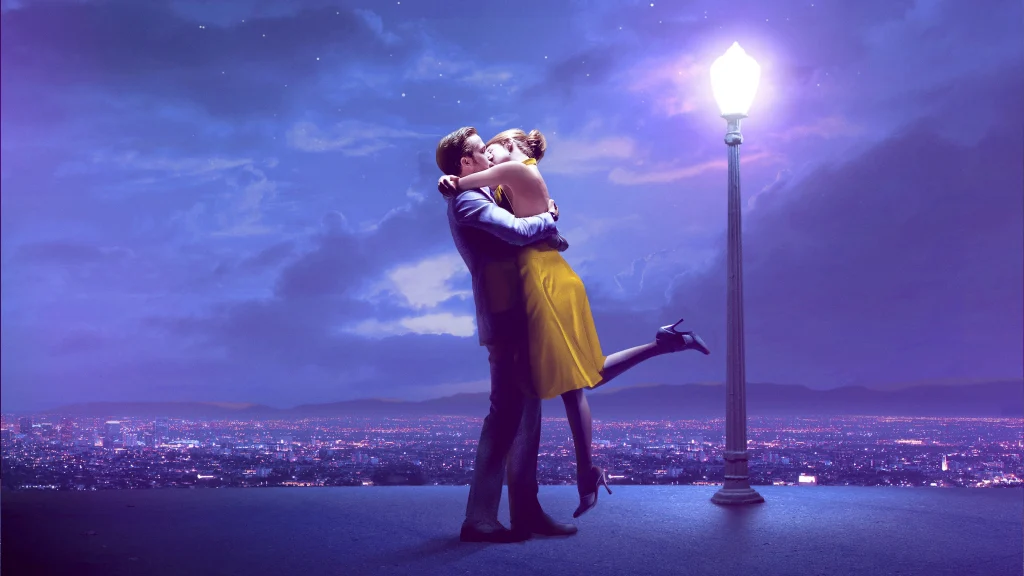
When that light pours down, everything outside the mind disappears. What you experience is pure ecstasy.
What I want to say is that La La Land may contain a hidden theme that many viewers have overlooked.
This hidden theme is called “being possessed.”
Why do I say that?
Let’s start with a very special technique used in La La Land—
Have you noticed a particularly striking image several times in the film? All the lights in the world disappear, and the last light left in the world falls on the protagonists.

The Last Light in the World
The first time you notice that light should be when the male lead, Seb, plays a Christmas tune at the restaurant. The owner who hired him has repeatedly told him to play only the assigned songs, or he’ll be fired.
But suddenly, in that moment, Seb seems to have been possessed. It’s as if all that remains in his mind are the piano keys in front of him and the melody ringing in his head.
The audience doesn’t want to listen? The boss is going to blow up? He’s going to lose his job? None of it matters.
He has to get that melody out, no matter what.
And then that light appears: wrapped in it, Seb plays “City of Stars.”

The second time you notice that light should be during Mia’s crucial audition.
As soon as the casting director says they want to see her improvise, she becomes a little helpless.
But in the next instant, Mia seems to empty her mind of every distracting thought. She seems to forget all the defeats she has suffered, forget her resentment at the casting director’s repeated disregard, and forget her hunger for fame.
She is completely immersed in her performance.
And then that light appears again. Wrapped in it, Mia sings the most moving song in the entire film.

The third time you notice that light is at the film’s climax.
Five years later, Mia and Seb meet again, and Seb is overwhelmed, unsure what to do.
But then, when he settles down at the piano, you can see in his eyes that he has instantly returned to the state he was in at the restaurant, when he cast everything aside to play.
He begins the intro to “City of Stars.” The world dims once again, that light pours down, and Mia and Seb spend another life inside it.

Being Possessed
That light appears more times in the film than these, but these examples should be enough.
So when exactly does that light appear?
It’s actually very simple: every time the protagonists cast aside all distracting thoughts and become completely immersed in their own creation and performance.
When Seb forgets the danger of losing his livelihood, and when Mia lets go of her fixation on becoming a star, that light pours down.

So what that light symbolizes is a particular mental state—the “being possessed” I mentioned at the beginning.
Being possessed means focusing so intensely on one thing that you enter a state of ecstatic obsession.
Self-Forgetfulness
When you’re being possessed, you completely become “self-forgetful.” You’re 100% immersed in the pleasure of getting the thing done. You don’t think about why you’re doing it. You don’t think about what will happen if it fails. You may not even remember who you are.
That’s what “unity of knowledge and action” really means!
All that remains in your consciousness is your action. Apart from that, there isn’t a single distracting thought in your mind.
In this moment, you are utterly pure!

The Conditions for Being Possessed
When do people become possessed?
First, of course, you have to be doing something you genuinely love. Being possessed isn’t being driven crazy; it’s “going crazy for love.”
Seb becomes possessed only when he plays piano, and Mia only when she performs.

The second condition is that the task has to be somewhat difficult. The difficulty has to be just right—not too high, not too low—so that it forms a challenge.
That challenge brings out your highest-level skills and forces you into your best possible state. When you’re possessed, you’re putting every ounce of your power into facing the challenge head-on.
In La La Land, the jazz Seb loves and the acting Mia loves are both perfectly suited to creating this kind of challenge.

That’s because jazz and acting are classic “creative activities”: they bring something out of nothing, so the difficulty and challenge are obvious.
Being Possessed in Whiplash
Actually, this isn’t the first time La La Land director Damien Chazelle has portrayed this obsessive state of being possessed.

Being possessed is practically the through-line of his work.
Take the climactic scene at the end of his previous film, Whiplash. At first, the demonic teacher Fletcher sets a brutal trap: he wants to completely destroy Andrew, the male lead who got him fired.

He deliberately makes Andrew prepare the wrong piece, then sends him onstage with no preparation at all, while every person watching below is an industry heavyweight who can determine his future.
But unexpectedly, Andrew, having taken a hundred thousand points of psychic damage, casts everything aside and walks back onstage.
This Andrew is the same Seb who plays “City of Stars,” the same Mia who sings “The Fools Who Dream.”

Andrew has become possessed. Nothing exists in the world except the drumsticks in front of him, and he begins the finest performance of his life.
And then comes the most moving moment in Whiplash: the demonic teacher Fletcher is actually drawn in by the perfect performance and becomes possessed along with Andrew.
He becomes completely self-forgetful. The vengeful fury that had been uncontrollable moments earlier simply evaporates. He keeps the beat for the male lead and conducts him through the perfect performance.

The Experience of Being at the Peak of Life
When Seb plays his jazz, when Mia performs with abandon, when Andrew casts aside his supposedly terminated artistic career, and when Fletcher forgets why he wanted revenge, what exactly are they experiencing?
What they experience is nothing less than “the peak of life.”
Do you think the only way to reach “the peak of life” is to become a general manager, take the CEO job, or marry a rich, beautiful woman?
Not at all. Being possessed can absolutely rival those things.
When that light pours down, everything outside the mind disappears, and what you experience is pure ecstasy!
Being Possessed = Happiness?
That’s why so many people equate being possessed with happiness.
They just don’t use the word “being possessed.”
Flow
“Being possessed” doesn’t sound very nice. So over the years, it has been replaced by a psychology term that sounds much more grand: flow (Flow).
Don’t you often hear people say that if you want to be happy, you have to “live in the present”?
And what is flow, if not being in the present alone? Isn’t it about throwing everything else out of your mind?
So, following that line of thinking, the more often people are in flow, the happier they are.
But then, wouldn’t teenage gaming addicts be the happiest people in all of history? After all, gaming is one of the easiest activities for achieving flow.

I doubt many people would agree that gaming addicts are the happiest people alive.
I suppose only a small group of people who like to head off into the deepest mountains at the slightest disagreement, sit in meditation, and practice Zen would crudely equate flow with happiness.

Flow Is a Double-Edged Sword
Actually, rigorous scientists and perceptive artists have a much clearer understanding of flow.
They have all noticed, independently, that like every other pleasurable experience, flow has an addictive magic.
Being immersed in flow is indeed immensely pleasurable. But once time has passed and you look back at it, it’s hard to predict whether it ultimately fulfilled you or harmed you.
For example, psychologist Mihaly Csikszentmihalyi, who proposed the concept of flow, gives various examples of negative flow in his book optimal experience.

The book gives examples:
American veterans who fought in Vietnam or other wars sometimes reminisce about their experiences in combat and describe them as a kind of flow. Crouched beside a rocket launcher in a trench, the focus of life suddenly became clear: kill the enemy before the enemy killed you.
The admiration Germans felt for Hitler before World War II also often put them into flow.
There’s an old story that some female fans, listening to Hitler’s speeches, became so aroused that they reached orgasm on the spot.

That’s flow on a biblical-flood scale. So tell me: is that kind of flow good or bad?
Both Righteous and Evil
That’s why I prefer the word “being possessed” to describe this mental state.
Because it can be both righteous and evil. Whether it’s a clear spring or a mudslide depends entirely on the internal and external circumstances. There’s no telling.
I think Damien Chazelle, the director of La La Land, also has an exceptionally sharp insight into the dual nature of being possessed.
He simply loves depicting the state of being possessed itself. As for its consequences? Chazelle deliberately keeps things ambiguous.
For example, Whiplash stops abruptly at the very height of that performance. The director never tells us what this episode of being possessed means for the future of that teacher and student.
Likewise, in La La Land, is the price Seb and Mia pay for the ecstasy of that moment of being possessed worth it? The director gives us no clear answer.

A Second Life
Even so, I think I still sensed something in that dazzling “second life” at the end of La La Land.
As for this “second life,” everyone seems to interpret it this way:
Although the two protagonists separate in reality, it’s comforting enough that they can spend a lifetime together in their imagination.

But me?
I’d rather interpret it this way:
I don’t know whether reality became better or worse when I stepped out of that light;
I don’t know whether the things I gave up to make that light pour down were worth it;
I don’t even know whether, to make that light pour down, I hurt the people who love me and the people I love.
All I know is this:
When I’m bathed in that light,
I feel as if I’ve lived a deeply satisfying life.
And so,
I have no regrets.
References and Gossip Mentioned in the Article
1. Love and Dreams in La La Land
I think the two apparent themes in La La Land—love and dreams—are both handled inadequately.
Because they aren’t painful enough.
You’re just in a long-distance relationship, right? Some of us have to cross provincial borders to go to work, okay?
You just can’t become the lead in a movie or the owner of a bar, right? That’s what you find frustrating? Any one of our Mr. Wang Feng’s students could tell a story that would crush yours in seconds, okay?

2. Flow: the psychology of optimal experience

The book’s English title is Flow: the psychology of optimal experience. It uses the term “optimal experience,” which is a different thing altogether from “happiness.”
The Chinese title was clearly translated that way to cater to the various mass-market “happiness courses” that have flooded the scene in recent years.
Original link
Collected in
- After revision, the core argument of this article was included in The 24-Frame Psychology Code.

Leave a Reply