Let’s start with the list:
The anchor:
BOOK 01 How to Think Straight About Psychology
Brain:
BOOK 02 We Are Our Brains: From the Womb to Alzheimer’s
BOOK 03 The Accidental Mind: How Brain Evolution Has Given Us Love, Memory, Dreams, and More
Cognition:
BOOK 04 Consciousness and the Brain: Deciphering How the Brain Codes Our Thoughts
BOOK 05 Thinking, Fast and Slow
BOOK 06 The Geography of Genius: A Search for the World’s Most Creative Places from Ancient Athens to Silicon Valley
Emotion:
BOOK 07 The Evolution of Desire: Strategies of Human Mating
BOOK 08 That’s Disgusting! Uncovering the Secrets of the Psychology of Disgust
Intention:
BOOK 09 The Hidden Self: A New Understanding of the Unconscious Mind
BOOK 10 Willpower: Rediscovering the Greatest Human Strength
Group:
BOOK 11 SuperCooperators: Altruism, Evolution, and Why We Need Each Other to Succeed
BOOK 12 Not by Chance: My Life as a Social Psychologist
The anchor
First, we need to know that psychology is a disaster area when it comes to pseudoscience.
At least half of the books sold as psychology books aren’t really psychology; and at least half of the people calling themselves masters of psychology aren’t reliable psychologists at all—they may not even have studied psychology. If something has even a little to do with relationships, the soul, or counseling, you can call yourself a psychologist. I won’t name names.
Since the waters of psychology run deep and all sorts of monsters are roaming around in them, we first need to bring out an anchor and pin these demons down.
BOOK 01 How to Think Straight About Psychology
This anchor is the first book we recommend: Canadian psychologist Keith Stanovich’s How to Think Straight About Psychology. It’s the crown jewel of our psychology shelf, and a must-have for anyone ready to impulse-buy.

I first read this book years ago, and since then its title has changed twice. It was originally called Psychology: A Different Kind of Book, and is now called This Is Psychology. Three titles, but actually the same book. Personally, I prefer How to Think Straight About Psychology.
This book clears away the confusion and tells us what reliable psychology really is. Plenty of people claim to be doing psychology, but only those who use scientific, empirical methods to explore psychological and behavioral规律 are doing real psychology.
The keywords here are “science” and “empirical evidence”. In today’s psychology profession, if you want to publish a claim, you also have to provide scientific evidence for it.
You have to run experiments, collect data, and let experimental results and survey data do the talking. You can’t claim that all Chinese people are “giant babies,” toss out a few anecdotes, and call it a theory. You have to bring data to prove it.
How to Think Straight About Psychology shows us exactly how reliable psychologists use scientific, empirical methods to establish that a psychological claim holds water.
If you really absorb this book, you may gain a decent ability to tell psychology from pseudopsychology. Later, when you pick up a new psychology book in a bookstore, a few pages should be enough for you to get a rough sense of its quality. It’s also an excellent book for training scientific thinking.
In short, this is a must-read among the must-reads in psychology.
Brain, Cognition, Emotion, Intention, Group
After that crown jewel, the next 11 books each deal with a specific area.
While choosing them, I felt my indecisiveness was entering its terminal stage. Psychology covers far too many areas. Wherever there are people, there’s psychology; the number of things you could study within it is astronomical. It’s just too complicated.
So with a list of around ten books, whatever I choose, I’m bound to leave out far more than I include. Even multiplying the list by ten might not cover every major research area.
On the other hand, I think psychology’s research fields can also be made very simple. I have my own summary: viewed from the broadest angle, five characters capture the most important dimensions of the human psychological structure, and they are also psychology’s five major research fields.
Those five characters are: Brain, Cognition, Emotion, Intention, and Group. I’ll explain what they mean in a moment.
The 11 books I’ve chosen each represent two or three books from these five fields. Of course, they can’t possibly sum up all of psychology. They are 11 doors, and behind every door is a vast world waiting for you to explore.
Dimension One of the Psychological Structure: Brain
The first major dimension of the human psychological structure is “brain.” The brain’s brain.
BOOK 02 We Are Our Brains: From the Womb to Alzheimer’s
Every psychological activity in a person has a corresponding neural basis in the brain.
One book is especially good at helping us understand the relationship between these subjective psychological activities and objective brain activity. It’s We Are Our Brains: From the Womb to Alzheimer’s, by Dutch neuroscience heavyweight and University of Amsterdam neurobiology professor Dick F. Swaab.
“We are our brains”—the title says it all: from memory to personality, from adolescent sexual impulses to sacred religious experiences, from addiction to autism, everything we subjectively perceive actually has a corresponding basis in the brain. I am my brain.

Through We Are Our Brains, we can see that the brain is the stage for all psychological activity. The structure of that stage, its lighting and scenery, determine what we experience subjectively.
BOOK 03 The Accidental Mind: How Brain Evolution Has Given Us Love, Memory, Dreams, and More
Once we have that foundation, a question naturally follows: how was the brain—the stage for psychological activity—built?
We’ll look for the answer in the next book, The Accidental Mind: How Brain Evolution Has Given Us Love, Memory, Dreams, and More, by Johns Hopkins University neuroscience professor David J. Linden.

This book tells us that the brain, like our other organs, is a product of evolution. And “evolution is a tinkerer, not an engineer”: it can’t design from scratch a structure perfectly suited to the current environment; it can only patch and modify what already exists.
That’s why the brains of modern humans still contain huge amounts of evolutionary baggage. The brain’s structure is actually pretty awkward: the stage’s foundation may have been laid millions of years ago, while some of the scenery is still being fine-tuned.
To understand how the brain works, “evolution” is a crucial perspective.
A quick summary:
In the Brain dimension, both We Are Our Brains and The Accidental Mind are written by neuroscientists.
Neuroscience and psychology really shouldn’t be separated. In recent years, the two fields have increasingly crossed boundaries and merged. So I don’t think recommending two neuroscience books in a psychology reading list is off topic at all.
Dimension Two of the Psychological Structure: Cognition
The second major dimension of the human psychological structure is—“cognition,” the “knowing” part of cognition.
This dimension means that people have a subjective perception of the world: consciousness. On that platform, humans can think, use thought to interpret the world we perceive, and decide how to act. The highest-level expression of thought and action may be creation—using creativity to change the world.
So in this dimension, I think the three most important levels are:
Humans are conscious,
Humans can think,
Humans can create.
Each level builds on the one before it.
There’s a recommended book for each level.
BOOK 04 Consciousness and the Brain: Deciphering How the Brain Codes Our Thoughts
Under the first level, “humans are conscious,” I recommend Consciousness and the Brain: Deciphering How the Brain Codes Our Thoughts by California Institute of Technology professor of cognitive and behavioral biology Christof Koch.

Professor Koch is an authority on consciousness, one of the deepest problems in psychology and philosophy—a truly god-level scholar. He also wrote the classic Quest for Consciousness, which is better known in the Chinese-speaking world.
Consciousness and the Brain was written later than Quest for Consciousness. It offers a more comprehensive and profound summary of Koch’s insights into consciousness.
The Chinese edition isn’t very well known, and I suspect the translation did it dirty. In China’s book market, translations of science books are a huge trap; many good books are ruined by bad translations. I strongly recommend that the publisher retranslate Consciousness and the Brain.
Even with the current less-than-satisfactory edition, if you settle down and read it, you should still feel the impact of its one deep, breathtaking insight after another.
BOOK 05 Thinking, Fast and Slow
Under the second level, “humans can think,” I recommend Nobel Prize winner Daniel Kahneman’s Thinking, Fast and Slow. This may be the best-known book on my list—you may already have read it.
Here’s a spectacularly inappropriate analogy: Daniel Kahneman is the Wang Feng of psychology, single-handedly holding up half the sky of the field.

“Human thinking is rational, but rationality is not sufficient.” Thinking, Fast and Slow gives the most complete account of this feature of human psychology.
BOOK 06 The Geography of Genius: A Search for the World’s Most Creative Places from Ancient Athens to Silicon Valley
Under the third level, “humans can create,” I recommend American journalist Eric Weiner’s The Geography of Genius. It’s the only book on my list not written by a professional psychologist or neuroscientist.

“Genius” in the title refers to people who have left behind great creative works, so the book is really exploring human creativity.
The author travels the world in search of places that produce genius, from Athens in its golden age, to Florence in Leonardo da Vinci’s era, to Silicon Valley, where geniuses still appear in clusters today. Through these journeys, he wants to understand why genius keeps gathering in particular eras and particular places.
The book never gives a definitive answer. But along the way, the author keeps identifying social institutions, cultural customs, geography, and psychological factors that influence creativity.
Clearly, this isn’t a purely psychological book; it’s an interdisciplinary exploration of creativity. For a topic as wildly complicated as creativity, I think this interdisciplinary perspective is exactly what we need.
A book like this also shows us how psychology works with and alongside other fields to explore a complex question together.
Dimension Three of the Psychological Structure: Emotion
The third major dimension of the human psychological structure is “emotion”—that is, emotions and feelings.
Things that benefit our survival and reproduction generate positive emotions, driving us to pursue them; things that threaten our survival generate negative emotions, driving us away from them.
So emotions and feelings are really an instinct to pursue benefits and avoid harm. One book for pursuing benefits, and one for avoiding harm.
BOOK 07 The Evolution of Desire
For “pursuing benefits,” I recommend The Evolution of Desire, written by David Buss, a psychology professor at the University of Texas at Austin. Its subject is the one thing human beings love most—sex—and it explains how our mate preferences and sexual behavior evolved.
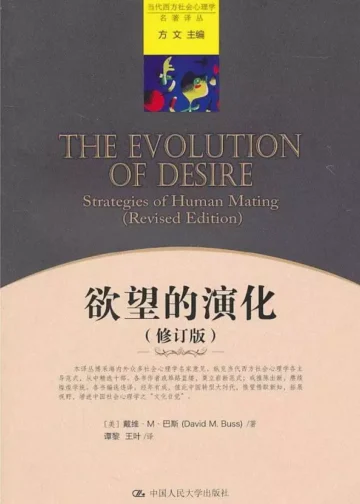
David Buss is a famous evolutionary psychologist, and the evolutionary-psychology framework has particularly strong explanatory power when it comes to human mate choice. In The Evolution of Desire, Buss takes that little matter between men and women apart from the inside out with evolutionary psychology.
BOOK 08 That’s Disgusting!: Uncovering the Mysteries of Repulsion
For “avoiding harm,” I recommend That’s Disgusting!: Uncovering the Mysteries of Repulsion, by Rachel Herz, a psychologist who studies smell and the psychology of eating.

The book starts with disgusting foods and gradually reveals the value of the emotion we call “disgust” or “repulsion,” and what it really means for human survival.
After reading it, you may even find that human morality and the norms of civilization were, to a considerable extent, built around “disgust.”
Animals seem to have only the physiological response of vomiting, while humans alone evolved vomiting into the emotion of disgust and repulsion. It may be uniquely human. So using “disgust” as a starting point for thinking about our instinct to avoid danger is a very good angle.
The fourth dimension of psychological structure: intention
Next, let’s talk about the fourth major dimension of human psychological structure—“intention,” the intention in free will. The central question here is: To what extent do people possess free will and get to decide what they do?
BOOK 09 The Hidden Self: The Secret Life of the Brain
First of all, a great many human actions are automatic responses. What controls them is the subconscious—the instincts our genes gave us. Free will is ineffective for a large portion of these behaviors.
When it comes to the human subconscious, the most interesting and thought-provoking summary may be neuroscientist David Eagleman’s The Hidden Self: The Secret Life of the Brain. Yes, David Eagleman is the author of The Species That Defies the Ordinary, the book we just finished discussing on our show.

You probably know Freud’s iceberg theory: 90% of an iceberg’s volume is underwater, and only 10% floats above the surface where we can see it. Human consciousness is similar: only a very small part of consciousness, the part above the surface that we can perceive, is visible; beneath the surface is the subconscious.
The subconscious is enormous. Although we are unaware of it, it determines many of our behaviors.
When Freud proposed this metaphor, he actually didn’t have much scientific evidence to offer. If you want scientific evidence, you have to look in The Hidden Self, which uses a large number of psychology and neuroscience cases to explain how people act and make decisions under the control of the subconscious.
This book presents the scientific version of the “iceberg theory.”
BOOK 10 Willpower: Rediscovering Our Greatest Human Strength
If there are automatic behaviors, then of course there are also behaviors controlled by consciousness. That is where free will gets to flex its muscles. Free will shows itself most powerfully when people use willpower to fight their instinctive impulses.
For this theme, I recommend Willpower: Rediscovering Our Greatest Human Strength, by Roy F. Baumeister, a psychology professor at Florida State University. It’s a bestseller, so you may already have read it.

In this book, the author summarizes several famous conclusions. Some of them have attracted controversy in recent years.
For example, one experiment in the book showed that willpower is a lot like a muscle: use it too much and it gets tired. If you use too much willpower at once, it gets depleted. In recent years, some researchers have found that this result cannot be replicated in the lab. The debate over it is still ongoing.
Old conclusions being overturned by new evidence is extremely common in psychology. Human nature is far too complicated, and our understanding of many aspects of it is only just beginning. Every time new evidence overturns an old conclusion, our understanding of the issue has actually moved one step forward.
Science never claims that it has discovered everything or explained everything. As long as the new evidence is solid enough, science can calmly accept an old view being overturned—provided, of course, that your evidence is solid enough.
Science is capable of admitting mistakes. That is its greatest strength.
For a relatively young discipline like psychology, moving forward by admitting mistakes is simply everyday life. Willpower and some of the controversies it sparked are a perfect example of this scientific routine.
I’m also posting here the controversies surrounding some of the experiments in Willpower:
https://www.guokr.com/article/441263/
The fifth dimension of psychological structure: groups
Finally, let’s talk about the fifth major dimension of human psychological structure—“groups,” as in group life. Humans are social animals. We have an innate need for social connection, as well as many psychological mechanisms for interacting with others in groups.
Among these mechanisms, one of the most important may be the “psychology of cooperation.” The old saying goes that if everyone looked out only for themselves, the world would come to an end. People often have the impulse to maximize the interests right in front of them; humans seem to possess an instinct to benefit themselves at others’ expense. And yet, why are we also so good at cooperating?
From families and villages to cities, from companies to nations, humans have built what may be the most complex system of cooperation on Earth. How did we acquire this astonishing capacity for cooperation?
BOOK 11 Super Cooperators
Super Cooperators offers part of the answer. Its author is Martin A. Nowak, a professor of mathematics and biology at Harvard University. He is a scholar of almost godlike stature, publishing in Nature and Science as casually as most people eat three meals a day.

In Super Cooperators, he lists at least five forces that drove humans to evolve cooperative behavior.
Martin A. Nowak’s mathematical foundations are extraordinarily strong, and much of his research is done through mathematical modeling. So the more mathematical sections of Super Cooperators can be a little difficult. But even setting those aside, the remaining narrative passages are vivid and fascinating enough.
BOOK 12 Not by Chance
Within the dimension of human sociality, the second book I want to recommend is Not by Chance. It may be the most distinctive book on the list—it’s an autobiography. Its author is Elliot Aronson, one of the world’s leading social psychologists.

What’s remarkable about this book is that it is both an autobiography and a popular science book about social psychology.
Aronson very skillfully weaves some of social psychology’s most important insights and conclusions into the story of his own life. You watch a major academic’s life rise and fall, and learn social psychology at the same time—a wonderfully strange reading experience.
I also think this book is a science-based motivational book. As its title suggests, what a person ultimately becomes is not by chance (or by worshipping every kind of chance). It tells us that a person can completely break free from the constraints of unhappy childhood experiences and personality flaws, and achieve self-fulfillment through continual self-improvement.
That brings us to the end of all 12 recommendations.
All 12 books have their own distinctive styles: essayistic writing in The Geography of Genius, autobiography in Not by Chance, and dense, hard-science popularization in Thinking, Fast and Slow.
The 12 books also cover a wonderfully broad range of content. They span the major research areas of psychology while reflecting its intersections with many other disciplines.
In The Consciousness and the Brain, we see psychology intersecting with neuroscience and philosophy; in Thinking, Fast and Slow, psychology intersecting with economics; and in Super Cooperators, psychology intersecting with mathematics.
At the same time, the 12 books are not neatly separated from one another in content. There is a great deal of overlap and cross-pollination among them.
For example, “free will” is a shared underlying theme in several books. And behind almost every book lies the idea of evolution.
One of the great pleasures of reading is watching different books collide over the same idea, or watching them verify one another—starting from different angles and arriving at a common principle, the “unity of the great way” I’ve mentioned on my show.
Leave a Reply