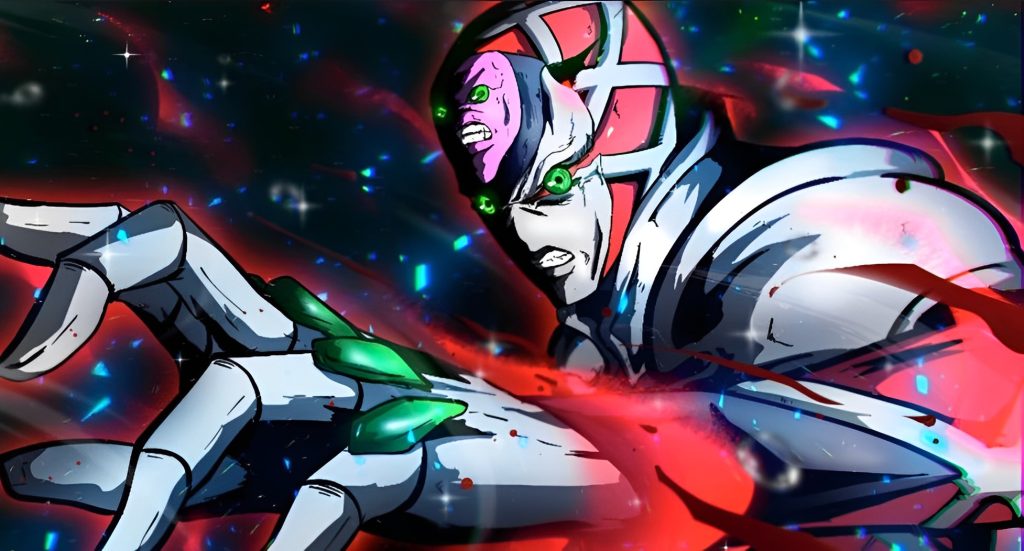
This article analyzes a small detail in JOJO. JOJO fans, please don't skip this one.
In my previous article about JOJO’s Bizarre Adventure, I discussed how the battle system evolved, and mentioned that Part 5 ends with a one-sided final battle against the BOSS. As I said then, the reason is that King Crimson, the BOSS’s substitute, is so absurdly overpowered that even the author couldn’t think of a reasonable way to finish him off. So he had to let the protagonist’s substitute, Gold Experience, evolve into the realm of Requiem and instantly kill the BOSS. (Honestly, this super-substitute was so shameless it could instantly kill practically any substitute that had appeared in JOJO.) King Crimson’s ability is not only powerful but extremely complicated. Many readers—and perhaps the author himself—can’t quite explain what this substitute is doing. This article is an attempt to analyze it.
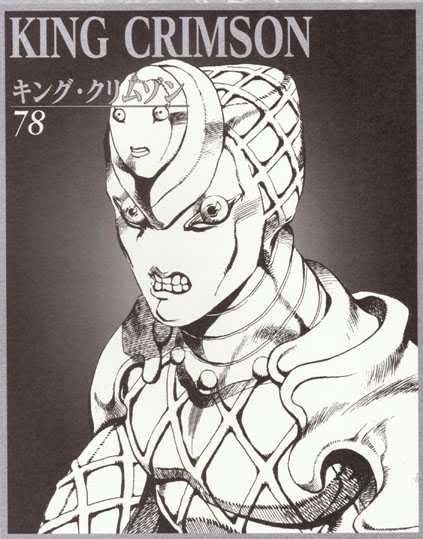
King Crimson’s ability can roughly be described like this: it can predict the future a few seconds ahead, and delete a short segment of that future.

As a rule established since Part 3, every BOSS’s ability is related to time. On the surface, “predicting the future” clearly sounds like a time-related power. But judging by King Crimson’s performance in the few fights he joins, his ability can be explained another way. In my interpretation, it actually has little to do with time (I need this detour because otherwise we can’t cover everything King Crimson can do):
King Crimson is actually a “world simulator”—or, more precisely, a supercomputer that can virtualize an entire world and calculate its trajectory.
When King Crimson activates its ability, the entire world disappears and is virtualized as a program inside this supercomputer. The world’s state just before virtualization—including all physical and mental existence—becomes the computer’s “input.” The world can run in this virtual program for at most 10 seconds. King Crimson itself (that is, the BOSS) can inspect the trajectory of the world running inside the simulator at any time.
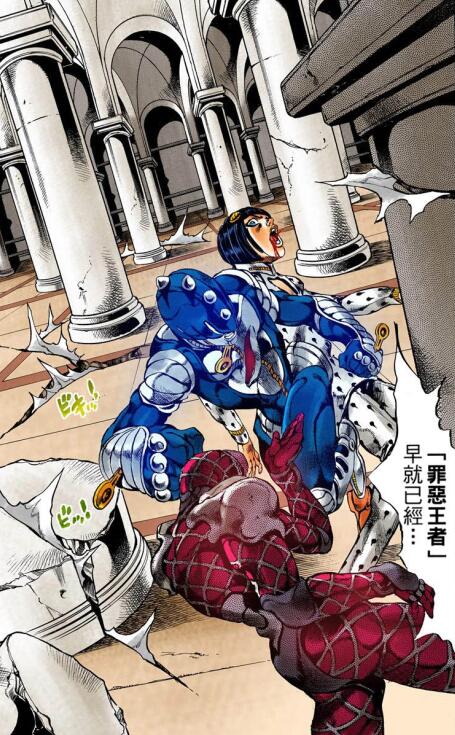
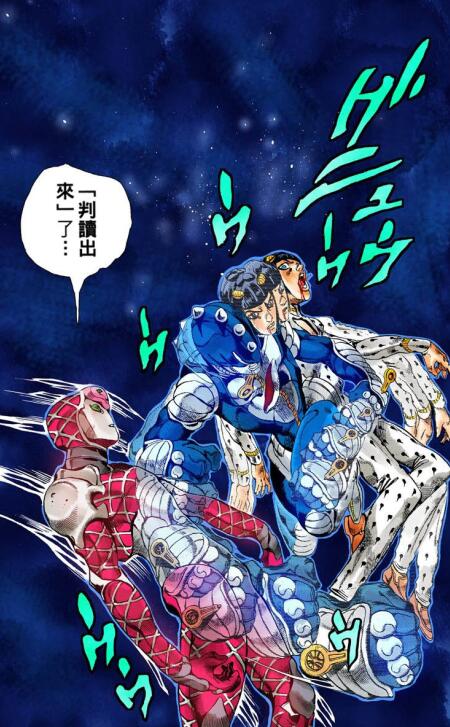
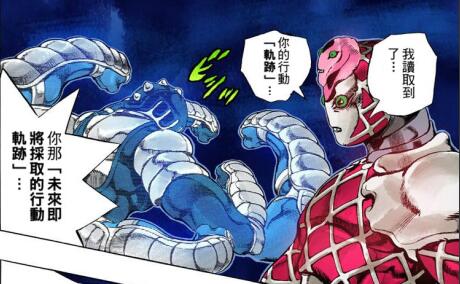
When the 10-second limit is reached, and King Crimson’s ability ends, the world is restored from the simulator back into the real world.
—Ugh, that probably sounds even harder to understand than predicting or deleting the future. But I need this detour because otherwise we can’t cover everything King Crimson can do.
King Crimson’s ability has three modes—
1. Mode One: the Spirit-Flesh Unity Mode
Since King Crimson itself can inspect the trajectory of the world in the simulator at any time, it possesses what people call the ability to predict the future. Since the simulator can run the world for only 10 seconds at most, it can predict only roughly 10 seconds into the future.
Suppose the world enters simulator mode at point A and runs for 10 seconds. The BOSS can see what will happen during those 10 seconds if the world continues along its original trajectory.
Let’s call the point 10 seconds later point B. Here’s the question: when King Crimson’s ability ends and the world is restored to reality in the state it had at point B, does the BOSS still have his ability to predict the future?
Obviously not. That would just mean the BOSS and the whole world experienced the same 10 seconds together, which would be pointless. So for the BOSS’s prediction ability to activate, the world has to start from the state at point A.
In this mode, King Crimson itself is merely a spectator, calmly watching the future.
The “Spirit-Flesh Unity Mode” (why call it that? Keep reading and you’ll see) can be summarized as follows—
Virtualization start point: A
Virtualized duration: up to B (10 seconds)
Reality restoration point: A
BOSS during virtualization: a calm, handsome man
Everyone else during virtualization: completely unaware
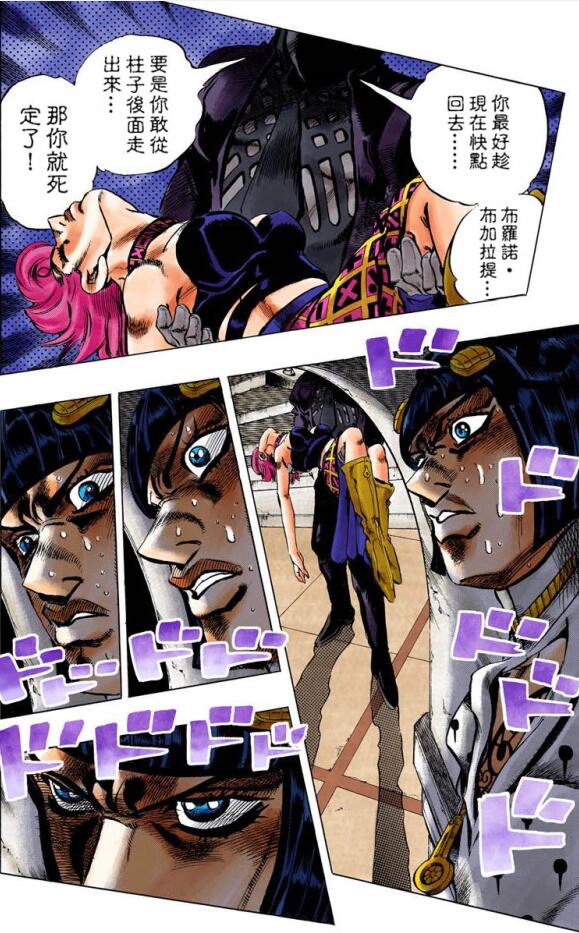
The Part 5 BOSS used this mode many times. For example, during Bucciarati’s first attempt to assassinate the BOSS, the BOSS “predicted” where Bucciarati was hiding and warned him not to make pointless attacks.
He also activated this ability while fighting the leader of the assassination team through his second personality:
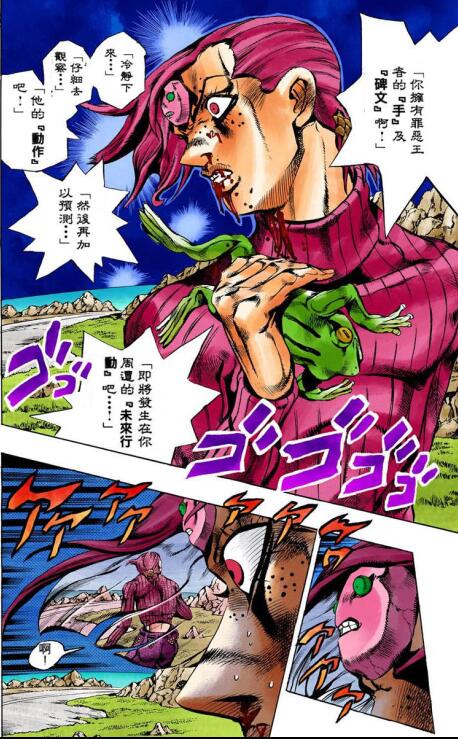
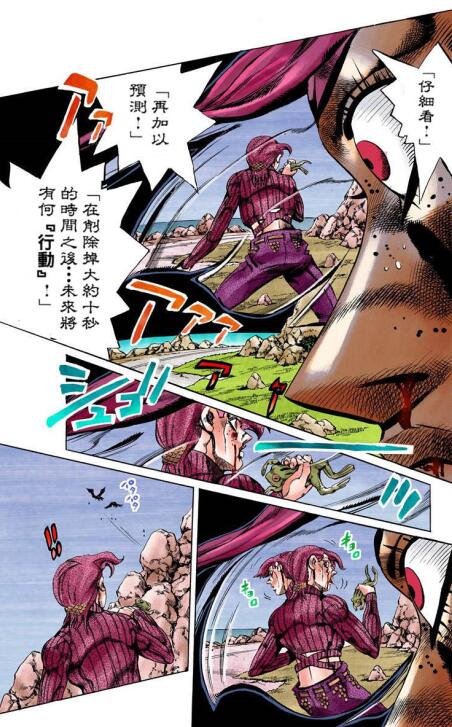
King Crimson | Can the future of “prediction” be changed?
Can it?
The BOSS repeatedly says that the future he sees is destined to happen, but this is just the author’s sloppy thinking. If every future is predetermined, isn’t King Crimson’s ability basically the “prophecy manga” gag from Part 3, with a god doing all the work? And that god, as every manga reader knows, is only there to adjust the atmosphere.
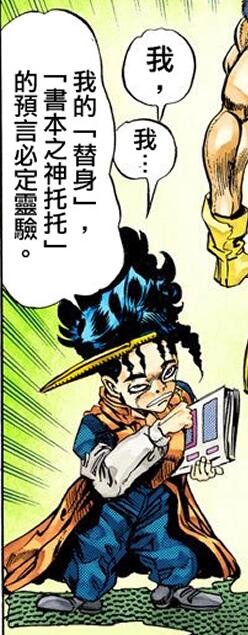
Suppose I am the BOSS, and my King Crimson sees that, 10 seconds from now in the virtual world, someone beside me will trip over a rock and fall. If I sit there and do nothing, then sure enough, 10 seconds later that person will trip and fall.
What I see is indeed certain to happen as long as I don’t visibly interfere. But if I walk over and kill him first, the dead man obviously won’t trip anymore.
Besides, many facts in Part 5 show that the future can be changed. In the fight where Bucciarati sneaks up on the BOSS, the BOSS must have predicted that if he simply walked over, he would be ambushed a few seconds later. So he stopped and warned Bucciarati (though he hadn’t actually seen it yet) not to attack. That “warning before the fact” had plainly already changed the future.
Actually, nothing here changed the future, because in my interpretation the future King Crimson sees is merely a virtual result calculated by a computer from the current input. Whether it really happens depends on whether you add new variables—interference—after seeing the result.
2. Mode Two: the Spirit-Flesh Separation Mode
In Part 5, whenever the BOSS activates his ability, there is often a “collective daze” across the entire world:
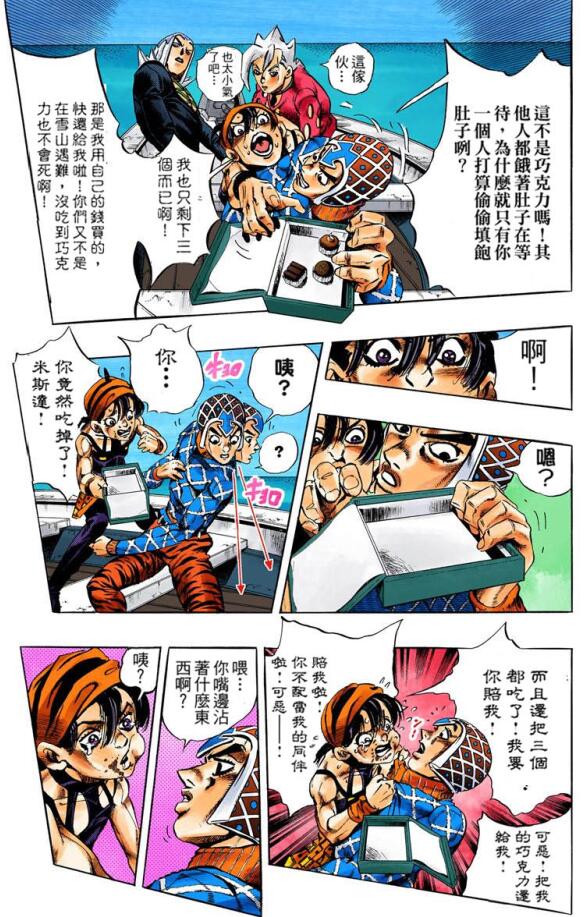
—Time suddenly jumps forward a few seconds. Your body’s posture and the objective state of other things have clearly moved into the future, but your consciousness is still several seconds behind.
This is when the BOSS’s second mode activates.
Let’s first summarize Mode Two (the Spirit-Flesh Separation Mode):
Virtualization start point: A
Virtualized duration: 10 seconds, ending at B
Material world (including people’s bodies and the whole physical world) restored to reality at: B
Spiritual world (people’s souls/consciousness) restored to reality at: A
BOSS during virtualization: usually takes action
Everyone else during virtualization: carries on as usual
Everyone else after virtualization ends: suddenly loses several seconds of memory
In Mode Two, suppose the world disappears at point A and is virtualized as a running program. At the point B, 10 seconds after A, the world returns to reality. What happened between A and B?
The answer is: for the vast majority of events in the world, everything is normal, exactly matching the trajectory that should have occurred in the real world.
Before point A, you were taking your first sip of water; after point A, the you moving along the world’s trajectory continues with the second and third sips. Before A, you were doing the calculation 3; you got 373-3=370 and 370-3=367; after A, the you in the world’s trajectory continues with 367-3=364, and so on. I use the subtract-three task often used in psychology experiments to draw attention: people in this trajectory-world aren’t mindless bodies shambling around. They have brains, just as they do in the real world. Your soul, thoughts, and consciousness are also input variables for King Crimson. I stress this because many friends think people are unconscious between A and B. I disagree.

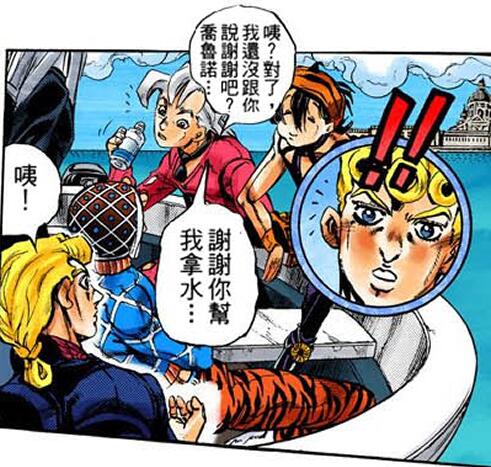
All right, that’s it. Up to this point, the ability has done nothing; everything is exactly the same as in the real world.
The key is point B. When the trajectory-world runs to point B and outputs, the material world inherits the result of the trajectory before B and returns to reality. In other words, the material world jumps 10 seconds into the future.
But the spiritual world—people’s consciousness—jumps back to point A. That means you have no memory whatsoever of the trajectory between A and B. You were taking your first sip of water, then suddenly realize you’ve already drunk half a glass, with no memory of drinking it. You were calculating 370-3=367, then suddenly discover you’ve already reached 358. A sports referee presses the stopwatch, then suddenly realizes the athlete has crossed the finish line and he has already pressed the stop button. You clearly just did all those things, yet have no memory of doing them.
At this point, you may notice that this ability still doesn’t seem very useful. Its apparent function is merely to cause a universe-scale collective daze; at least in actual combat, it doesn’t seem decisive.
For example, if a strong fighter is battling the BOSS at point A and the BOSS activates Mode Two, the strong fighter in the trajectory-world gives the BOSS a sound beating. At point B, the fighter suddenly realizes: Wait, why haven’t I attacked yet? Why is the BOSS across from me already bruised and swollen? But who cares—keep punching…
So this ability isn’t very useful against a super-powerful opponent, but against an opponent whose close-combat strength isn’t overwhelming, it works just fine. In particular, it exploits the fact that people have no memory of A to B, letting the BOSS hide while observing his opponent.
For example, the BOSS’s sneak attack on Narancia uses exactly this feature. King Crimson, hidden on one of Bucciarati’s teammates, suddenly activates Mode Two, sneaks up and kills Narancia, then quickly hides himself while ending Mode Two. Even if someone else in the group happens to see him during the ambush, as long as he hides and ends Mode Two before they attack, he is safe. Their consciousness returns to before Mode Two began, so they cannot use clues from the trajectory-world to infer where King Crimson is hiding.
Here, King Crimson’s strength, the team’s ability to respond to a sneak attack, and their close-combat abilities are not especially impressive. If the team had someone like Jotaro, King Crimson couldn’t succeed with this ability alone.
If this were all King Crimson could do, then apart from making opponents regularly dazed, it would offer no overwhelming advantage in real combat.
3. The Terrifying Third Mode: “Where Did the BOSS Go?” Mode
Now we come to King Crimson’s genuinely terrifying third mode. On the basis of Mode Two, besides doing everything described above, King Crimson can also calculate the trajectory of the world while the BOSS does not exist.
In other words, let the world enter the trajectory-world at A, but exclude the BOSS! The trajectory-world runs without the BOSS, and at point B the BOSS reappears together with the world.
To summarize:
Virtualization start point: A
Virtualized duration: 10 seconds, ending at B
Material world (including people’s bodies and the whole physical world) restored to reality at: B
Spiritual world (people’s souls/consciousness) restored to reality at: A
BOSS during virtualization: The BOSS is gone!
Everyone else during virtualization: Where the hell did the BOSS go?
Everyone else after virtualization ends: Why is the BOSS’s fist suddenly stuck in my stomach?
Put simply, this ability gives the BOSS invisibility on top of the Second Mode (and not just invisibility—he disappears completely)!
As for where the BOSS reappears when the world returns to reality at Point B, the author never spells it out. But judging from what we see, he can’t reappear too far from where he disappeared at Point A (it seems to be no more than the distance he could walk during the interval from A to B). Otherwise, if he disappeared at Point A and reappeared at Point B on the other side of the world, he’d truly have a flawless, invincible Stand.
Now let’s look at what happens to the formidable opponent fighting the BOSS when the Third Mode is active. At Point A, the real world enters the Trajectory World, and the formidable opponent in the Trajectory World discovers that the BOSS is gone, so he starts looking everywhere.
What is the BOSS outside the Trajectory World doing at this point? He’s looking at the result of a world in which he doesn’t exist.
Suppose that, when the BOSS sees Point B, he knows the frantic opponent will appear at a particular spot. He then places the fist that currently doesn’t exist in the Trajectory World at that spot and waits for the opponent. Once Point B arrives, the world and the BOSS’s fist return to reality together, and the opponent suddenly finds the BOSS’s fist buried in his stomach.
From the opponent’s perspective, one moment he’s watching the BOSS right in front of him, ready to hit him; the next, he suddenly discovers that the BOSS behind him has punched straight through his stomach.
That’s what is truly terrifying about King Crimson. No one can fight an enemy who disappears completely, then can puncture you at any moment with an invisible fist. If you run into him, the only thing you can do is flee in one direction; as long as you run fast enough, King Crimson may not be able to catch you. The moment you stop, though, just wait for a fist to appear out of nowhere and punch through your stomach.
That’s exactly what happened the first time Bucciarati fought the BOSS:
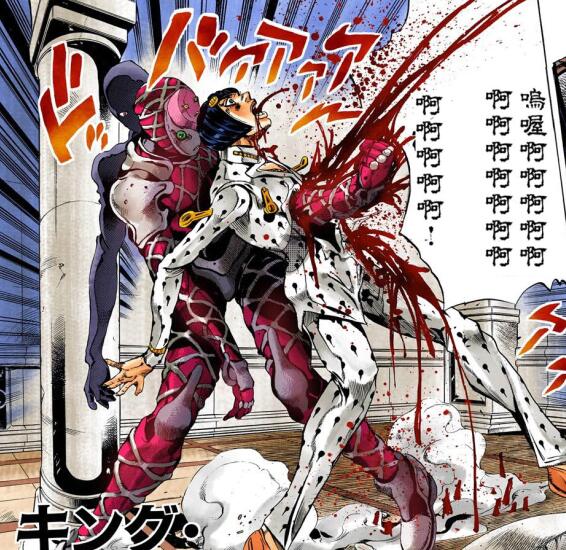
The so-called “time deletion” ability actually refers to the Third Mode. For example, in the BOSS’s fight with the leader of the Assassination Squad, the BOSS uses “time deletion” to dodge Aero Smith’s bullets: just before a bullet is about to reach his body, he activates the Third Mode and disappears. In the Trajectory World, the calculated result is that the bullet continues flying as if the BOSS weren’t there. Once the bullet has passed through the area occupied by the BOSS’s body, he deactivates the Third Mode. The apparent result is that the “process” of the bullet passing through his body has been deleted.
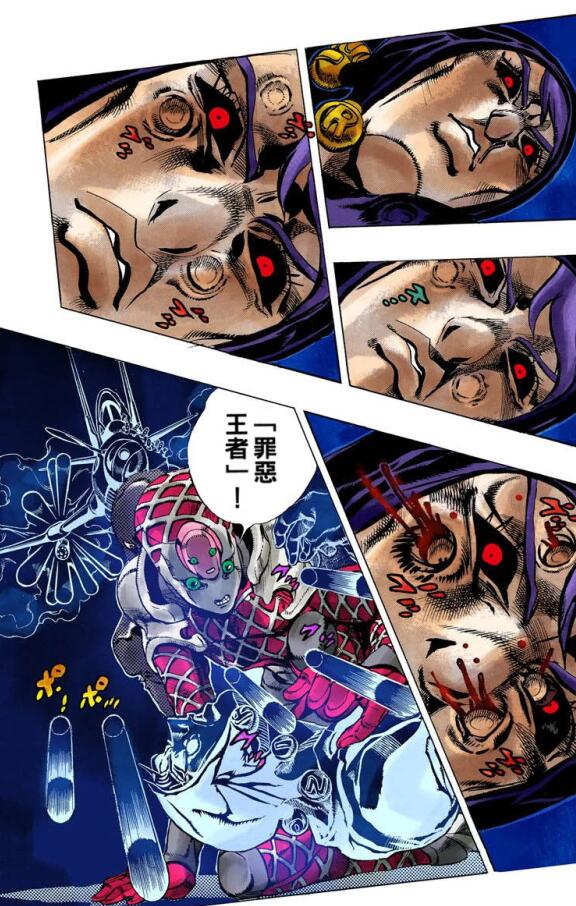
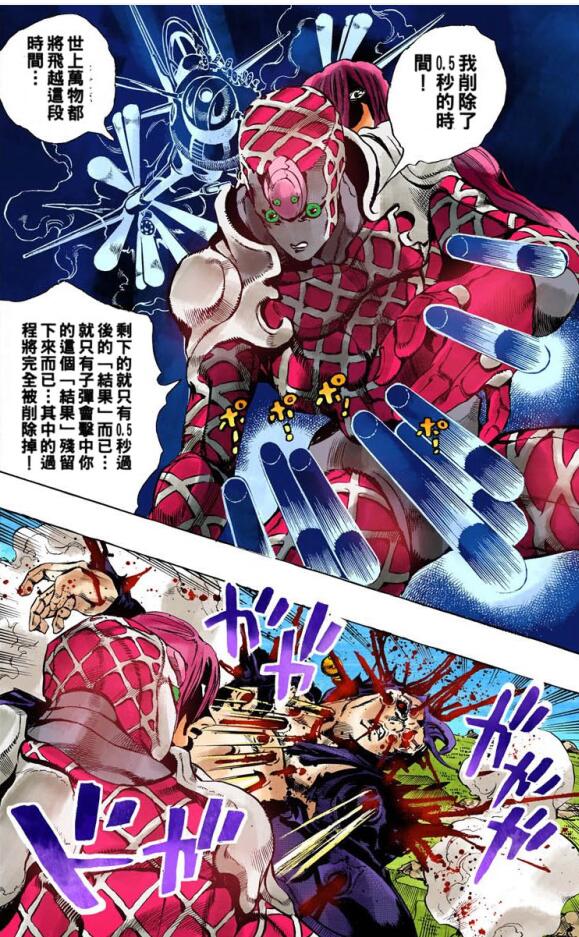
Using the three modes above separately or in combination basically explains all the situations in which the BOSS fights in Part 5.
With these three modes at his disposal, the BOSS is practically invincible. Since the Stand’s balancing principle has been so thoroughly demolished, the author simply decided to go all the way: let “shamelessness” defeat “invincibility”, and have the protagonist’s Stand, Gold Experience, evolve into Gold Experience Requiem and take down the BOSS.
But what exactly is this shameless Gold Experience Requiem? I mentioned it in passing in my article “If Superman Is So Strong, How Can Batman Fight Him?“. I won’t go into it again here.
Version history
This series was originally called "JOJO's Bizarre Adventure: An Absurd Epic" and has been extensively revised. The original was published on Mtime and MSN Blog; the original link no longer exists.
Leave a Reply