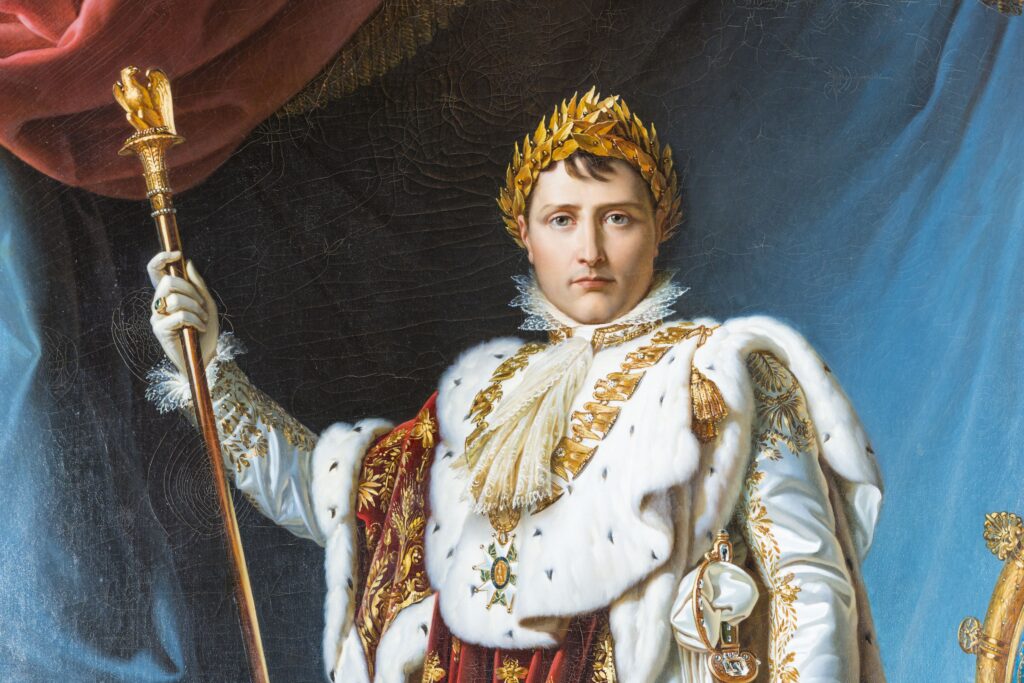
It is said that a general once remarked in front of Napoleon that he felt a little awkward about being so much taller than the emperor (Napoleon was definitely considered short in Europe, standing under 1.7 meters).
Napoleon replied: “You may be taller, but I am greater.” (You may be taller, but I am greater.)
This anecdote reflects a widespread belief:
Short men work harder to make up for their disadvantage in height by gaining advantages through their actions—for example, accumulating more wealth and attaining higher social status and more power.
This is what is known as the “Napoleon complex.”
Why does the Napoleon complex exist?
The most popular explanation used to be the “inferiority complex theory” proposed by the psychoanalytic master Alfred Adler: after people become aware of their shortcomings, they sometimes concentrate their efforts on compensating for that particular shortcoming, and may even turn a disadvantage into an advantage. Adler called this “overcompensation.”
Evolutionary psychologists understand the “Napoleon complex” from another angle: they believe it may well be related to sexual selection between men and women. The Napoleon complex may be a complex exclusive to short “men.” Height is a significant mating advantage for men, so when faced with the “threat” of taller men, short men feel an urge to compensate for this disadvantage in areas such as resources and status.
A paper recently published in Psychological Science tested this hypothesis from evolutionary psychology.
In the paper’s preliminary experiment, the researchers first compared men and women.
Participants first had to answer one question: “Do you often feel short?” They rated it on a scale from 1 to 7.
Then, participants completed a “Dictator Game” alone in a small cubicle. The Dictator Game is one of the most common money-allocation games in decision-making research: a participant divides a sum of money between themselves and another person, with complete control over the decision. Whatever amount the other person is given is what they get, with no right to object. In this preliminary experiment, participants had an envelope containing 8 one-dollar coins in front of them. They decided how many to keep for themselves and how many to give to an unseen stranger.
For female participants, there was no correlation between how short they felt and how they divided the money. For male participants, however, the more often they felt short, the more money they kept for themselves when dividing it—in other words, they tended to claim more resources.
This preliminary experiment showed that the Napoleon complex really is exclusive to men.
Next came several formal experiments. The general procedure was as follows:
In the first formal experiment, the researchers introduced competition between men. When playing the money-allocation games, each pair consisted of one tall man and one short man. Before dividing the money, the two men underwent a series of physical measurements together, while the researchers loudly announced the results. Of course, most of the measurements were just a ruse; the one that really mattered was height, which primed the participants’ awareness of height.
After the measurements, the tall and short men were paired to play two money-allocation games. The first was the “Dictator Game” from the preliminary experiment. Compared with the tall men, the short men kept more money for themselves. The “Napoleon complex” appeared.
The second game they played was called the “Ultimatum Game.” In this game, one person first proposes how to divide the money, but the other has veto power. If the other person accepts the proposal, they divide the money accordingly; if they reject it and veto the proposal, neither person gets a penny. In other words, if the proposal is not fair enough, the other person can choose mutual destruction.
In the Ultimatum Game, however, the “Napoleon complex” did not appear: the money-splitting proposals made by tall and short men did not differ.
This seems to suggest that short men are actually quite clear-headed. Only when they do not have to worry about a tall man choosing mutual destruction with them do short men really go after more resources.
In the second formal experiment, the researchers had participants play another game in which they could punish their opponent by adding more hot sauce to their food. The short men did not directly punish their opponents with hot sauce simply because they felt disadvantaged in height. This suggests that the “Napoleon complex” does not seem to lead short men to engage in direct physical attacks on tall men; they simply prefer to claim resources in more indirect ways.
References:
Note
- This series of “New Psychological Insights” articles was written at the time to accompany content related to Zhichao Wei: New Psychological Insights. These short popular-psychology essays and miscellanies were published on the now-closed platform Fantún, and the original link no longer exists.
Leave a Reply