
A few days ago, I read an excellent essay by Li Xiaofei about the common ground between Chinese wuxia culture and American superhero culture (Guardians of the Galaxy | How Americans Make Wuxia Films). He argues that wuxia and superheroes both reflect people’s inner fascination with and longing for the “superhuman.” I couldn’t agree more. One wears the outer garment of traditional Eastern culture, the other is wrapped in science-fiction elements; their surfaces are worlds apart, but their spiritual cores are remarkably similar. Christopher Nolan’s third Batman film, The Dark Knight Rises, offers a particularly interesting example: a movie that is unquestionably a superhero film on the surface can also be read through a wuxia lens. If we deliberately misread it this way, The Dark Knight Rises is, in its entirety, an American wuxia film.
Before watching The Dark Knight Rises, the brilliance of the second film, The Dark Knight, had largely reinforced my impression of the series as crime films. But after finishing the third, and looking back over Nolan’s Batman series as a whole, I realized that The Dark Knight was actually one spectacular detour, while The Dark Knight Rises finally brought the series back to its proper subject for the finale.
That subject isn’t “crime” at all. It’s “wuxia.” The whole story is really just a tale of a martial-arts school’s grudges and grievances—
Part One, Batman Begins | Apprenticeship and Killing the Master
The story begins with the most important foundational step in almost every wuxia tale: finding a master and learning the art.
In the first film, young Mr. Wayne leaves home, claiming he wants to understand the psychology of evil. But his master, Ra’s al Ghul, casually tosses that goal aside with the line “evil is not complicated,” and instead helps Wayne overcome his inner fear. What Wayne ultimately gains from this journey isn’t an understanding of criminal psychology, but a master, kung fu, and the ability to fight crime with his bare hands.
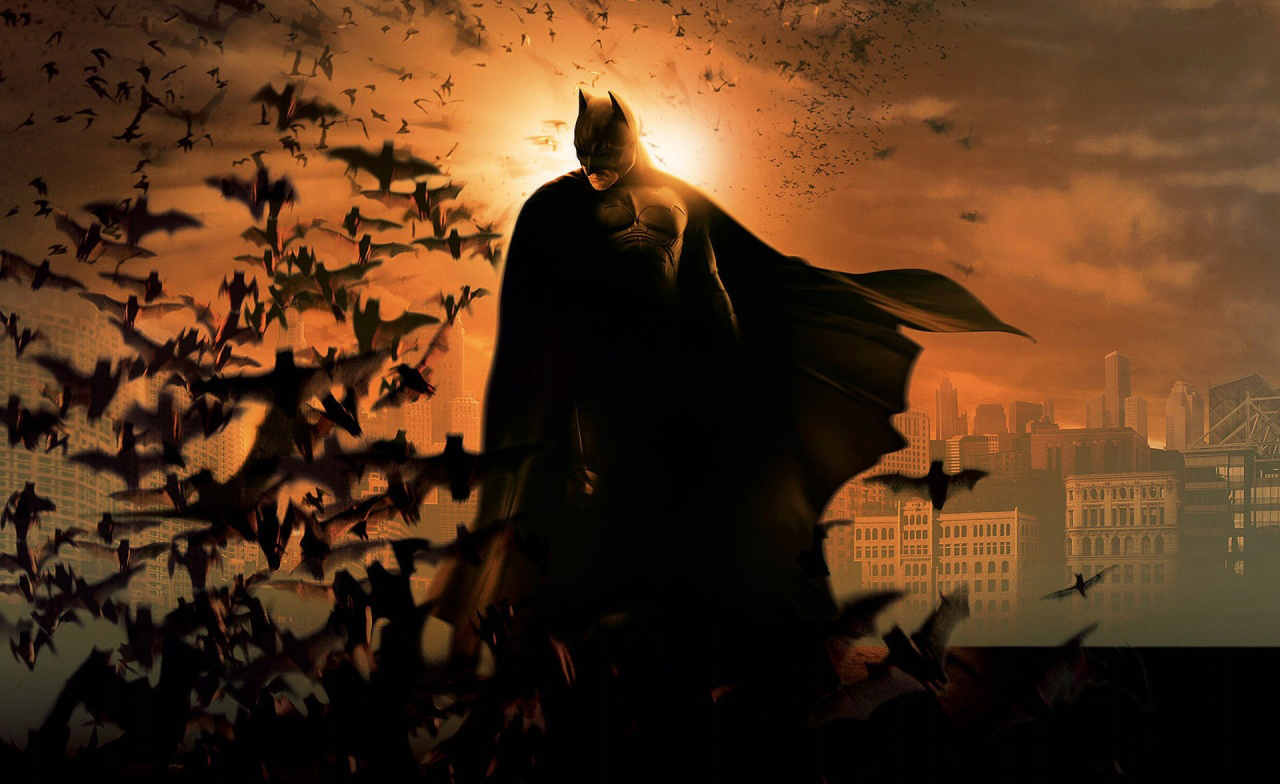
This is the most important foundation of Batman’s existence—”I’ve trained” (the other foundation being “I’m rich”). That’s why young Mr. Wayne can say, with a straight face, that anyone can become Batman, while all the other fake Batmen can do is get beaten up (no money, no training).
And this is really the basic logic of every wuxia film: if you want to uphold justice, you have to be able to beat the bad guys, right?
After “finding a master and learning the art,” another plot point familiar to every wuxia audience follows immediately: “killing the master.” Just as Linghu Chong eventually discovers that his revered master, Yue Buqun, is the real villain, young Mr. Wayne suddenly realizes that the master he loves is actually the BOSS.
Wayne, however, doesn’t agonize over it like Linghu Chong. He simply gets rid of his master.
Part Two, The Dark Knight | Leaving the School
On the surface, Batman has officially graduated after killing his master. But actually, he hasn’t. Wayne has inherited some of Ra’s al Ghul’s important ideas, such as “evil is not complicated.” He naively believes that evil is genuinely easy to understand, that criminals merely use crime as a means to some end, and that once you identify the end, you can deal with the criminal. And in the first film, Batman really does handle the mobsters of the Falcone family this way.
Then the Joker burst onto the scene and kicked Batman back to where the series began. Only after the Joker appeared did Wayne suddenly realize that his understanding of evil wasn’t much deeper than it had been before he left home; some evil remained completely beyond him. In the face of the Joker’s evil, Ra’s al Ghul’s view of evil collapsed in an instant. The Joker even corpse-whipped Ra’s al Ghul.

In the dimension of evil, Ra’s al Ghul and the Joker occupy opposite extremes, with almost no overlap.
Ra’s al Ghul says evil isn’t complicated because he sees it as nothing more than a process he must endure for the sake of his grand objective—just as he later does himself. Restoring balance to civilization is what matters; so-called evil is merely one of the means used to reach that goal. As long as you understand the goal of the crime, the evil itself isn’t hard to understand.
The Joker stands at the other extreme. What is his goal? Crime seems to be nothing but a game to him. If we have to name a goal, it is simply to show how easy it is to bring out the evil in people’s hearts—and isn’t people’s readiness to fall into evil one of evil’s most important features? So the Joker’s only goal, beyond displaying evil, is nothing. This is pure evil stripped of any “goal.” In the Joker’s eyes, it is only a game. But to me, it represents another extreme face of evil: an evil of “strength through desirelessness,” the Zen of evil.
Ra’s al Ghul’s crime is instrumental, serving another purpose: worldly evil. He is the Confucian or activist among criminals. The Joker’s crime, by contrast, is purer art: otherworldly evil. He is the Daoist or artist among criminals.

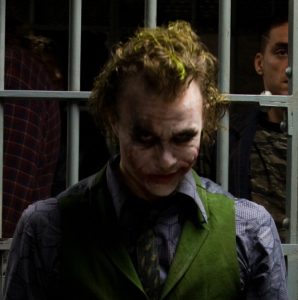
So Ra’s al Ghul emphasizes the meaning of the goal, while the Joker excels at displaying the art of crime.
Batman originally understood only the former kind of evil. The Joker is what showed him evil’s other face.
Only after his encounter with the Joker did Batman truly surpass his school in his understanding and realization of evil. From this perspective, the Joker is actually Batman’s second master.
Part Three, The Dark Knight Rises | The School’s Remnant
That’s why I think Batman only truly becomes his own master—only truly graduates—after undergoing the double training of Ra’s al Ghul and the Joker. Following my original guess, the more mature Batman in the final film would surely have to face unprecedentedly powerful evil. And that power should show itself not only in concrete strength, but even more in the realm of evil itself.
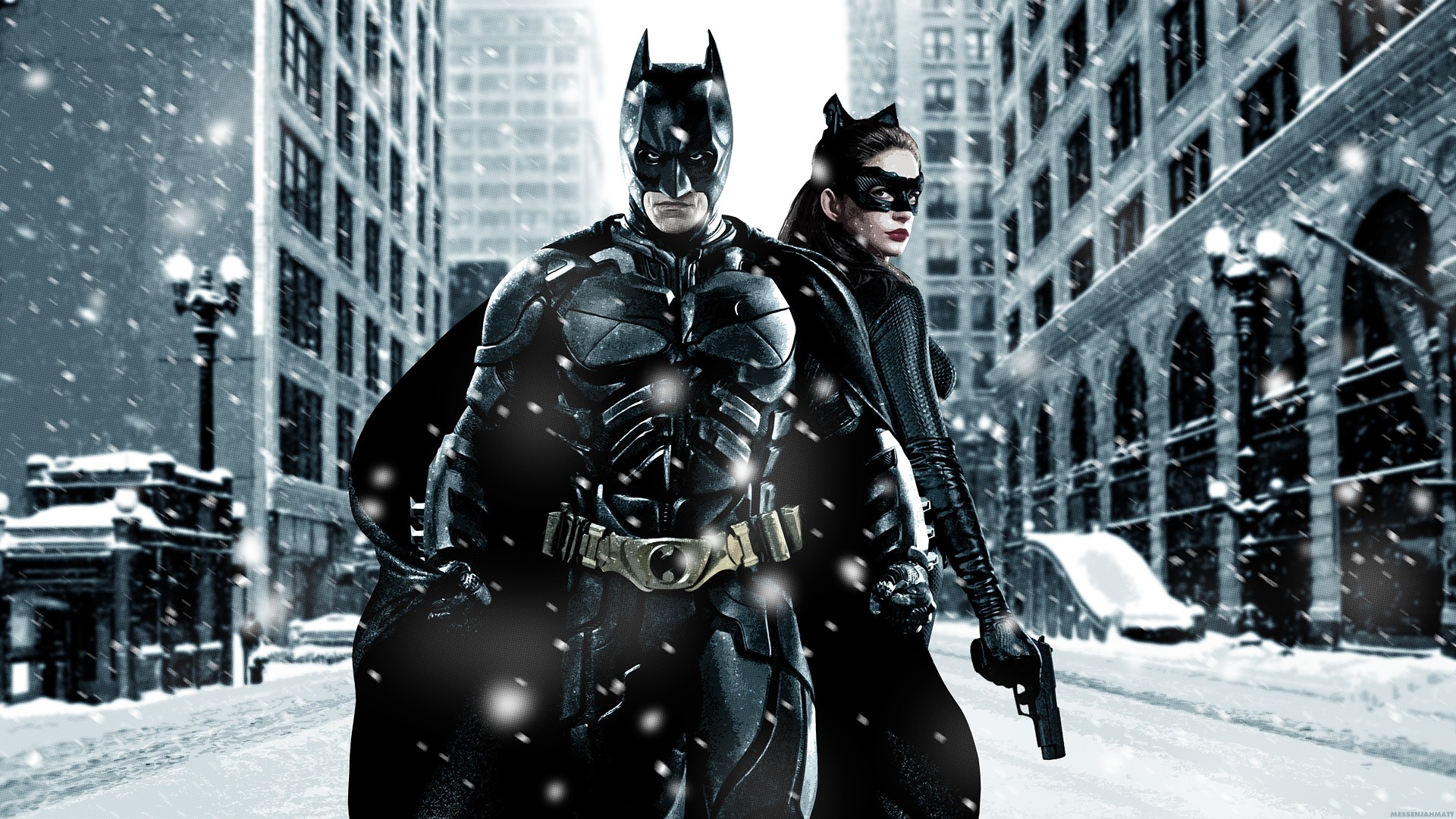
This final opponent should be a grandmaster of evil, combining Ra’s al Ghul’s worldly evil with the Joker’s otherworldly evil, resolutely applying an artist’s criminal techniques to a fanatical goal of remaking the world, using Daoist emptiness to carry out a Confucian project of governing society.
How I hoped Bane in the third film would be such a grandmaster of evil.
Sadly, I was completely wrong. My guess followed the theme of “crime,” so I expected the realm of evil Batman faced in the third film to be the culmination of the first two. But Nolan didn’t think that way. In this third film, he didn’t level up the realm of evil (though he did level up its scale); instead, he upgraded the “martial arts.”
Sigh. In Nolan’s mind, this series really is a wuxia film after all.
I’ll discuss the wuxia side first, then the crime side.
1. The Wuxia Side | Taizu Changquan and the Secret Manual Beneath the Cliff
In terms of identity, Bane is another familiar setup in the minds of those of us who’ve watched too many wuxia stories: the remnant of a martial-arts school. The third film’s villain doesn’t build on the shared foundation of the first two; he seems to skip the second entirely and continue directly from the first: the remnant once expelled from the school has returned to avenge his master.
More importantly, as in many wuxia novels, the remnant of a martial-arts school can usually learn some kind of demonic technique, which leaves him vastly more powerful than his respectable fellow disciples.
Batman and Bane’s first confrontation is the best scene in the entire film. In Nolan’s deliberate arrangement, the action scenes become more “plain” with each film. The action in Batman Begins has a distinctly surreal quality, much of which faded in The Dark Knight. By The Dark Knight Rises, the action is downright clumsy, so plenty of viewers probably won’t like it.
But “clumsy” and “deliberately clumsy” are fundamentally different.
Clumsy is Taizu Changquan; deliberate clumsiness is Xiao Feng performing Taizu Changquan.
In this fight, Bane has the aura of a peerless master: Xiao Feng at Juxian Manor, using supreme skill to perform Taizu Changquan. Every flashy ornament has been stripped from the martial arts, leaving only the bone-crunching force of fist against flesh. The strongest martial power comes from the simplest, most direct killing move—Nolan’s understanding of martial arts is remarkably on point.
Whether or not Bane is a criminal mastermind, at least in martial arts he unquestionably has the bearing of a master.
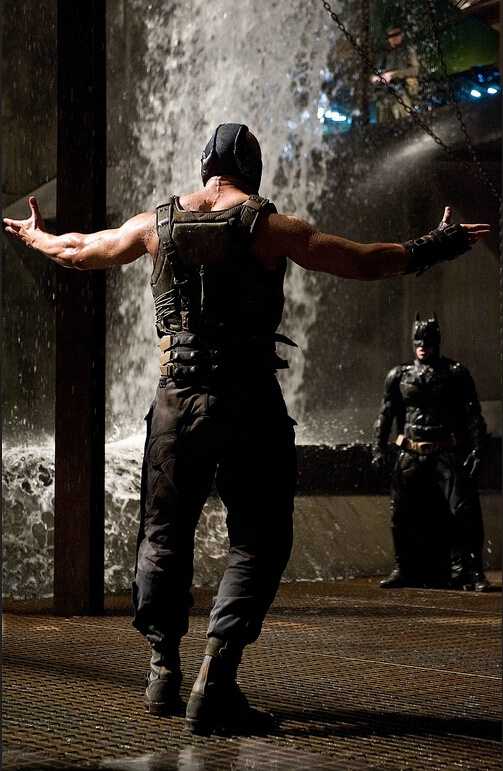
After Batman is brutally broken by Bane, Nolan—now possessed by Tsui Hark—shifts the story into another wuxia staple we know by heart: training beneath a cliff to level up.
If Bane had read wuxia novels when he was young, he wouldn’t have made such a huge mistake and thrown Batman into the bottom of a cliff. Chinese audiences all know that a protagonist thrown off a cliff will not only survive, but will definitely find a secret martial-arts manual at the bottom, master an invincible art, climb back up, and take revenge.
Young Mr. Wayne’s experience at the bottom of that cliff isn’t as straightforward as finding a secret manual, but it is every bit as melodramatic: not only does a miracle doctor help set his broken bones and heal his injuries, a reclusive master also guides him toward enlightenment. At last he masters a superhuman art and emerges at full health.
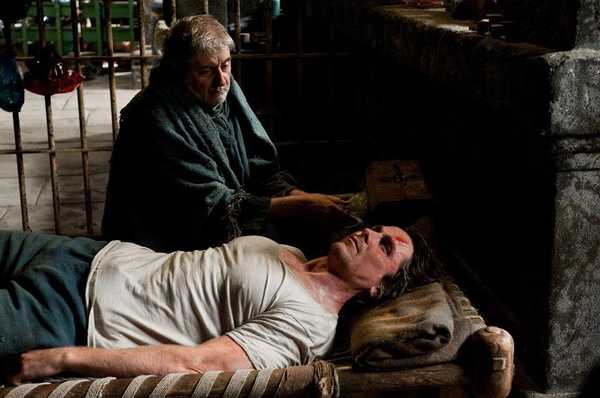
So the central story of The Dark Knight Rises is entirely the standard wuxia-film pattern of meeting a powerful enemy, being defeated, training to level up, and challenging that enemy again—almost completely at odds with what I personally expected from it.
2. The Crime Side | Land Reform and the Neutron Bomb
Now, back to the crime side.
Bane’s worldly evil—that is, the direct purpose of his crimes—is tied to Ra’s al Ghul. His goals are basically twofold: avenge his master and carry on his master’s legacy by destroying Gotham City (at least on the surface, those are the two goals).
So we have to look at why Ra’s al Ghul originally wanted to destroy Gotham City. In the first film, Gotham is corrupt and overrun with criminals; in the film’s words, “the city is rotting.” Faced with a patient whose disease has reached the organs, only shock therapy will do. Since Gotham was corrupt beyond saving, Ra’s al Ghul’s radical action had a certain logical justification. His goal, at least from his own logic, holds up. But by Bane’s time, Gotham has been at peace for eight years and is a fairly decent place—nothing like the terminally ill city it once was. Destroying a city like this no longer has the logical justification Ra’s al Ghul once had.
So Nolan had to find a logically credible foundation for Bane’s criminal objective, and what he found was the wealth gap. The result is that The Dark Knight Rises turns into a story about Bane launching a land-reform uprising of poor peasants in Gotham City, that thoroughly evil capitalist metropolis.
As I remember it, before the film came out Nolan even suggested in an interview that he intended to criticize both the wealthy and the mobs in a revolution, as if he were going to offer a profound exploration of the wealth gap and the revolution that follows from it. But what the film ultimately delivers is merely a little scratch of the itch on both sides.
For one thing, the wealthy in the film are nowhere near so callously rich that they would provoke a revolution. They do, at least, actually hold charity galas. So the psychological basis for Bane’s revolution is incredibly flimsy. For this kind of nonsense, a revolution? Give me a break.
For another, Nolan gives us no details at all about the poor in the film—the future mob—and their transformation from citizens into rioters. Under Bane’s utterly inept incitement, they turn into a mob in an instant.
In the first two films, Gotham City, though facing all kinds of difficulties, still “isn’t beyond saving.” Showing that it is worth saving wouldn’t have been difficult; all it needed was a little space devoted to one or two examples of ordinary citizens’ flashes of humanity. In the first film, that flash is really the little boy in the slums: a few simple looks are enough to make the audience believe there is still something pure and beautiful, something worth saving, in this city. In the second film, it is the humanity shown by the citizens on the two ferries.
But by the third film, the entire population of Gotham has become a blur in the background, and there isn’t a single comparable flash of humanity. In the end, everyone who dares resist Bane is a civil servant—including the police—not a single ordinary citizen. The only character who vaguely resembles such a flash is the orphanage boy who draws the Batman symbol in chalk. But there is nothing on him that resembles the innocent spark of the boy in the first film; he is simply a rabid Batman fan.
So although Bane had no basis for launching a revolution before the revolution began, the course of the revolution nevertheless validates his actions. This contradictory setup strips Batman’s rescue attempt of its logical foundation too: in The Dark Knight Rises, Gotham has become a city that simply isn’t worth saving. If the people in a civilization could so easily turn into a mob as a whole, I would choose to be Ye Wenjie in The Three-Body Problem and wipe out that civilization, rather than try to save it like Batman.
All in all, the film is remarkably muddled in its many setups for the criminal objective—the revolution.
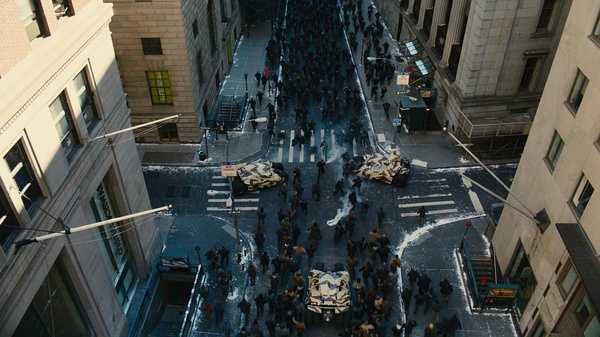
Now let’s look again at the evil of Bane’s origins—in other words, his criminal artistry.
First, personal charisma. Compared with the Joker’s eloquence and string of classic lines, Bane’s speaking ability is a complete disaster. In the first half of the film, when he isn’t talking quite so much, Bane has a very powerful presence, from his swaggering hijacking to the ease with which he KO’s Batman. But that presence basically lasts only until the moment he gives his revolutionary declaration. This speech, with no logic, no substance, and hardly any dramatic force, essentially destroys Bane’s charisma. In the first half, the desperadoes following Bane are portrayed as fanatical believers, death squads ready to follow a single order from him and gladly die. But after that speech, it’s hard to believe that a leader with such mediocre powers of incitement could make so many people follow him with such absolute devotion, because we know that this level of fanaticism cannot be sustained by brute force alone.
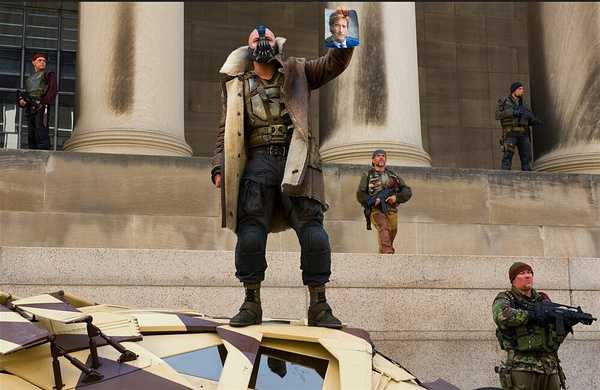
Then there are his criminal techniques. In the previous film, the Joker’s crimes were basically low investment, high return: spending little to accomplish a great deal, nearly bringing down a city with only the cheapest weapons. It was all brains, all technical sophistication. Bane, by contrast, plays the least sophisticated move of all—threatening people with a neutron bomb, that most clichéd gambit, worn out by countless films. The weapon itself has become more technologically advanced, but the criminal technique is still woefully lacking.
So in my eyes, Bane is merely a martial-arts powerhouse, nowhere near the standard of a criminal mastermind.
On the theme of “crime” developed in the second film, the third film’s performance can only be called woefully inadequate. So I had no choice but to treat it as a wuxia story. At least from the wuxia angle, the series ends with a reasonably complete structure.
But none of that is actually the most important reason I don’t much like this film. What disappoints me most is that Nolan’s early attempt to “tell comic-book superhero stories against a realistic background” falls apart completely in this third installment. I discuss that in another piece.
Version history
- Zhihu Q&A version: How should The Dark Knight Rises be evaluated?
Leave a Reply