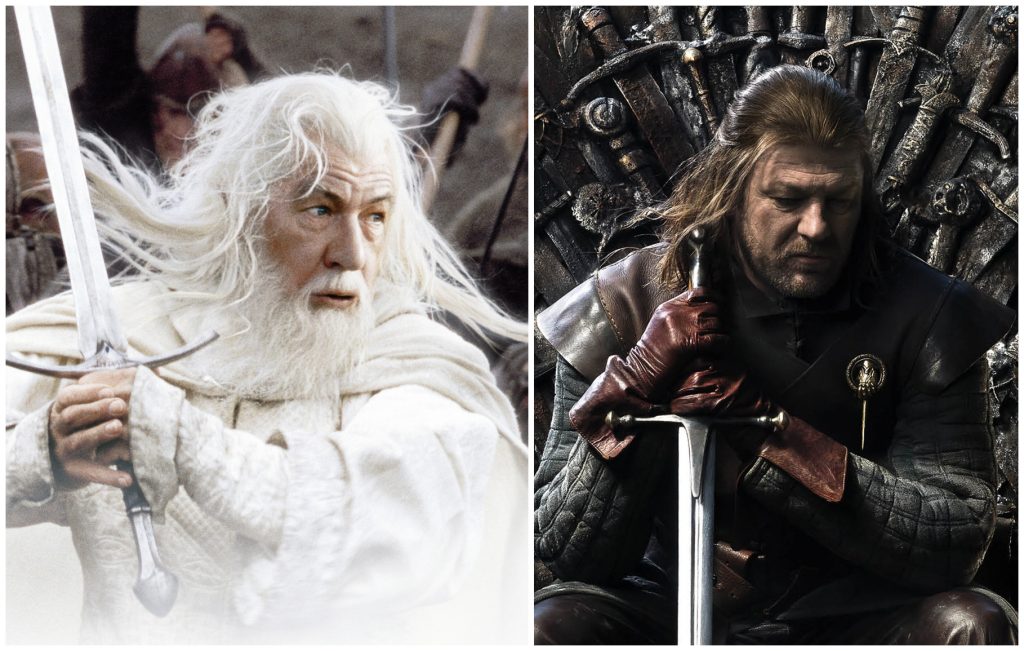
Disclaimer: I still haven't read The Lord of the Rings novels. The comparison below is based on A Song of Ice and Fire, its television adaptation Game of Thrones, and the three films of The Lord of the Rings, and has nothing to do with the original novels.
This article isn’t meant to put down The Lord of the Rings by using A Song of Ice and Fire as a pretext. I had simply just finished watching the A Song of Ice and Fire series and reading the first four volumes of the novels, and then, taking the release of the extended-edition Blu-ray as an excuse, rewatched the three Lord of the Rings films. So it seemed like a good time to put these two representative works of old and new epic fantasy side by side for a simple comparison.
Fans of The Lord of the Rings, please indulge this slightly unorthodox comparison of mine ^_^
I don’t read much fantasy. It was only after reading Qu Chang’s book A Song of Dragons a few years ago that I began to vaguely understand a tiny bit about the history of fantasy novels: before A Song of Ice and Fire, fantasy novels basically followed The Lord of the Rings model. We now call them old epic fantasy. The era of new epic fantasy began with A Song of Ice and Fire as its landmark.
Readers and researchers have already discussed the comparison between old and new epic fantasy at length. But as a reader and viewer who often suffers from what you might call a rather pointless itch, the comparison that interests me most is how these two representative works of old and new epic fantasy handle “intelligence.” Because from one angle, both The Lord of the Rings and A Song of Ice and Fire are stories about war, and war cannot do without intelligence. You could say that all wars are information wars. Yet the characters in the two works treat intelligence in such strikingly different ways, and with such different attitudes.
1. The Information Warfare of A Song of Ice and Fire
In A Song of Ice and Fire, intelligence is given a remarkably important place. Readers and viewers can clearly trace how information travels among the various forces in the story, and across different times and places. Whenever a key event occurs, the spread of the news immediately becomes an important hinge in the plot that follows.
For example, there is a small detail like this in Season 1 of Game of Thrones:
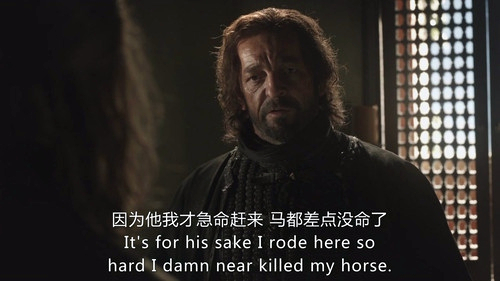
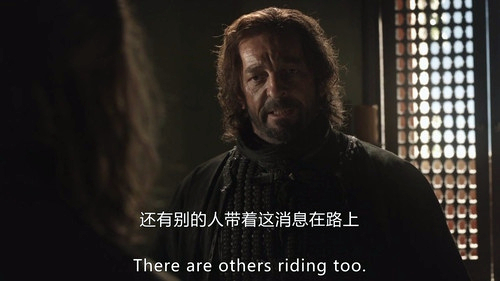
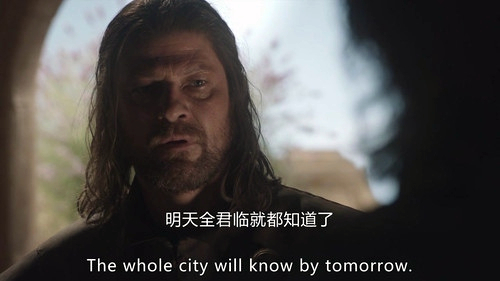
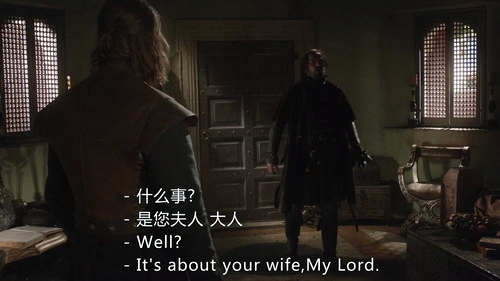
This is only one of the details related to the spread of information that appear practically everywhere in A Song of Ice and Fire. The black brother Yoren works himself to death to reach King’s Landing before everyone else, because he needs to deliver important information about Lady Catelyn to Eddard. And anyone familiar with the story knows that what happens to Eddard later is deeply connected to how he handles that information.
Another example: in A Song of Ice and Fire, Varys—the Master of Whisperers, the “Spider”—is a character who lives with information and makes his living from it, and is one of the central figures shaping the plot. Some of the book’s major developments are closely tied to the intelligence he provides.
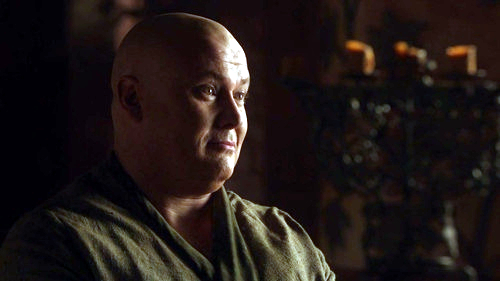
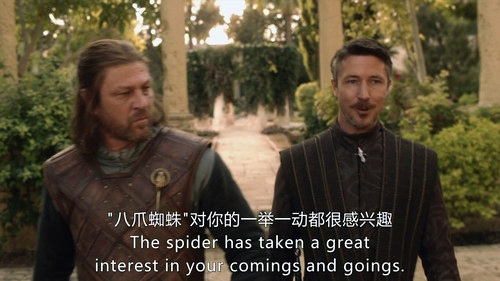
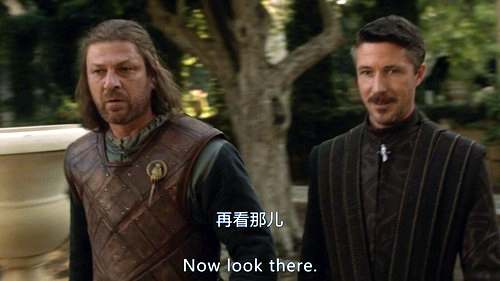
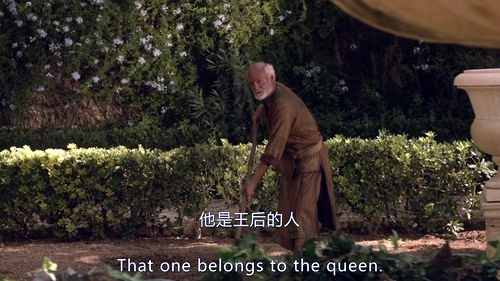
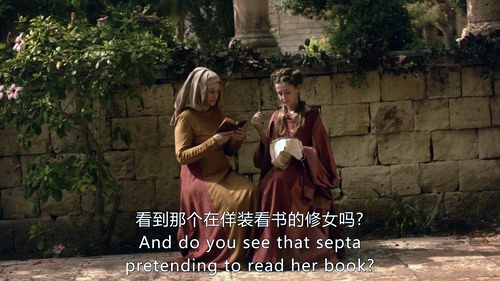
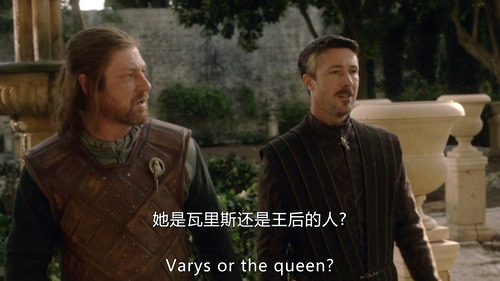
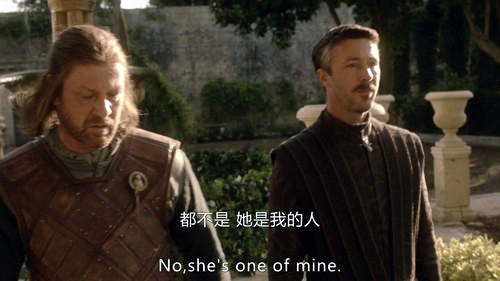
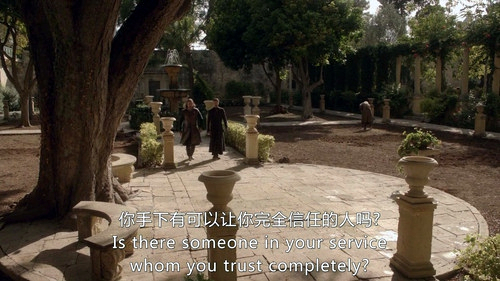
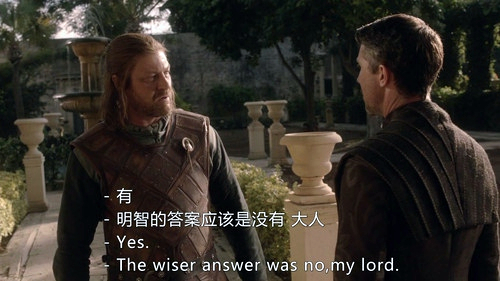
The players who understand the rules of the game of power take intelligence so seriously that whoever holds power in King’s Landing has to rely on it heavily. Whoever has the information has the world. This exchange between Littlefinger and Eddard explains this side of information flow rather well:
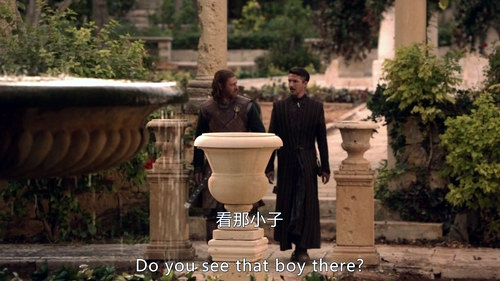
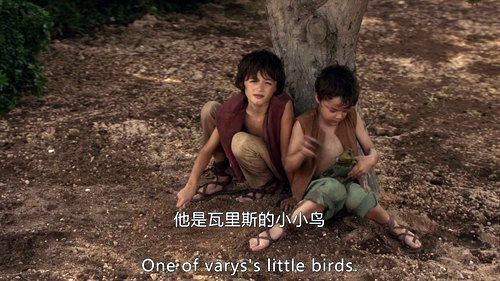
By sharp contrast, the people living in the secular world where magic and mystery have long since vanished are completely oblivious to another kind of information.
One of the major themes of A Song of Ice and Fire is the awakening of ancient, mysterious powers. As the story progresses, ancient magic, races, and mysterious forces that once existed only in old nurses’ bedtime stories awaken one after another, while the secular world, obsessed with nothing but the game of power, remains numb to them. The real crisis in the story comes from these awakening ancient powers, yet information related to them is dismissed by the centers of power as ridiculous rumor.
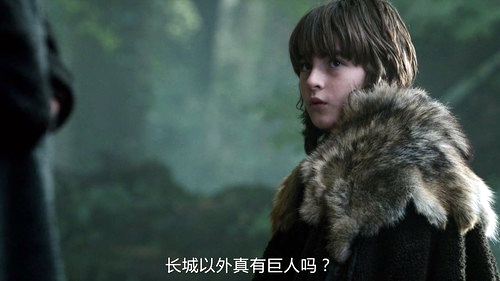
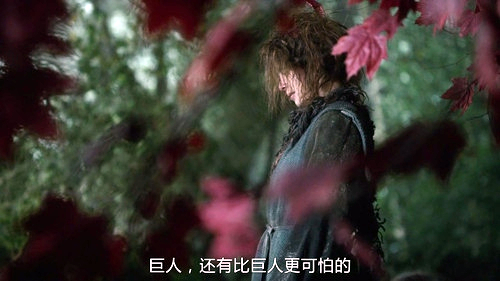

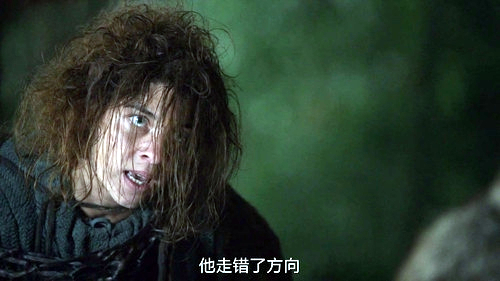
Readers and viewers can plainly feel the storm gathering, while the people inside the precarious tower remain unaware. A gripping narrative tension naturally arises from this neglect of information.
Whether it travels fast or slow, whether people accept it or ignore it, information always has a plot logic and a psychological logic supporting its movement. The spread and trajectory of that information—and whether it is ultimately accepted—have an enormous impact on how the plot develops.
That is the information warfare of A Song of Ice and Fire. Ravens fill the skies of Westeros, and they always seem to carry information to the people who need it.
2. The Information Warfare of The Lord of the Rings
In The Lord of the Rings, however, the spread of information is downright bizarre. Let me stress this again: I still haven’t read the original Lord of the Rings novels, and I don’t intend to. Everything I say below about information in The Lord of the Rings is limited to the films themselves. If you tell me that some detail is explained perfectly clearly in the novels, and that I shouldn’t talk nonsense here just because I didn’t understand it from the films alone—well, my apologies, and please do correct me. But as far as films go, I think that except in deliberately gimmicky special cases (such as Donnie Darko), a film has an obligation to explain, within its own plot, whatever needs explaining. You can’t expect every viewer to be a reader. If you have to consult the original novels to make sense of a film’s plot, then in the ordinary sense, that film has failed (for example, Harry Potter films 5, 6, and 7).
(1) The relationship between the forces of good in Middle-earth and Mordor
Let’s first look at the relationship between the forces of good in Middle-earth and Mordor.
At the beginning of the story, Middle-earth seems to be enjoying an age of peace and prosperity. But we soon discover that Middle-earth has never truly achieved peace across the whole land. Sauron’s lair, Mordor, has always been there—not only with a towering fortress, but with plenty of troops. After the ancient war, n years later, I don’t understand why the Elves and human kingdoms of Middle-earth enjoyed an advantage for centuries yet never wiped out Mordor.
This is what Mordor looks like at the beginning of the story:
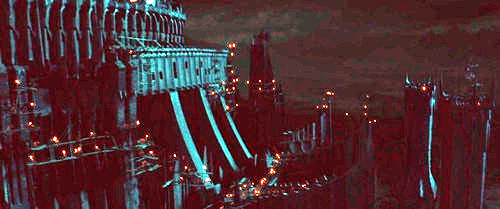
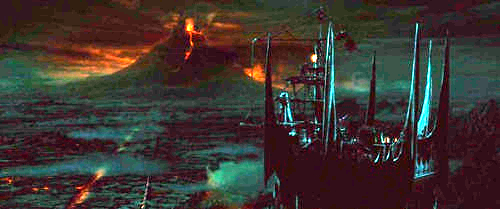
It wasn’t built overnight after the One Ring resurfaced. Whether the Ring is there or not, Mordor is still there. For all those centuries, who knows what the victorious Elves and humans were doing after the ancient war ended? Even if they couldn’t kill Sauron, couldn’t they at least sweep through the place from time to time and never let Mordor grow strong? Would the later war really have been so exhausting then?
So were the good people of Middle-earth simply short on intelligence, unaware of Mordor’s condition all along?
Wrong.
Because Mordor is absurdly close to Gondor—
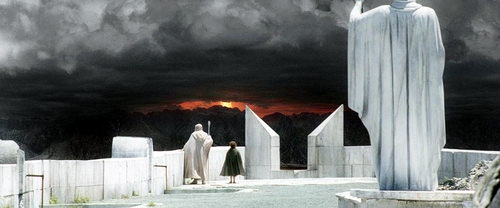
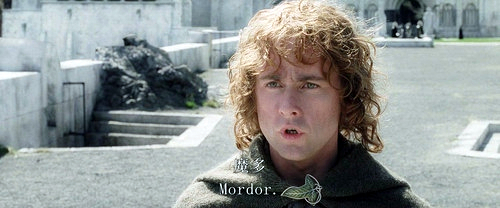
—they’re practically neighbors!
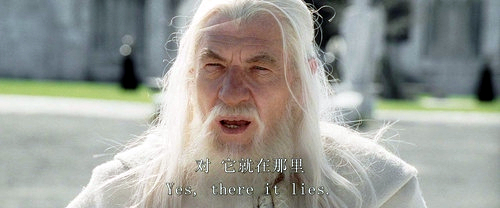
—For crying out loud, you knew Mordor was right across from Gondor’s capital, Minas Tirith?!
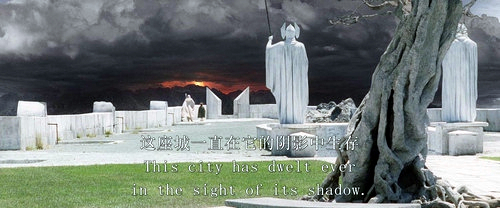
—Good grief, you even knew it had been flashing with lightning over there the whole time?!
All right, then was it because Mordor had never come into conflict with Middle-earth before this crisis, so Middle-earth simply overlooked its existence?
Wrong again.
Because Gondor had plainly been fighting Mordor for years:
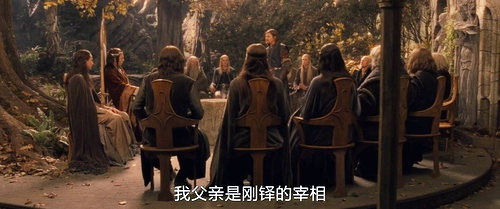
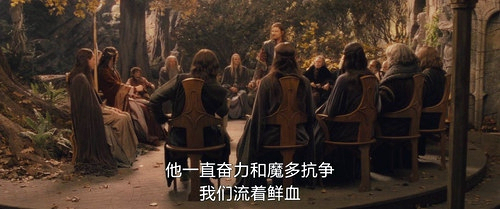
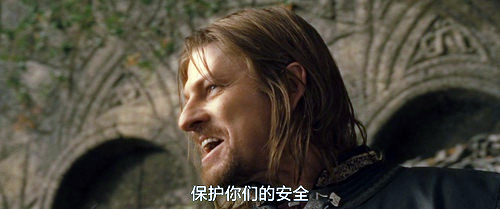
—Wait, so these Elves, who so self-righteously look down on humans, have actually been protected by humans all along?!
Moving on:
The war between Gondor and Mordor was extraordinarily bloody. Quite a few cities were reduced to partial ruins; this wasn’t something that happened overnight:
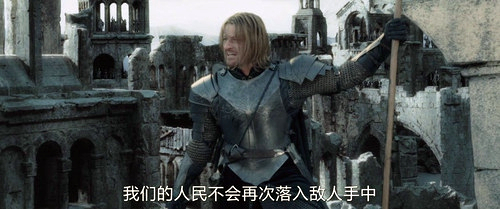
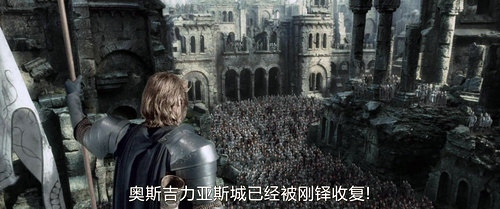
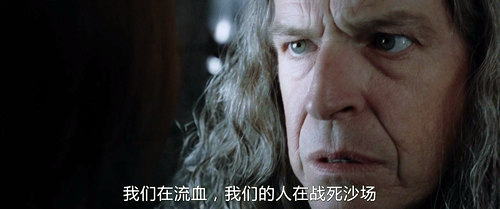
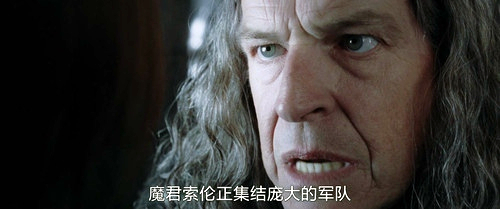
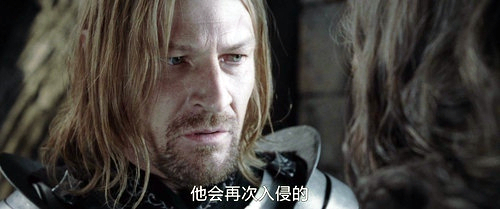
—They’d been fighting for n years. Did those high-and-mighty Elves and wizards really not know about it?
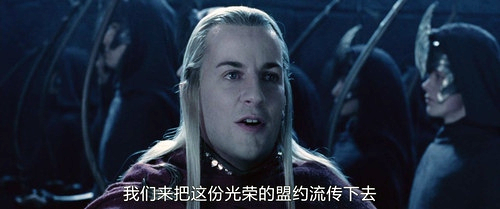
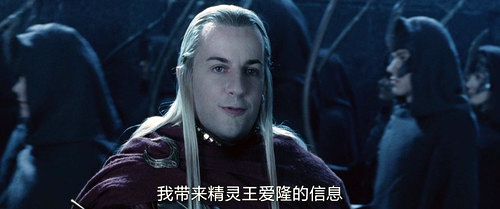
—Glory, my foot. You left Gondor fighting alone for n years, and you still have the nerve to talk about a glorious alliance?!
On the one hand, this story gives me the illusion that Sauron and Mordor reappeared overnight after the Ring revealed itself, and that Middle-earth suddenly began taking Mordor’s threat seriously overnight. On the other hand, the story also tells us that Mordor’s threat had actually existed all along. I just don’t understand why Middle-earth spent so much time letting that threat go unchecked before Mordor grew strong again, leaving the unfortunate Gondor—simply because it happened to be right across from Mordor—to resist it alone.
A wolf crouches outside your house for several days. You ignore it until it bares its fangs, then start screaming, “The wolf is here!” You deserve to be eaten.
(2) Seeing everything with the third eye, then seeing nothing at all
Now let’s look at the characters’ habit of “opening the heavenly eye.” At times they know everything; at other times they know nothing about information they ought to understand perfectly. Sometimes they have the third eye open, and sometimes they’re blind.
Take Gandalf.
At the beginning of the story, when Gandalf discovers Bilbo’s ring, he can’t determine whether it is the One Ring. He has to travel to Minas Tirith to look it up:
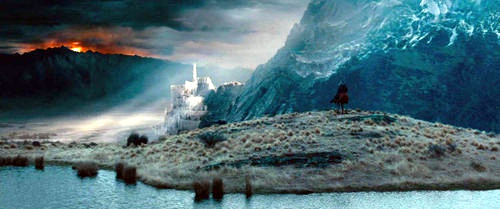
I can let that one go. I’ll assume that it was so long ago that even Gandalf the demigod couldn’t figure out this crucial piece of information. But then, as soon as Gandalf returns from Minas Tirith, he says to Frodo:
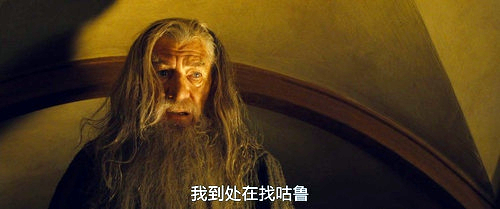
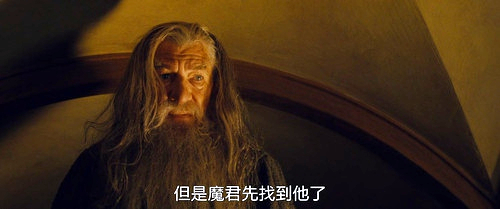
—For crying out loud, a few days ago you couldn’t even figure out what the One Ring looked like or what it did, and now you claim you’ve been investigating it all along?!
Because Gandalf wasted so much time going there and back, Frodo was directly put in danger later on.
On the one hand, he has only the vaguest grasp of information he ought to know perfectly well. On the other, he knows everything like some kind of immortal:
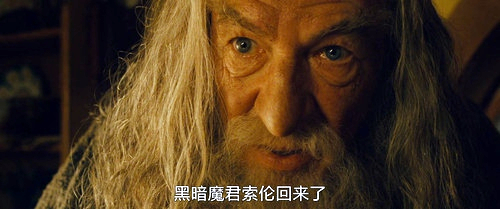
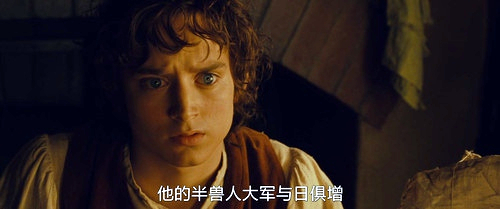
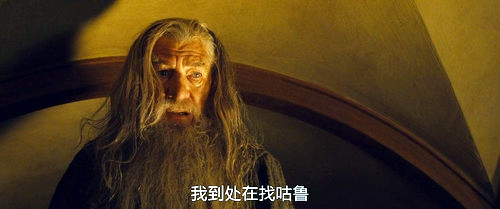
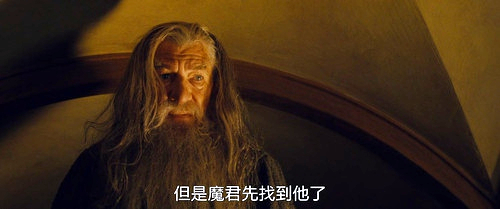
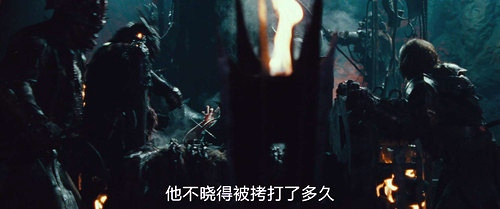
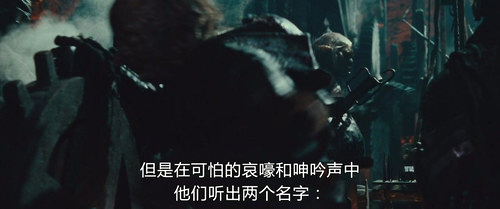
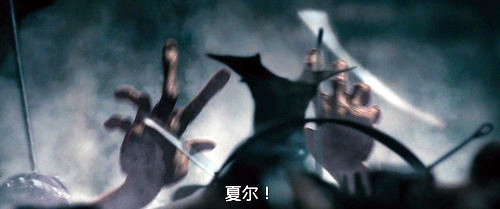
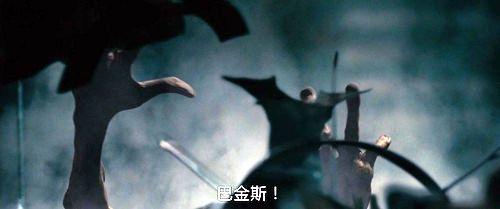
—For crying out loud, did you suddenly become the narrator and teleport through time? You just became omniscient? Even if you cracked my head open, I couldn’t imagine how he suddenly knew every detail of what had happened in Mordor overnight.
In the third film, Gandalf continues teleporting into the narrator’s seat:
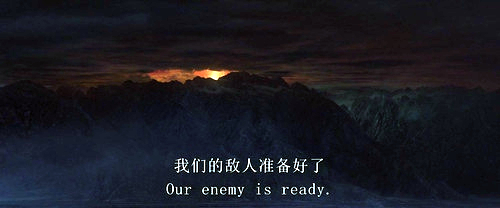
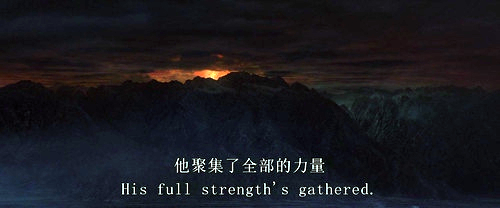
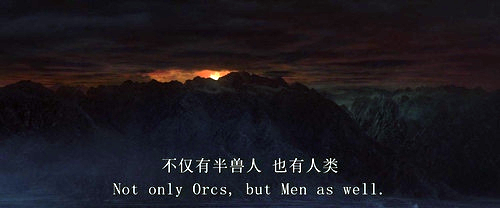
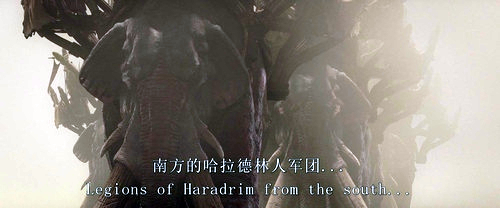
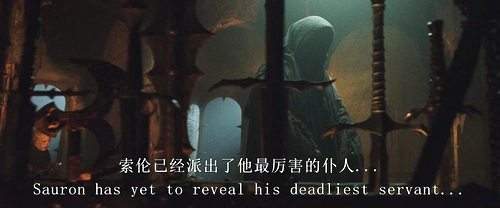
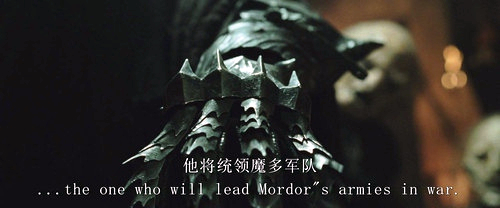
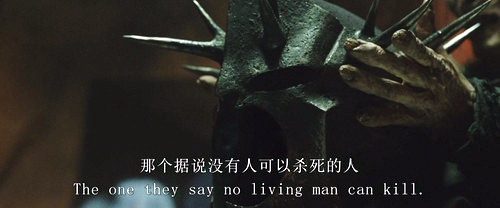
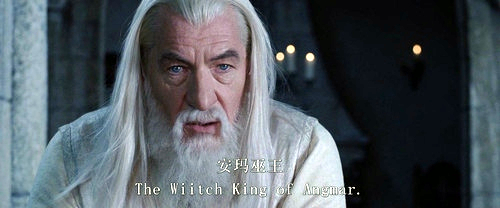
If we can understand the earlier information as news Gandalf picked up in Minas Tirith, how did Gandalf learn that the Witch-king of Angmar would lead the army?
In fact, the Witch-king only bursts out of his lair after Gandalf has finished narrating:
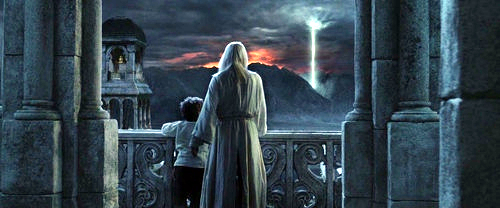
Let’s continue with Gandalf’s all-knowing side:
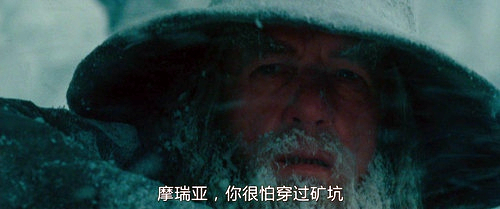
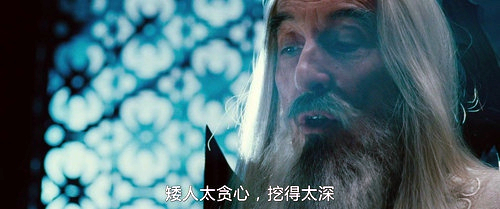
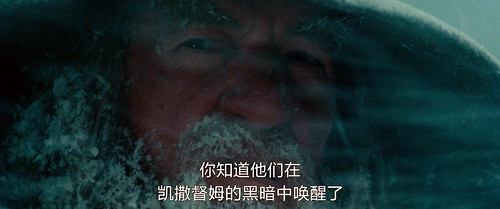
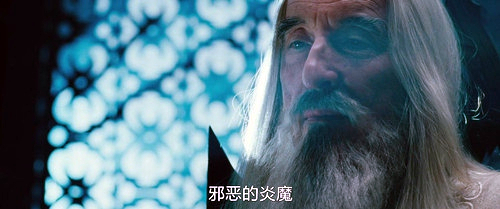
Judging from Saruman’s narration and Gandalf’s expression, Gandalf really did know early on that the Dwarves of Moria had awakened the Balrog. Yet at the same time, he clearly seemed to think that those Dwarves had still not encountered any real danger. Because immediately afterward, when the Fellowship enters Moria and discovers that the Dwarves in the mines have been wiped out by Orcs, he is just as ignorant of it as everyone else in the Fellowship:
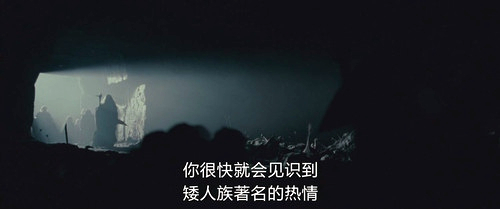
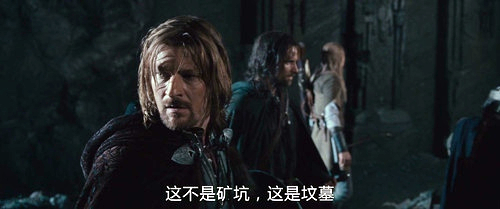
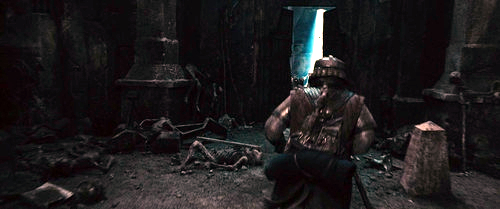
From Gimli’s tone, the Dwarves in this mine belonged to a fairly major Dwarven royal clan. And judging from the bones in the mine, the clan had been wiped out a long time ago. An entire royal clan is exterminated, and the whole of Middle-earth somehow knows nothing about it? Unless this was a people that had always been completely isolated from the outside world. But judging from Gimli’s lines, these Dwarves were also remarkably hospitable. How could their deaths have gone entirely unnoticed?
The target of my rant now shifts to Treebeard.
Before the climactic battle in the second film, Treebeard is tricked by the Hobbits into going to Isengard. When he sees that Saruman has chopped down all the trees, he lets out a roar—and suddenly a whole crowd of Ents walks out of the forest behind him:
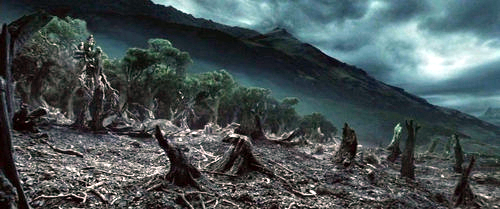
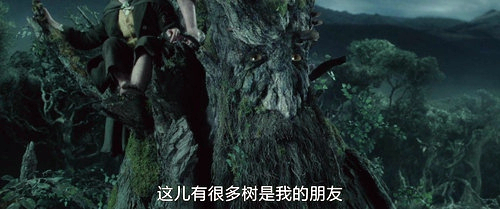
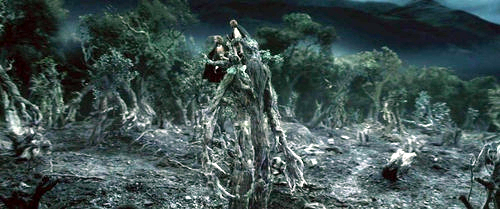
—For crying out loud, so these Ents had been hiding right next door the whole time? Then why hadn’t a single Ent passed the information up to leaders like Treebeard? Saruman hadn’t been chopping trees for just one or two days. Did these Ents, practically within arm’s reach, really have to wait until their leader saw it with his own eyes and got furious before they all came out to show their loyalty? This management system could give the * dynasty a run for its money.
Back to Gandalf.
Gandalf goes to Saruman to ask for information:
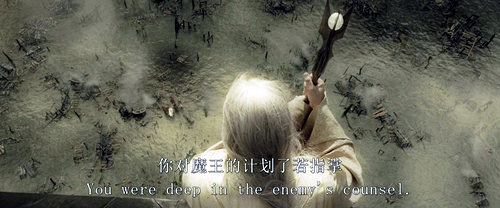
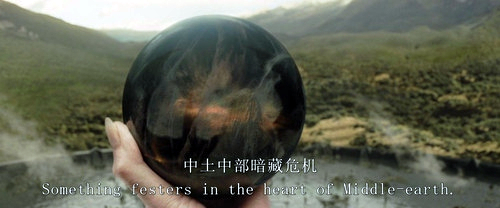
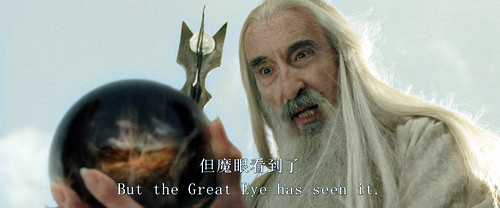
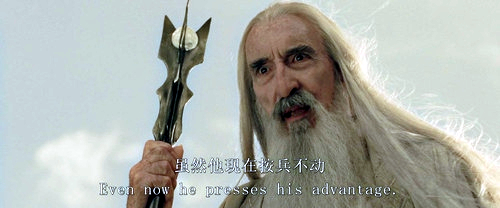
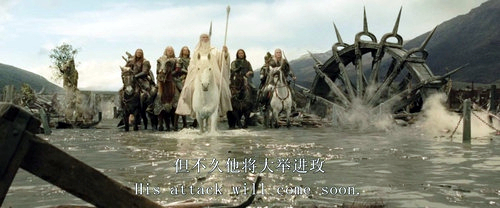
All right, then what important information is hidden inside the Eye of Sauron? Where is Mordor planning to launch its major attack?
After all that effort, the answer is finally revealed:
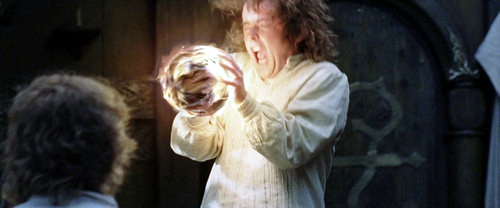
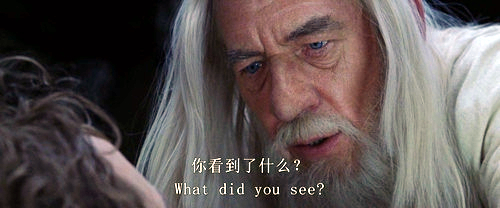
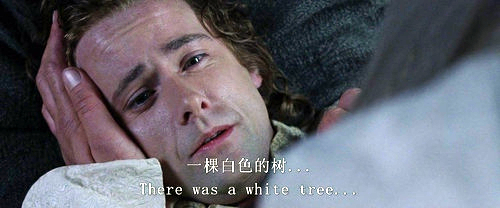
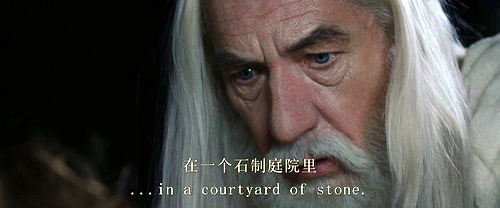
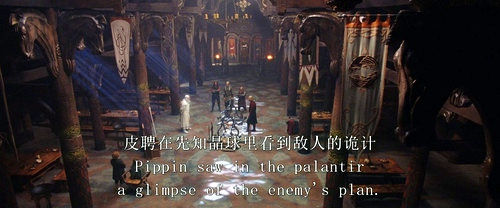
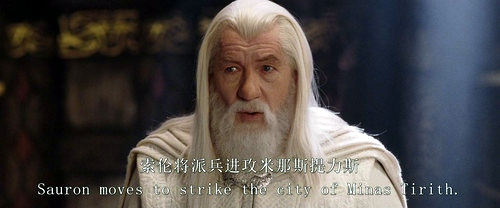
——So the answer was Minas Tirith all along! Talk about an epiphany—I suddenly saw the light!
Fuck me. One, Minas Tirith is right across from Mordor; two, it’s the capital of the most important kingdom of men. So, assuming they had enough troops, wasn’t Minas Tirith the obvious first choice? They went to all that trouble to get this intelligence, and this is all the strategic sophistication it has?
(3) The Dark Lord Sauron Is a Searchlight
After the victory in the defense of Minas Tirith, the king came up with a plan to draw attention away from Frodo:
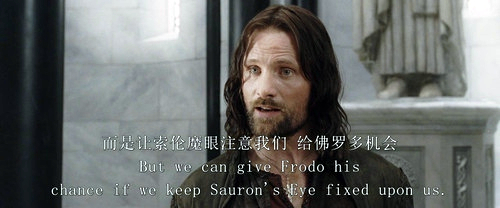
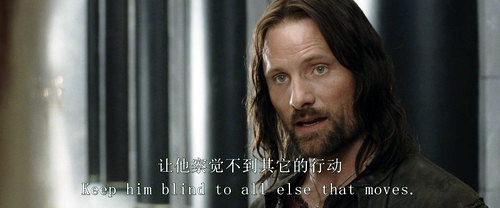
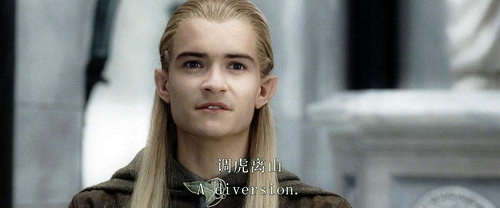
It was only here that I suddenly got it: Oh, I see—you guys are taking advantage of Sauron being a one-eyed monster!
And Sauron really was a one-eyed, sightless fool:
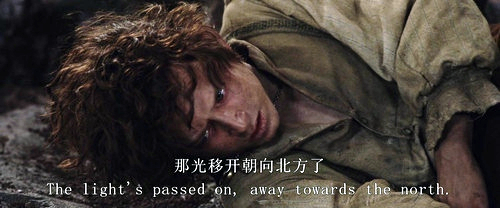
So it turns out that the Dark Lord who ruled Middle-earth with an iron fist had all the intelligence-gathering ability of a single
search,
light,
!
He can only look at one place at a time!
Against Sauron, Frodo and the others only had to imitate the Allied commando squad (sorry, this dates me), hit the deck, and they could slip right past him:
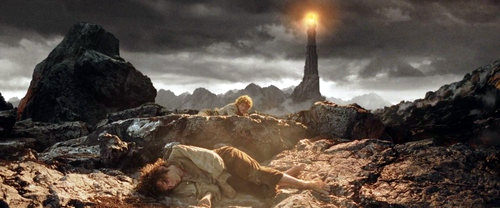
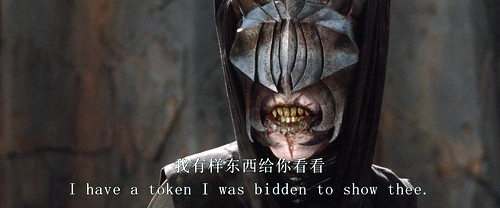
Sauron’s own reconnaissance was laughably poor, yet he clearly had intelligence that Frodo had already entered Mordor—for instance, he sent his vanguard to taunt Aragorn with Frodo’s mithril shirt:

Even so, Sauron somehow didn’t dare station a single Uruk-hai at the entrance to Mount Doom, the one place that could bring about his own destruction:
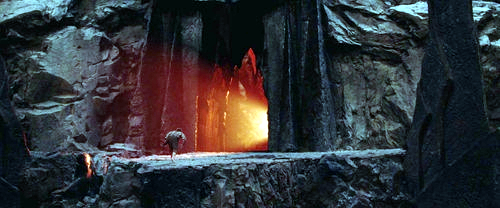
Actually, Sauron didn’t need to do anything complicated. He only had to station a dozen Uruk-hai here, and Frodo and company would have had no chance. Yet Sauron’s fatal weakness was wide open to these intruders, who could come and go as they pleased. So, basically, Sauron’s death in the end was entirely caused by his ignoring the intelligence about Frodo. He deserved to die.
(4) Couldn’t the Great Eagles Have Come a Little Earlier?
In the final battle, at the entrance to Mordor, the human army was plainly on the verge of being wiped out. Then the moth brought reinforcements:
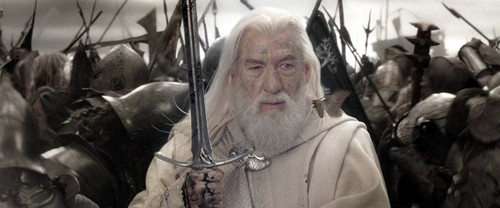
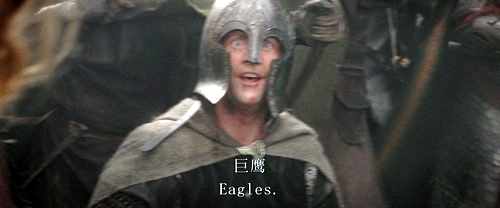
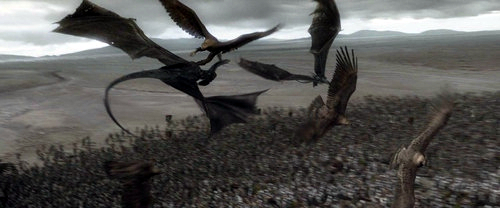
Did the Elves only just receive word that a battle was happening over here? Would it have killed them to send the Great Eagles half a day earlier? How many more people had to die in Minas Tirith because of that?
The transmission of intelligence in The Lord of the Rings is just like this moth: one moment it seems to be flying forward, and the next, in the blink of an eye, it turns a corner and flies straight into the fire.
This is the intelligence war between ravens and moths, between A Song of Ice and Fire and The Lord of the Rings.
Leave a Reply