
The towering figure behind Enlightenment Now: The Case for Reason, Science, Humanism, and Progress.
Hi, everyone. How was your Spring Festival holiday? Mine was pretty brutal. I feel like I nearly ruined my eyes.
Because over the holiday I finished a hugely important new English-language book: Steven Pinker’s Enlightenment Now: The Case for Reason, Science, Humanism, and Progress.
This book had already attracted a lot of attention a few weeks ago, because Bill Gates, who got an advance copy through the back door, wrote a whole article recommending it. Gates said it had reset his all-time favorite history book — all-time favorite, the book he has loved most in his entire life.

The book, as luck would have it, came out the day before New Year’s Eve, exactly when I was getting ready to take a break for the holiday. But after being lured in by such a heavyweight recommendation — and since I’d been looking forward to the book for ages — I gritted my teeth and tearfully finished this 576-page brick over the Spring Festival holiday.
In my Zhichao Wei: New Insights in Psychology series, I’ll spend several episodes talking this book through properly. But both the author of Enlightenment Now and his way of writing are so unusual that I decided to devote this episode first to giving him a grand introduction.
So, who is Steven Pinker? He’s a psychology professor at Harvard, 64 years old this year, with a head of curly silver hair. He has a bit of an Einstein vibe — but he’s better-looking than Einstein.
I think Steven Pinker could be called a dark god of psychology today. He’s both godlike and pretty darn strange.
Since we’re talking about a god, first of all, his kung fu is obviously at a supernatural level, and his status is highly respected.
Within academia, Pinker is widely recognized as one of the very top cognitive linguists and cognitive psychologists. He has won the Troland Research Award from the U.S. National Academy of Sciences, given each year to only two psychologists, as well as the Henry Dale Prize from the UK’s Royal Society.
When Pinker first started out, he studied human visual processing. Later, his interests shifted toward linguistics. His best-known early book was The Language Instinct, which argued that language is not a cultural product but a human instinct. It had an enormous influence.
The book was selected by American Scientist as one of the “100 Best Science Books of the 20th Century.”
The citation counts for Pinker’s books and papers put him near the very top among psychologists still fighting on the front lines today.

Outside academia, Pinker’s influence is also enormous.
In 2004, Pinker was named one of TIME’s 100 Most Influential People in the World.
In 2005 and 2008, he was twice selected by Prospect and Foreign Policy magazines as one of the “Top 100 Public Intellectuals in the World” (100 top public intellectuals).
So Pinker’s status and kung fu are on the level of Xiao Feng, Duan Yu, and Xu Zhu.
Where does the weirdness come in? In the fact that his academic path is very different from that of the average psychologist.
What does a normal academic career in psychology look like?
Psychology today is entirely an “empirical science.” That means every claim has to be proved with data. Where does the data come from? For most psychologists, they have to collect it themselves by running experiments.
So in a typical psychologist’s academic career, most of their time and energy goes into painstakingly running experiments, then turning the results into papers and publishing them in academic journals. For the really good psychologists, publishing a dozen or twenty papers a year is routine.
And some of the very best psychologists spend decades running experiments and publishing papers. Then one day they look back and think: Huh? All these papers and studies I’ve written over the years can now be assembled into a coherent theoretical system. So they write a book to present the whole system in one place.
Take Daniel Kahneman, for example. After winning the Nobel Prize in Economic Sciences largely on the strength of his papers, he wrote Thinking, Fast and Slow late in his academic career, when he was semi-retired, to introduce his scholarly achievements to the general public.
Writing a book can certainly bring both fame and money when done well, but for a serious scholar it is actually optional. I know plenty of brilliant psychologists who only write papers and never publish books. After all, papers are enough to establish academic status. In academia, a book is icing on the cake; papers are what really matter.
So, in the past, the word we most often used to describe how impressive a scholar was was “a scholar whose works could reach the ceiling.” But that no longer fits. Scholars in empirical disciplines don’t really write books anymore. Now we say, “This scholar is amazing — they’ve published more than 300 papers.” It’s become “papers reaching the ceiling.”
But Steven Pinker is an exception.
I checked the data. Most of Pinker’s most-cited original experiments were done when he was young. In the second half of his career, there have been very few highly cited studies that were purely original, hands-on experiments of his own.
So how has he maintained his academic status? Precisely by writing books.
Pinker has published 16 books so far, roughly one every two or three years throughout his academic career. At that pace, he obviously isn’t following the usual psychologist’s playbook — he simply hasn’t conducted enough original experiments to provide all the data for those books.
So where does the data come from? He digs it out of all kinds of sources and pulls it together. Steven Pinker may well be the scholar in psychology today with the broadest range of vision, the most reading under his belt, and the most astonishing ability to gather material.
In other words, Pinker not only has internal kung fu on the level of Duan Yu; like Wang Yuyan, he has also read every martial-arts manual in the Lang Huan Jade Cave.
Apart from a small portion that draws on his own research, Pinker’s books rely mainly on the data he has collected and assembled to argue for his views.
And in today’s academic world, where people generally have to run their own experiments and write papers to establish themselves, Pinker has remained at the summit of academia through “second-hand data.” That is not only because his ability to collect data is unmatched, but also because he is extraordinarily good at distilling, synthesizing, and elevating his own ideas from that data.
That makes him more than a simple “knowledge mover.”
Because assembling and distilling knowledge is especially important. Many grand systems of knowledge or theoretical frameworks are hard to see clearly through one isolated paper after another.
Only when those scattered points of knowledge are brought together can the framework or system emerge. That is the work Pinker does: assembling and distilling, and finding the larger patterns behind the data.
So his most influential books, such as The Language Instinct, The Stuff of Thought, and The Better Angels of Our Nature, may all claim to be aimed at general readers, and may have drawn intense media and public attention and sold very well, but I don’t think we can call them “popular science books.”
A popular science book simply takes conclusions that are already clear and fully formed within academia and introduces them to the public in a different style. That is a “knowledge mover.” But Pinker’s books are both popularizations of science for general readers and scholarly distillations of knowledge.
If you just perform a bunch of masters’ techniques on the street, you’re merely a street performer. But if you can distill the moves of all those masters into a single Heart-Destroying Palm technique, then you’re a grandmaster of your generation.
So those popular science books finish their job once they’ve spread the knowledge. Pinker’s books, by contrast, go back into academia and get cited extensively.
That puts him in the same company as Richard Dawkins’s The Selfish Gene and Jared Diamond’s Guns, Germs, and Steel. Their influence cuts through both academia and public understanding at the same time.
Of course, plenty of people in academia are already doing this work of assembling and distilling knowledge. But for most scholars, it is already quite an achievement to make the knowledge within their own discipline or field clear and coherent.
So the form their knowledge synthesis takes is still usually a paper, just a slightly special kind — a meta-analysis, a review, or a collection of papers. A knowledge summary confined to one discipline or field also fits neatly into a paper. So when all is said and done, a normal scholar is still writing papers.
But the kind of knowledge synthesis Steven Pinker likes to do crosses disciplines completely.
Especially in his writing in recent years, the topics have been extraordinarily broad. One book he published in 2011, The Better Angels of Our Nature, asks why violence has gradually declined as civilization has developed throughout human history.
Violent behavior is of course a question psychology cares about. But Pinker’s discussion crosses from psychology into sociology, history, archaeology, anthropology, evolutionary biology, and philosophy. He has gathered almost every study related to violent behavior — because that is the only way to make sense of a grand question like “violence.”
Enlightenment Now is the same. It discusses the value of Enlightenment thought today, another hugely broad question. I lost count of how many disciplines Pinker crossed in this book to make his case.

A summary of knowledge from such a vast perspective is not something one paper can handle. It has to be a book several hundred pages long.
That makes Pinker a scientist whose books reach the ceiling in an age when papers reach the ceiling.
Pinker’s scholarly style seems almost impossibly unconventional today. But turn the calendar back a hundred years, and we find that in the academic center of the time — Europe — most intellectuals did research exactly this way. What papers? There really weren’t any. If an intellectual wanted to leave a mark, they wrote a book.
But although both involve writing books, Pinker is also quite different from the classical European intellectuals.
When those classical European intellectuals wrote books, especially in the humanities, they did not have much actual experimental or survey data in hand. So they could only go “from air to air.” What does that mean? They cited other people’s “opinions” to support their own.
From opinion to opinion, things aren’t necessarily very reliable. The kind of book I like least is exactly this sort. You may not have read many of the books written by European intellectuals one or two hundred years ago, but you may have encountered the style indirectly. A lot of so-called European literary classics are packed with this kind of digressive commentary woven into the narrative.
But Steven Pinker is different. He is completely a modern scientist. His books go “from data to ideas.” Even when he cites a lot of other people’s ideas, he uses them to support the data in the book.
That way of arguing is much more persuasive.
So Steven Pinker is an unconventional scientist who combines the style of a traditional European intellectual with that of an American empirical scientist. Scientists with that combination are incredibly rare — an endangered species, basically.
And on top of all that, Pinker is somehow also a top-notch master of writing. He came out of cognitive linguistics, so he understands the subtleties of language and writing on a level most people simply don’t.
His previous book was called The Sense of Style: The Thinking Person’s Guide to Writing in the 21st Century, and it’s considered the best writing guide around today. The simplified-Chinese edition is reportedly stuck in translation limbo, so far only the Traditional Chinese edition has made it out. If you’re curious, you can try hunting it down on the all-powerful Taobao.
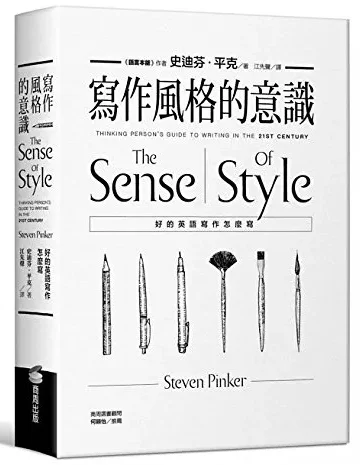
With such a deep background in linguistics, it’s no wonder Pinker’s prose is so wonderful.
For instance, when I was reading Enlightenment Now: The Case for Reason, Science, Humanism, and Progress, it was so long that by the time I got near the end, I was close to losing it. My whole brain was going, ‘How is this still not over? How is this still not over?’ But then I reached the final few pages, the wrap-up, and suddenly the adrenaline and tears came flying out together. I was completely moved by the power of the writing.
And with that, we’ve more or less finished introducing this extraordinary character, Steven Pinker. If you’re interested in Enlightenment Now: The Case for Reason, Science, Humanism, and Progress, scan the QR code below and head over to my course Zhichao Wei: New Insights in Psychology to listen.

Leave a Reply