
This is a guide to Inception, written for Shanghai TV magazine when the film was first released overseas.
Endless Dreamscapes:
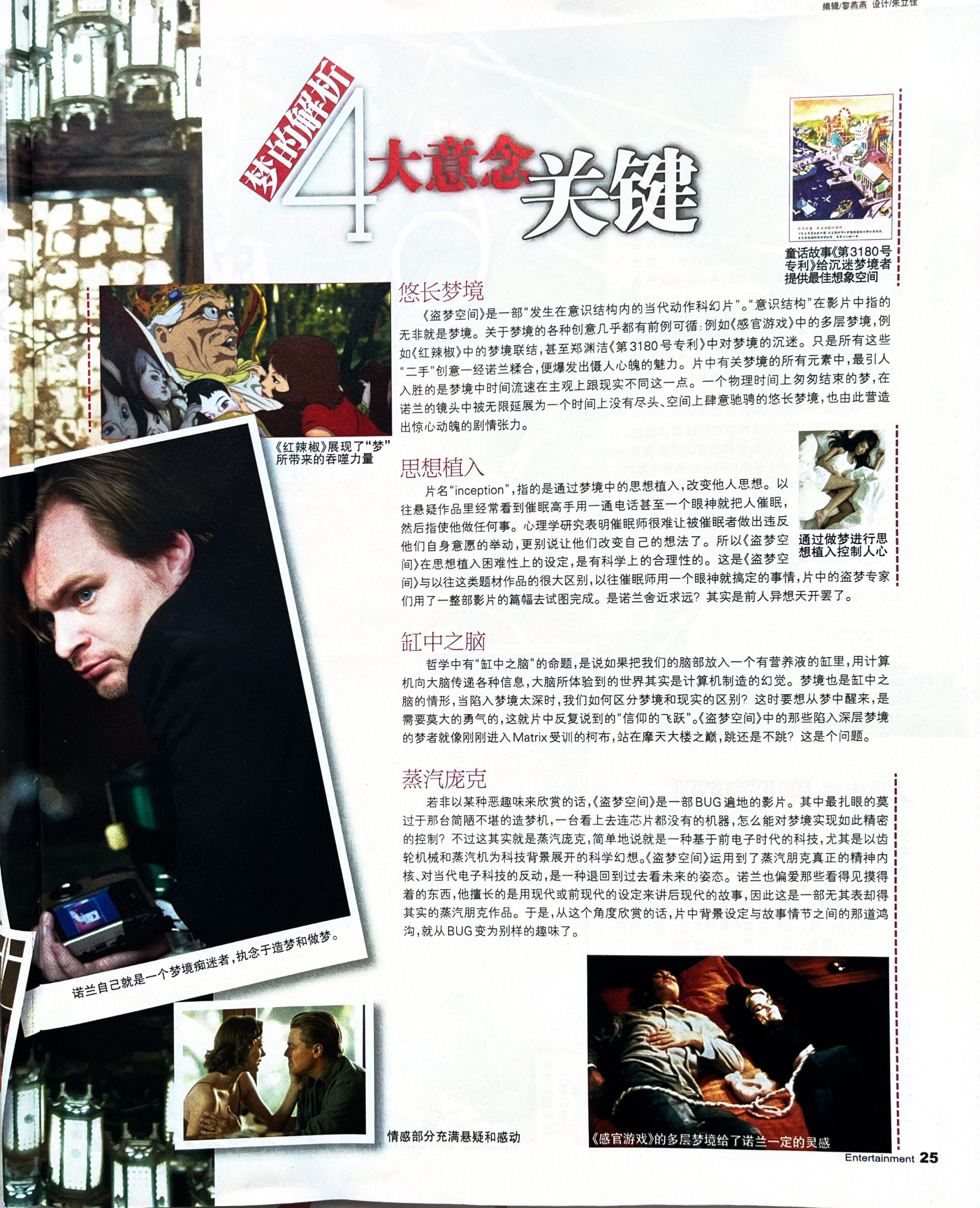
Inception has been called “a contemporary action science-fiction film that takes place within the structure of consciousness.” The phrase “structure of consciousness” is somewhat pretentious; in the film, it means nothing more than dreams. The imagination of dreams in film and literature has never stopped, and Nolan is far from the first to explore it. Nearly all of Inception’s ideas about dreams have precedents: multilayered dreams in eXistenZ, for example; the linking of dreams in Paprika; even Zheng Yuanjie’s obsession with dreams and abandonment of reality in Patent No. 3180. Yet once Nolan blends all these “secondhand” ideas together, they erupt with a mesmerizing force. Of all the film’s dream-related elements, the most captivating is the subjective difference between the speed of time in dreams and in reality. A dream that ends in a flash of physical time is extended, through Nolan’s lens, into an endless dreamscape in time, with space to roam at will—and in the process creates breathtaking dramatic tension. That’s how Nolan’s films work: the stories rarely contain a master’s compassionate grandeur, and some of the ideas aren’t even original, but he always finds a way to tell them with one climax after another.
Thought Implantation:
In the film, the word “inception” refers to changing someone else’s deeply rooted ideas by implanting a thought in a dream. In certain suspense works with surreal elements, we often see hypnotic masters put someone under with a phone call or even a glance, then order them to do anything. In reality, that simply isn’t possible. The human mind has powerful defense mechanisms, and psychological research shows that it is difficult for a hypnotist to make a hypnotized person do something against their own wishes—let alone change ideas that were once deeply rooted. So Inception’s premise about the difficulty of thought implantation has a certain plausibility. Of all the states of consciousness we know, dreaming is the state in which our defense mechanisms are lowered the most. Only through deep dreams can genuine mental reprogramming be completed. This is a major difference between Inception and earlier works in the genre: something a hypnotist used to accomplish with a glance, the dream thieves in Inception spend an entire film trying to accomplish. Is Nolan taking the long way around? Actually, it was his predecessors who were letting their imaginations run wild.
Brain in a Vat:
Philosophy has a thought experiment called the “brain in a vat”: if our brain were placed in a vat of nutrients and a computer transmitted all kinds of information to it, so that the world the brain experienced was actually a computer-generated illusion, how could the brain verify whether the world it perceived really existed? Dreams are also a kind of brain-in-a-vat situation. When we sink too deeply into a dream, how can we tell the difference between a dream and reality? Waking from a dream then requires enormous courage—what the film repeatedly calls “a leap of faith.” The dreamers trapped in Inception’s deep dreams are like Neo, newly arrived in the Matrix for training, standing on the edge of a skyscraper: jump or don’t jump? That is the question.
Steampunk:
Unless you enjoy it with a certain perverse sense of fun, Inception is a film riddled with bugs. The most glaring one is that shabby dream machine: how can a machine that looks as if it doesn’t even contain a chip exert such precise control over dreams? Then look at the film’s setting. It is entirely the present-day real world. Apart from the sensational dream machine, there seems to be no other unbelievable cutting-edge technology anywhere. At first glance, then, the technological backdrop and the functions technology can perform in the film are wildly out of sync. But that is precisely where Nolan’s perverse sense of fun lies. That sense of fun is steampunk. Put simply, steampunk is a form of science fiction built around technology from the pre-electronic age, especially gears, machinery, and steam engines—Nolan’s The Prestige is a classic example of steampunk. But there are no gears or steam in Inception, so how can it be steampunk? Because the true spirit of steampunk is a reaction against contemporary electronic technology: an attitude of returning to the past to look at the future. For steampunk fans, modern electronic technology has become too ethereal; the solid, tangible things of the past feel much more reassuring. In The Dark Knight, Nolan has the Joker say, “I have old-fashioned tastes. I like dynamite, gunpowder, and gasoline.” If you know Nolan’s work, you’ll understand that this is really Nolan expressing his own tastes through the Joker. Nolan too favors things that can be seen and touched. What he does especially well is use modern or premodern settings to tell postmodern stories, and Inception is no exception. It is therefore a steampunk work that lacks the outward appearance but captures the essence. Seen from this angle, the gulf between the film’s background setting and its story changes from a bug into a distinctive kind of fun.
(The subject of “steampunk” will be discussed in greater detail in another article.)
Originally published in Shanghai TV

Leave a Reply