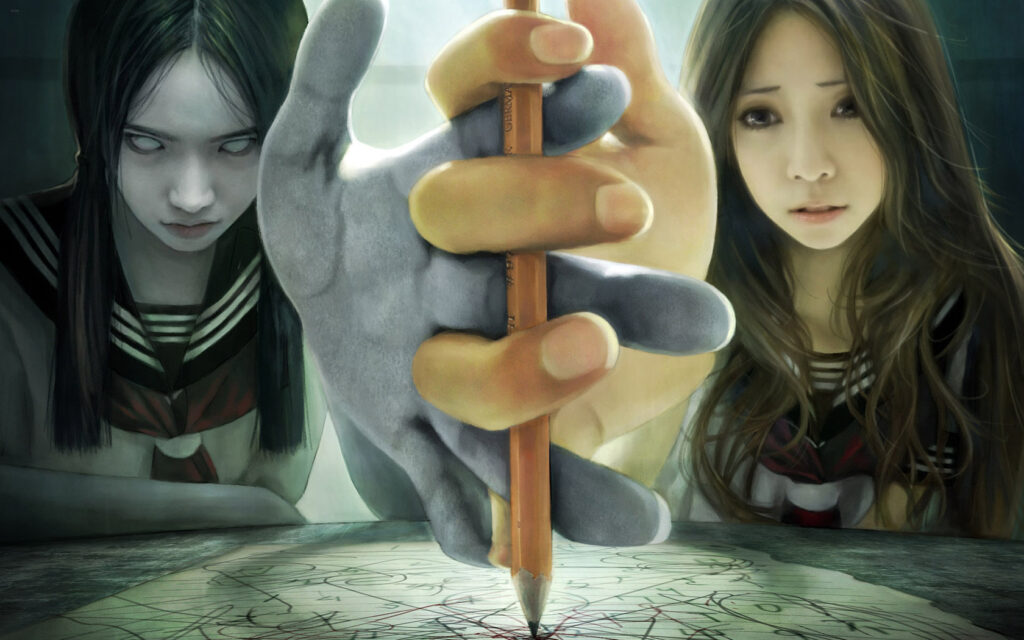
Have you ever played with the Pen Fairy? Two people, a sheet of paper, and a pen: after reciting a simple one- or two-line incantation, you can summon the Pen Fairy to possess the pen. Under the Pen Fairy’s control, the pen starts moving on its own, its tip wandering among the characters on the paper and answering any question you ask.
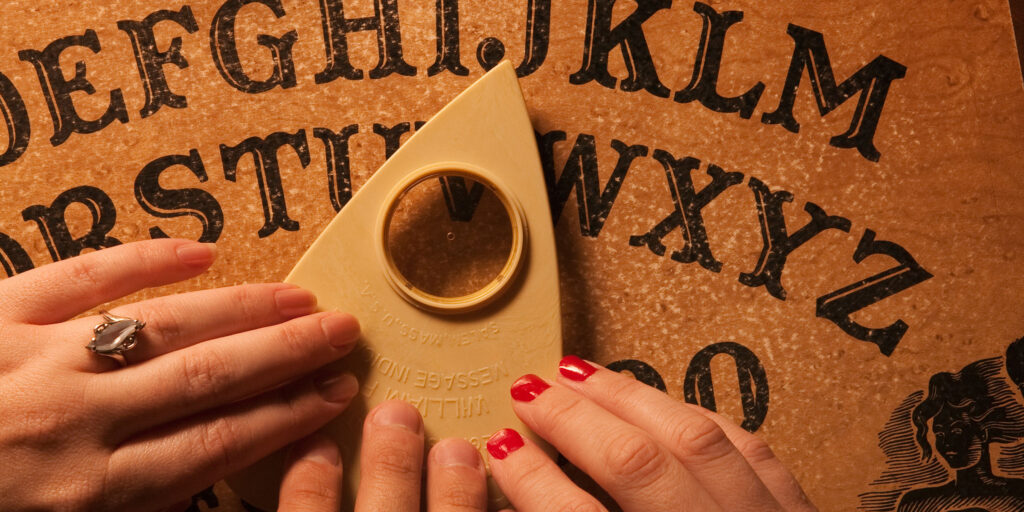
Games like this exist all over the world. In China there are the Pen Fairy and the Coin Fairy; in Japan, the Coin Fairy; and in Europe and the United States, the popular “Ouija board” (see the illustration).
I explained the psychological principles behind the Pen Fairy in my book The Alluring Illusion (Miren de Jiaxiang): simply put, there is no Pen Fairy possessing the pen. What makes it move is nothing more than the operator’s subconscious. And of course, the person answering the questions is the operator too (I won’t go into that here).
Still, although this explanation is not hard to make sense of in principle, there used to be a lack of truly direct, hard evidence. This time, it looks like we finally have some.
In a recently published paper, scientists used eye-tracking data to prove that the answers given by the Pen Fairy unquestionably come from the operators’ own psychological expectations.
In this paper, the researchers were not actually studying the Pen Fairy, but the Ouija board, which is more popular in the West. When playing with a Ouija board, two operators place their fingers on the planchette. The planchette passes over the letters on the board, which spell out words to answer the questioner’s question.
For example, one of the operators asks, “What will my future boyfriend be called?”
As soon as the question is asked, both people feel the planchette begin to move on its own. They watch helplessly as it stops first on D, then A, then V, I, and D. The ghost on the Ouija board has spelled out David—the name of the future boyfriend. Yet throughout the whole process, neither person seems to feel that they themselves are pushing the planchette along.
The researchers fitted the two Ouija board operators with eye-tracking equipment and tracked their eye movements in real time. The measure they cared about most was whether, before the planchette moved toward a particular letter, the operators made a predictive saccade toward that letter (this “eye movement that jumps ahead to the target letter” is mostly unconscious, but it can show that the operators have in fact made a prediction).
Here’s what they found:
Take the answer “david” produced by the Ouija board. When the planchette moved toward the letter d, predictive saccades by the operators were rare. In other words, at the initial stage of generating the answer, the process was actually quite random: the planchette simply came to rest on some letter after being pushed randomly, without either person expecting anything in particular.
But as the letters accumulated—from d to a, then to v and i—the operators’ predictive saccades became more and more frequent each time the planchette moved toward the next letter.
In other words, as the number of possibilities capable of forming a meaningful word decreased, the operators increasingly “knew” where the planchette was going. Before it moved toward a letter, they had already looked in that direction. So the planchette was actually moving in line with the operators’ expectations.
But why don’t the operators themselves feel even a little bit that they’re the ones pushing the pen along? If the people answering the questions are clearly the two operators’ own subconscious minds, why is this “sense of separation” so strong?
The paper did not directly investigate this question, but the researchers offered a guess. The answer is actually very simple: taking turns.
The two people operating the Pen Fairy do not continuously control the planchette’s movement.
What may really happen is something like this: when the planchette is moving toward the letter i, one operator may unconsciously push it a tiny bit in that direction. Then control switches to Operator B. After B applies a tiny push, B hands control back. In this way, the planchette moves in one direction through alternating pushes. The thing is, because neither operator is in control the whole time, they may both subjectively underestimate their own contribution to the planchette’s movement. From their subjective point of view, most of the time it feels as though some other force is directing the planchette. That strong sense of separation comes from this illusion.
References:
Andersen, M., Nielbo, K. L., Schjoedt, U., Pfeiffer, T., Roepstorff, A., & Sørensen, J. (2017). Predictive minds in Ouija board sessions. Phenomenology and the Cognitive Sciences, 1-12.
Note
- This series, “Little Lessons in New Psychological Knowledge,” consisted of short popular-psychology essays and casual pieces written at the time to accompany the related content Zhichao Wei: Little Lessons in New Psychological Knowledge. They were published on the now-closed platform Fantu, and the original link no longer exists.
Leave a Reply