
A lot of us don’t get enough sleep during the workweek, then catch up on the weekend by sleeping until we wake up naturally—that’s probably a pretty typical way to live. After catching up on sleep, I do usually feel, subjectively, like I’ve recovered a bit of my energy. But in reality, do “sleep debt + catch-up sleep on weekends” and “getting a regular amount of sleep every day” affect our health differently?
A paper recently published in the Journal of Sleep Research looked into this question.
The study’s conclusions were based on follow-up survey data from 43,880 Swedish adults. Its main findings were:
First, among participants aged 65 and over, the researchers found no significant relationship between sleep duration, sleep patterns, and mortality risk (so older people can sleep however they want?).
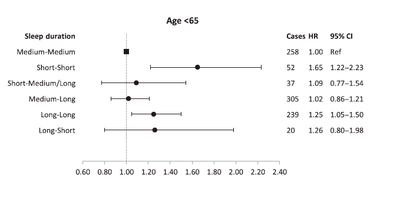
For participants under 65, the findings are summarized in the chart attached (in the chart, short sleep means ≤5 hours of sleep, medium sleep means 6–7 hours, and long sleep means ≥9 hours).
1. Regular medium-length sleep is best
The sleep pattern associated with the lowest mortality risk was the first row in the chart: “medium on workdays—medium on weekends,” meaning a stable 6–7 hours of sleep every day, including both workdays and weekends. (In other words, a regular sleep schedule.)
2. Catch-up sleep on weekends (for leveling out mortality risk) helps
The patterns that showed no significant difference from a regular sleep schedule were “medium sleep on workdays—long sleep on weekends” and “short-to-medium sleep on workdays—long sleep on weekends.”
The latter—“short-to-medium sleep on workdays—long sleep on weekends”—is the catch-up sleep pattern. This result seems to show that catch-up sleep is at least effective for leveling out mortality risk. (That said, as I mentioned earlier in a Q&A for the Psychology New Insights course, catch-up sleep may not restore sleep’s role in consolidating learning and memory.) If you don’t get enough sleep during the week and catch up on weekends, your mortality risk is no different from that associated with a regular sleep schedule.
3. Sleep deprivation is the most harmful
The highest mortality risk was associated with “short sleep on workdays—short sleep on weekends,” meaning constantly running a sleep deficit. Compared with regular medium-length sleep, long-term sleep deprivation raised mortality risk by 65%! “Long-term sleep deprivation is basically suicide.”
4. Sleeping too much isn’t good either
Another interesting finding was that participants in the final two rows of the chart—in other words, those who slept for a long time on workdays (more than 9 hours), regardless of how much they slept on weekends—also had a 25%-26% increase in mortality risk. Looks like sleeping too much isn’t great either.
***
However, this study is correlational in nature. These conclusions show only a correlation between mortality risk and sleep patterns; they do not establish a causal relationship. So please treat the findings above with appropriate caution.
References:
Åkerstedt, T., Ghilotti, F., Grotta, A., Zhao, H., Adami, H. O., Trolle‐Lagerros, Y., & Bellocco, R. (2018). Sleep duration and mortality–Does weekend sleep matter?. Journal of sleep research, e12712.
Note
- This series of short popular-science and informal articles about the “Psychology New Insights” course was written at the time to accompany related content from Zhichao Wei: Psychology New Insights. They were published on the now-closed platform Fatuan, and the original link no longer exists.
Leave a Reply