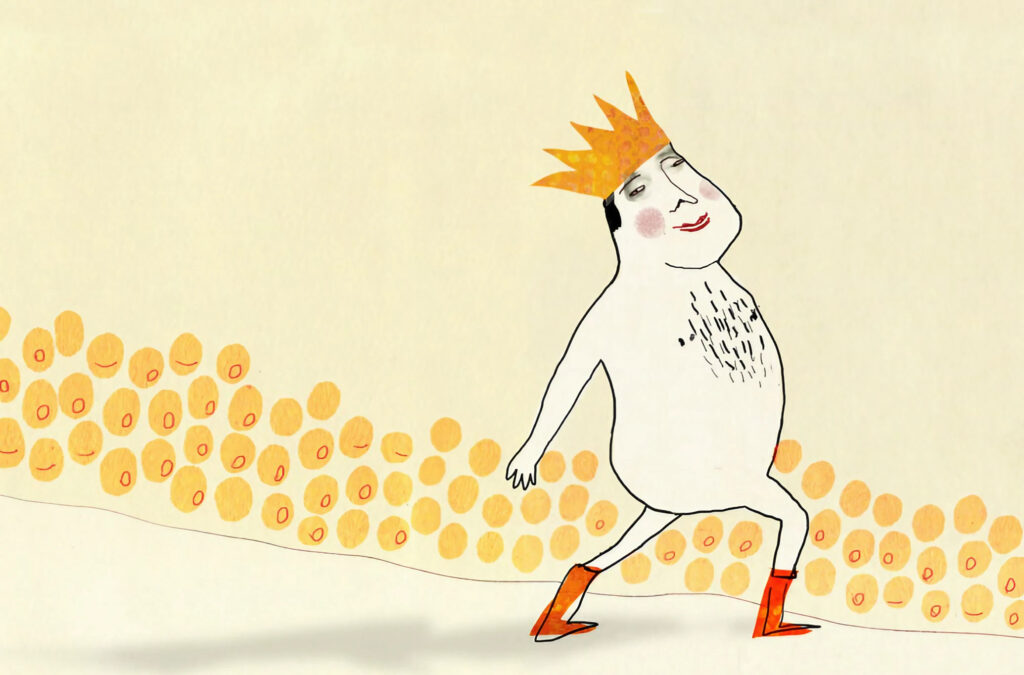
Seen from a psychological perspective, what we are really seeing in the story The Emperor’s New Clothes is a phenomenon called the false consensus effect.
This effect refers to situations where you yourself do not really believe in something, or do not want to do it, but assume that everyone else believes in it and is willing to do it—so you give in. No one can see the Emperor’s new clothes, but everyone also believes that everyone else can see them. As a result, they all arrive at a consensus: “The Emperor is wearing clothes”—even though it is a completely false consensus.
This actually happens all the time in everyday life. For example, both partners in a couple suggest going to see a movie, even though neither of them actually likes it; they just both assume that the other person wants to see it.
In a fairy tale, a false consensus is easy to puncture: all it takes is one little boy to break the silence, and the consensus immediately collapses. In real life, though, exposing a false consensus is often not so simple.
Take an extreme case. In a dictatorship, some false consensuses are imposed on the whole society by the dictator through various means, and breaking the consensus may threaten your personal safety. Or take a less extreme case: even when no one is forcing you to do anything, you may simply feel pressure from public opinion or from the crowd, and unconsciously end up defending a false consensus.
In these situations, people will not only refuse to echo the little boy who broke the silence; they may actually punish him—even though, deep down, they agree with him.
One experiment offers a vivid demonstration of this phenomenon:
It was a wine-tasting experiment.
First, the researchers gave the participants—who were all wine lovers—a flattering label. They told them that the reason they had been selected was their refined taste in appreciating works of art. Then the participants began tasting wine.
The participants had to give two ratings. The first was a rating of the red wine they had tasted; the second was a rating of the other tasters’ level of discernment.
Each participant received three glasses of wine and rated them. In fact, all three glasses came from the same bottle, except that one had been mixed with a little vinegar.
Before the participant gave a rating, they were shown the ratings from the four tasters in front of them. Those four tasters were actually confederates planted by the researchers, and they all gave the vinegar-spiked wine the highest score.
After seeing the four confederates’ ratings, the real participant ignored what their taste buds were telling them and made a conformist judgment: they too gave the vinegar-spiked wine the highest score.
Next, the sixth taster appeared. He was also a confederate, but he rated the wine accurately, giving the vinegar-spiked wine the lowest score.
Finally came the stage where the tasters rated one another. There were two experimental conditions—
In the first condition, participants gave an “anonymous rating”; in the second, they had to give a “public rating under their real names.”
The result:
During anonymous rating, all the participants showed their respect for Taster 6 and gave him the highest score. In other words, when people do not have to openly declare their opinions, they admit their own cowardice and admire the courage of a hero.
But when they were required to give a public rating under their real names, the participants gave Taster 6 the lowest score. When people have to make their opinions public, they choose to cling to their own hypocrisy, attack the hero, and defend a false consensus that even they do not believe in.
So in the real world, perhaps The Emperor’s New Clothes would end like this: the little boy shouts, “The Emperor isn’t wearing any clothes!” No sooner are the words out than his parents clamp a hand over his mouth, while all the adults around him glare angrily at him. Amid the crowd’s cheers, the Emperor struts through the streets and happily concludes the procession.
References:
The experiment mentioned in the article: Willer, R., Kuwabara, K., & Macy, M. 2009. The false enforcement of unpopular norms. American Journal of Sociology, 115, 451–90.
Note
- This article in the “Psychology New Insights: Mini-Lessons” series was a short popular-science piece/rambling essay written at the time to accompany the related content of Zhichao Wei: Psychology New Insights Course, published on the now-closed platform Fàntuán. The original link no longer exists.
Leave a Reply