PART 1 here: Ancient Greece
PART 2 here: Diana of Ancient Rome
In this installment, we continue tracing the name of Wonder Woman/the Roman moon goddess, Diana, and arrive in the Middle Ages. Keeping with my broad-brush approach, I’ll just pick a few small medieval snippets to talk about.
In the Middle Ages, the ancestors of those familiar European powers finally made their grand entrances, each ruling the roost for a few years. They’ll appear one after another in later installments. For now, let’s talk about medieval France.
Small breasts continue to sweep the world
The kings and nobles of France began setting the fashion for Europe, and even the whole world, very early on—and to some extent they still do. So what was fashionable in medieval France? In a nutshell: small breasts continued to sweep the world.
In the Middle Ages, there was an interesting profession that no longer exists: the troubadour.
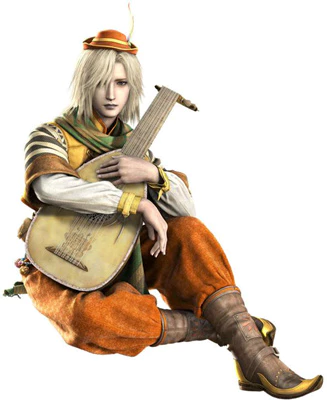
They traveled everywhere, gathered material, made up stories and tunes, and were sometimes invited to nobles’ castles to sing their finished stories to the ladies and young women. That’s right: troubadours were the medieval equivalent of joke writers.
In the 12th century, a collection of troubadour tales circulated in France called Garin le Loherain. It was a very raunchy, very violent little dirty book, and it said that breasts that were “firm and white as snow, like two apples” were the attractive kind. Not watermelons—apples.
Another legendary tale circulated in France in the 12th and 13th centuries, called Aucassin et Nicolette. It described “small, firm breasts, propping up the dress like two round walnuts.”
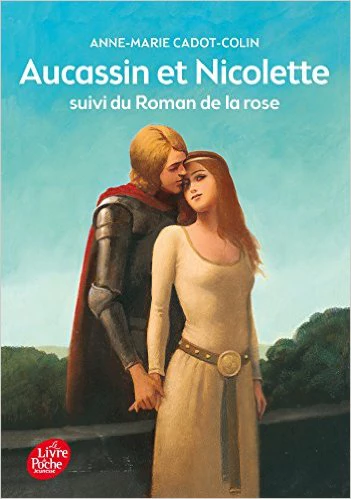
You see? Apples and walnuts—they’re both pretty small.
Judging from the stories and poems passed down from the 12th century, as well as the oil paintings from the later Middle Ages, it seems that from the Middle Ages all the way through the height of the Renaissance in the 16th century, French men consistently preferred women with small, pert breasts and slender, elongated figures.
Henry II and his mistress, Diane de Poitiers
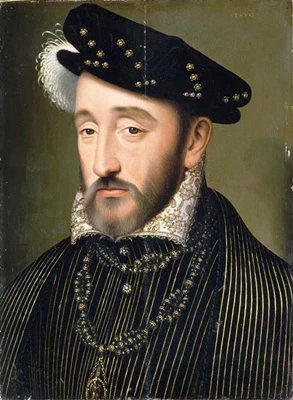
The person who may best represent this taste was the 16th-century French king Henry II (Henri II). In the Middle Ages, the woman who carried on the legend of the name Diana was Henry II’s mistress, Diane de Poitiers.
This is Henry II (1519-1559):
This is Diane de Poitiers (1499–1566):
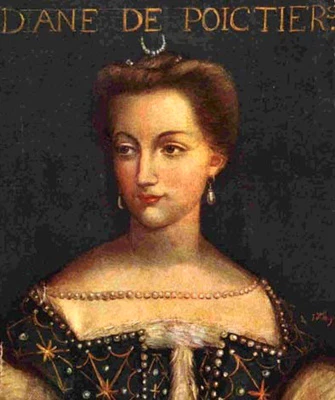
Don’t be misled by the way they look in the portraits. Look at the birth and death dates in parentheses: Diane de Poitiers was a full 19 years older than her lover, Henry II.

Henry II seems to have had a bit of a mother complex. Why? His miserable childhood explains it:
Henry II’s mother died in 1524, when little Henry was only 5. The following year (1525), his kingly father, Francis I of France, was captured in battle. One of the conditions for his release was that little Henry, who had just lost his mother, and his brother be sent to Spain as hostages. Before he left, Diane de Poitiers—then the countess of the Loire Valley—gave little Henry a farewell kiss in his mother’s place. The seeds of their later relationship were probably planted in that kiss.
He remained a hostage for four years. A prince by birth, he lived a childhood hardly different from an orphan’s. Supposedly, while in Spain, once little Henry had learned to read, he became obsessed with the popular chivalric novel Amadis of Gaul, seeking comfort in its noblewomen. And the image of Diane de Poitiers, who had given him that farewell kiss, increasingly overlapped with the image of the perfect noblewoman in the book.
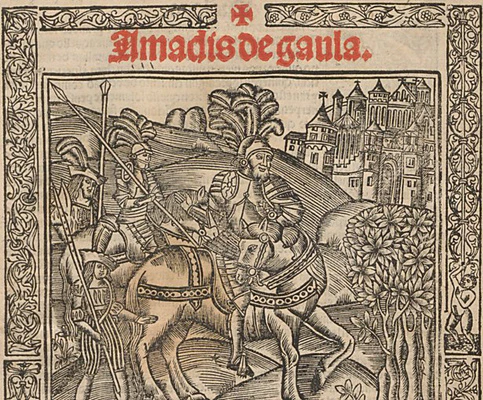
Later, after being released and returning home, Henry II married someone else as his queen—but presumably, starting at age 16, he began an affair with 35-year-old Diane de Poitiers. By then Diane was a widow; her husband had been dead for four years.
If you travel to France, you should visit the beautiful water castle called Château de Chenonceau in the Loire Valley if you get the chance. Henry II gave it to his mistress back then.

Their relationship lasted more than 20 years, ending only when Henry II died unexpectedly at 40. He was mortally wounded when an opponent’s broken lance pierced his head during a joust held for his daughter’s wedding celebration. In that final joust of his life, the lance Henry II carried was decorated with Diane’s ribbon, not the queen’s.
Henry II was so infatuated with Diane de Poitiers that he had her painted into all sorts of pictures. Her name, Diane, is actually the same name as the Roman moon goddess, Diana. So Madame de Poitiers professionally cosplayed the goddess Diana in all kinds of paintings; as a result, in the pile of French oil paintings left from the mid-16th century, the moon goddess all looks like the same person. In fact, they’re all modeled on the king’s mistress.
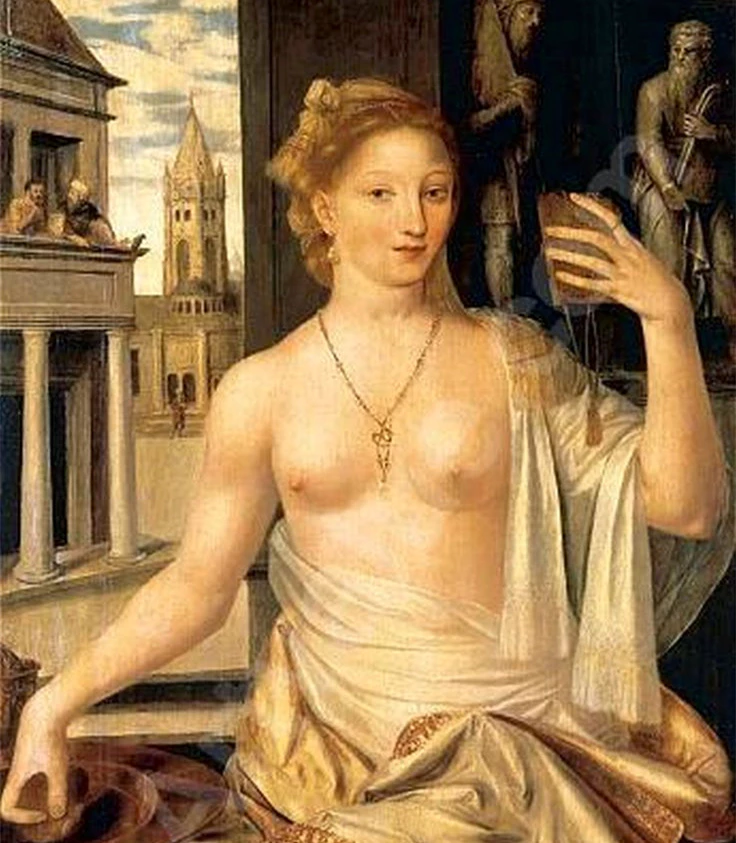
For example, take this painting from the Fontainebleau school, called Diana Huntress:
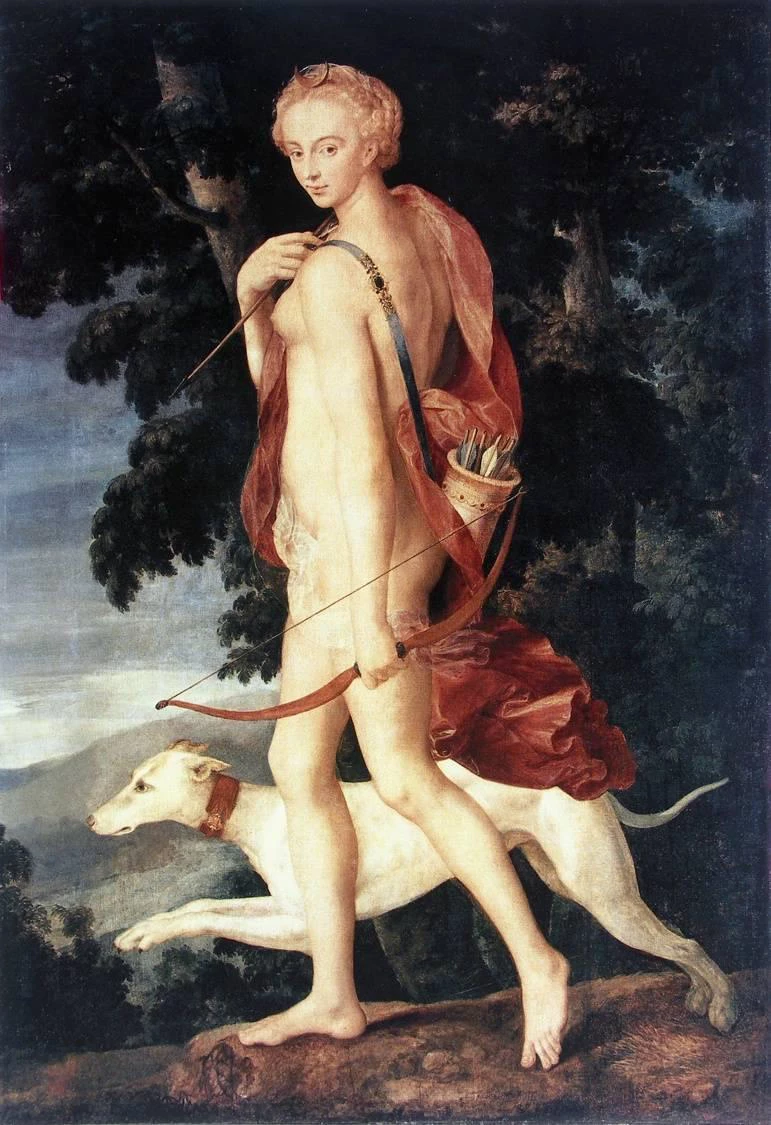
The Diane de Poitiers cosplayer in the painting is portraying the goddess Diana out hunting, and she has an incredibly athletic figure.
The painting was probably completed sometime between 1550 and 1560, meaning the person in it was already at least fifty. You really can’t tell, can you? Diane de Poitiers knew how to preserve her looks; supposedly, at sixty she still looked about thirty. In this painting, Diane in her fifties practically still has a teenage girl’s figure—especially her breasts, small and pert like a young girl’s.
Small and pert
These small and pert breasts perfectly matched the French male ideal of the time. Henry II was especially infatuated with Diane’s breasts. According to an observer at the time, “The king would touch Diane’s breasts from time to time, gazing at her tenderly, as if amazed by his own infatuation.”
To cater to this taste, French noblewomen did everything they could to “prevent” their breasts from growing. They generally had their own breast-reduction recipes—not breast-enhancement recipes, but the exact opposite: breast-reduction recipes. They mixed all sorts of strange things together and rubbed them on their breasts, trying to make them small and pert. The bizarre ingredients noblewomen used included pearl powder, lard, pigeon droppings, and toad eyeballs… They really went all out just to make their breasts a little smaller.
Separated to the sides
Actually, French men of the time wanted more than just small and pert breasts; they also had to be separated to the sides. Strange, right? It’s the exact opposite of today’s taste for desperately squeezing out cleavage.
Let’s bring up another representative figure: Henry IV, who became king of France in the latter half of the 16th century (1589–1610):
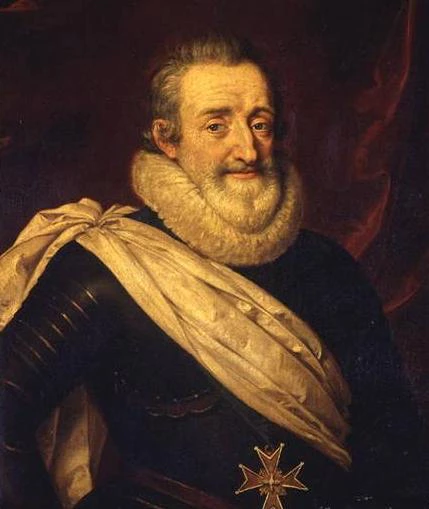
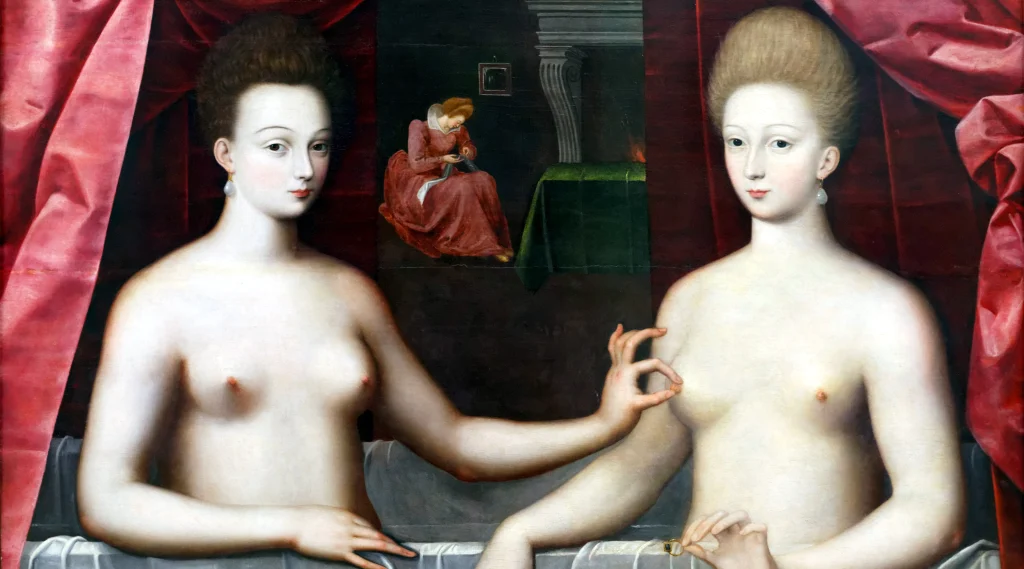
Henry IV had a mistress named Gabrielle d’Estrées, whose appearance I’m sure many of you will recognize. The Louvre has a famous painting called Gabrielle d’Estrées et une de ses sœurs, which you’ve probably seen:
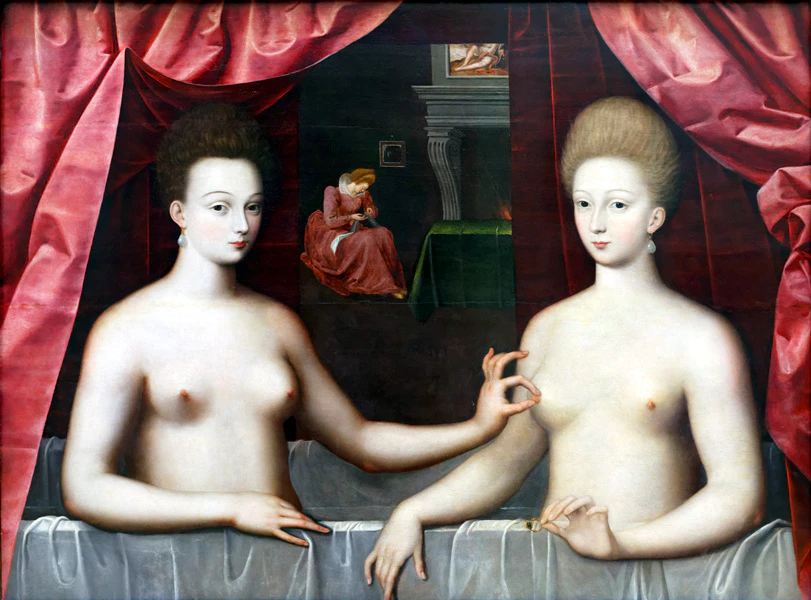
In this rather bizarre painting, there are two very similar-looking nude women, presumed to be sisters. The woman on the left pinches the right woman’s nipple. The one being pinched is Gabrielle, Henry IV’s mistress. The sisters’ breasts have exactly the shape French men liked best: small, and separated to either side.
Breasts of two classes
To preserve this breast shape, French noblewomen at the time wouldn’t breastfeed their own children after giving birth. They handed them over to wet nurses instead. Wet nurses, of course, came from the lower classes. In fact, nursing the children of noblewomen was one of the ways working-class women in France—and throughout Europe—made a living.
So in France at that time, breasts were divided by class. There were two kinds: the firm, small “upper-class breasts” meant for men to admire, and the huge, milk-producing, child-nursing “lower-class breasts” of wet nurses. The enormous breasts admired by today’s otaku men would, in the eyes of French aristocratic men back then, have been downright ugly and low-class. To those French noblemen, large breasts had nothing to do with sex appeal; they were associated only with feeding children.
The painting that best represents this class division is another portrait of Diane de Poitiers, by the French painter François Clouet:
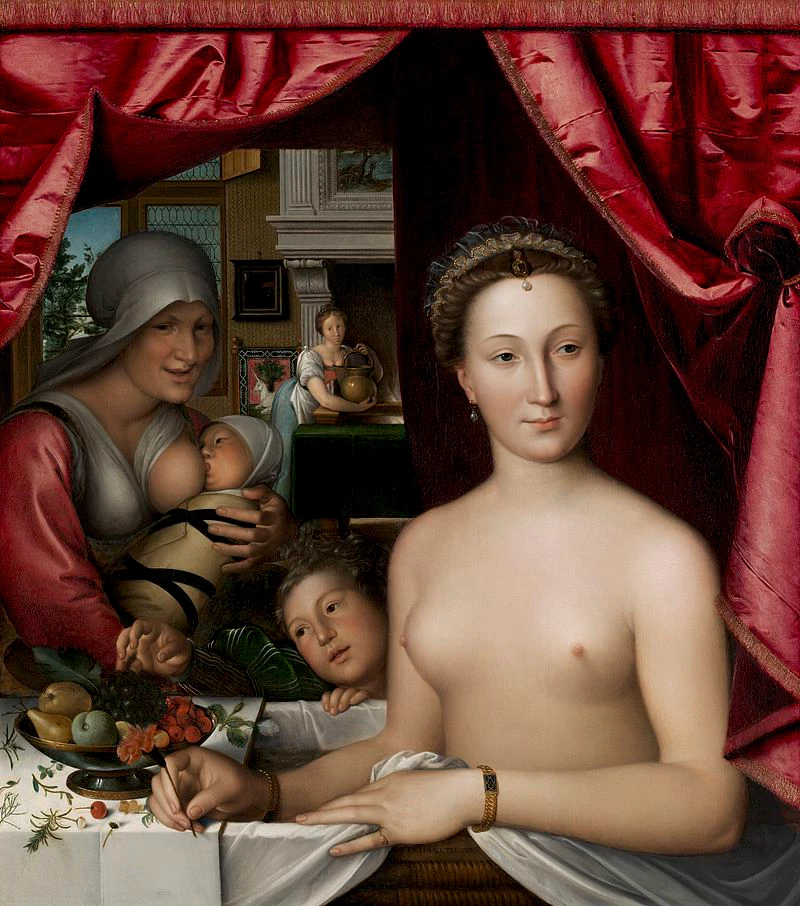
In this painting, Diane de Poitiers sits in a bathtub, while a wet nurse feeds a baby on the left. What we see is a vivid contrast between breasts of two classes: Diane de Poitiers on the right has small, firm, side-separated upper-class breasts, much like those in the previous painting. The wet nurse on the left has huge, round lower-class breasts.
Sigh. It’s really hard for a modern otaku man like me to understand France back then. If Cang Teacher, the otaku men’s goddess, traveled back to medieval France, she’d be the textbook image of a working woman.

So medieval France’s standard of breast beauty was genuinely quite different from the mainstream ideal we see around us today. At least the otaku men I know probably wouldn’t be into the kind of breasts French noblewomen had; they seem to prefer breasts like Cang Teacher’s.
Does culture shape beauty?
So here’s the question: why are we so different from people in the past?
Sociologists and anthropologists have an explanation for this. They say it’s simple: beauty is shaped by culture and ideas, and there has never been a universal standard throughout history. Take women’s bodies: the ancient Romans in the West liked slender figures, while people in China’s ancient Tang dynasty liked bodies that were round and well-padded. Then the descendants of those Tang people went back to preferring slender figures. Why? Because different countries, ethnic groups, and eras have different cultures.
For example, during the revolutionary era, thick eyebrows, big eyes, and a square face were in fashion, because thick eyebrows and big eyes were especially good at expressing the passion and positive energy of the revolution. That was what the culture of the time needed. Revolutionary culture therefore shaped revolutionary beauty.
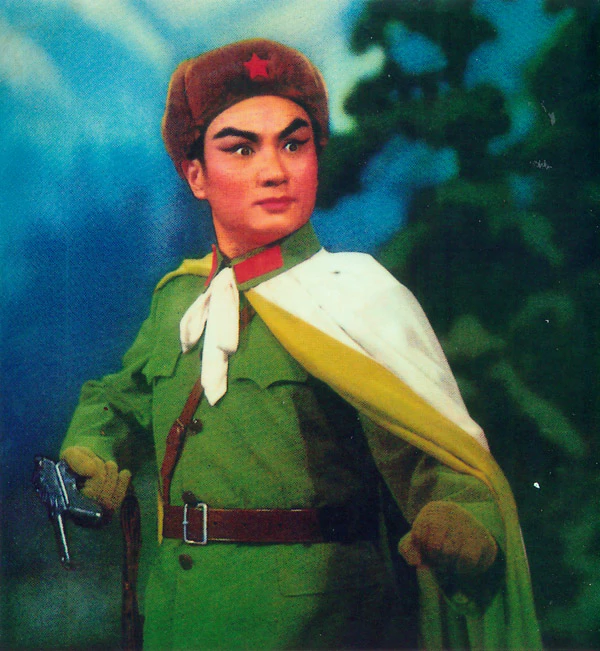
But times have changed, so thick eyebrows and big eyes aren’t necessarily popular anymore.

The idea that culture creates beauty sounds pretty convincing when sociologists say it. But I can’t help wondering whether it exaggerates culture’s role. Is culture some kind of brainwashing pyramid scheme that can make us fall in love with anything it wants?
Culture v.s. instinct
As I mentioned in the previous parts, when a particular part of the human body looks beautiful or ugly to us, it’s largely because the body is signaling something about reproductive ability. How people interpret those signals is certainly influenced by culture, but that influence must be limited. It can’t completely violate our biological instincts.
For example, some eras favored waists so narrow you could grasp them with one hand, while others preferred a slightly rounder waistline. This may indeed have been shaped by culture—after all, the King of Chu was fond of slender waists, and his palace women starved to death for it. But one thing is certain: in almost any era or culture, barrel-shaped waists are unlikely to become widely fashionable, because a barrel waist is a strong biological signal that the body is unhealthy—something we instinctively reject. No matter how powerful culture is, it can’t completely go against instinct.

Take the aesthetics of breasts, for another example: sometimes bigger, sometimes smaller. But no era could possibly make one breast big and the other small fashionable, because bodily asymmetry is a very strong signal that the body isn’t healthy enough (see part 1).
So my view is this: culture’s shaping of aesthetics can really only make our tastes fluctuate around this instinctive, biological, innate aesthetic sense, without ever straying too far from it.
The more an aesthetic judgment is tied to our instincts—such as our appreciation of the human body—the more limited culture’s influence actually is; the farther it is from our instincts, the more powerful culture’s role becomes. Take our appreciation of porcelain: the Song dynasty favored plain elegance, the Yuan and Ming dynasties loved blue-and-white ware, and the Qianlong era went for every color under the sun. Culture has a far stronger influence on things like that than on whether “bigger breasts or smaller breasts” are preferred.
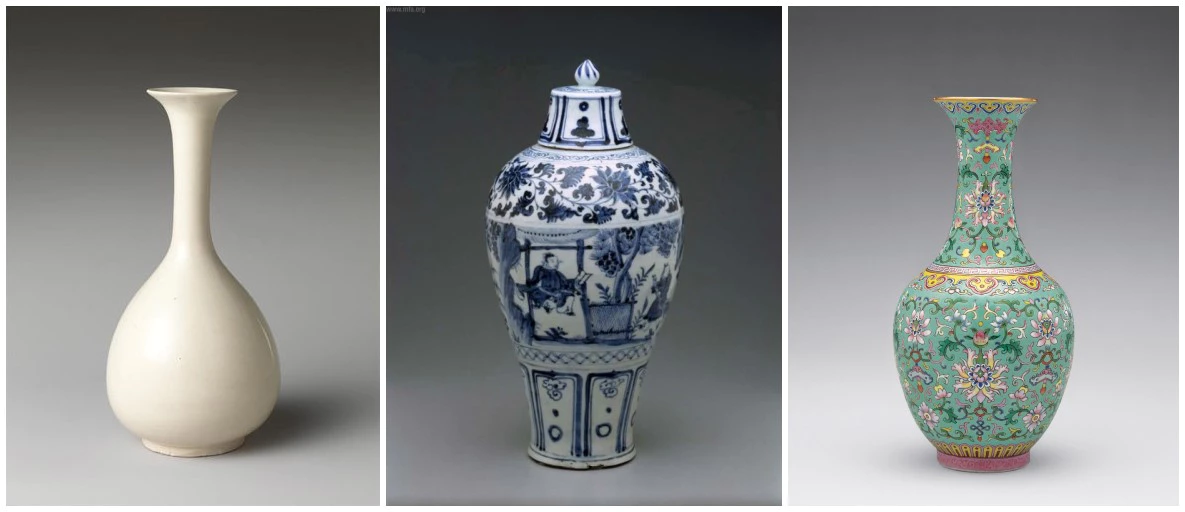
That’s the little rule we’ve teased out after talking about medieval France.
That’s it for this installment. Next time, we’ll continue with the Renaissance—which, actually, had already come up when I mentioned sixteenth-century France—and then move on to the tumultuous Age of Exploration and the age of great revolutions.
Leave a Reply