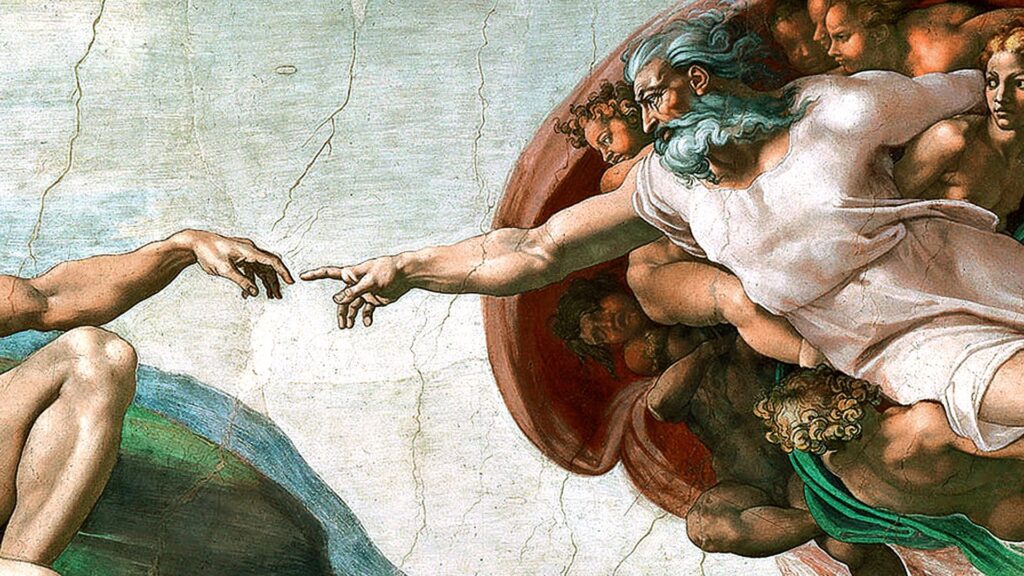
In the opening chapter of the Bible, Genesis, there is a familiar little scene about the creation of humankind—a—
While he (Adam) was fast asleep, He (the Lord) took out one of his ribs and closed the flesh back up—
Using the rib taken from him, the Lord made a woman and brought her to Adam. Adam said—
Finally, I found you, my
bone of my bone, flesh of my flesh!
She shall be called “Woman,”
because she was taken from man.
Okay, here’s the question: was Adam really missing a rib?
A missing rib obviously doesn’t make much sense, because any man can settle the matter with one quick bit of self-examination: the number of ribs on his left and right sides is exactly the same. No rib is missing. Unless God originally made Adam with an extra rib on one side or the other? That seems a little stingy.
So “rib” is very likely a mistranslation in the Bible we have today, or a later misreading. In the earliest version of the story, the bone missing from the man was not a rib. So which bone might it have been?
A biologist from Swarthmore College in the United States and a biblical scholar from the University of California, Los Angeles jointly investigated this question (very seriously). Their conclusion was—
Adam was missing not a rib, but a penis bone!
There is a striking difference between human males and other male primates: men don’t have a penis bone (among primates, the only other monkey without one is the spider monkey).
I have to say, Adam’s missing a penis bone makes far more sense than his missing a rib! Because the penis sits on the body’s midline, missing a bone from it wouldn’t create the jarring asymmetry of missing one rib.
Besides, the penis is obviously closely related to sex and reproduction, so in ancient legends, turning the penis bone into the source of woman makes considerably more sense than saying woman came from a rib.
The two scholars also found evidence in etymology:
In Hebrew, the noun translated as “rib”—tzela (formed from the 18th, 12th, and 16th letters of the Hebrew alphabet)—can indeed refer to a rib cage. But it can also mean a mountain ridge (2 Samuel 16:13), a side chamber (such as the side chambers surrounding the Temple mentioned in 1 Kings), or a pillar made of pine or fir, or the framework of a building (1 Kings 5:15–16). So the word can be used to mean a structural support beam. (Quoted from The Evolution of Beauty.)
And doesn’t “structural support beam” happen to be a perfect allusion to the main function of the penis bone? —
The two scholars even found anatomical clues in the original text of Genesis. Genesis 2:21 mentions another etiological detail:
“And closed up the flesh”—The Lord God closed up the flesh. This detail reflects a visible feature unique to the human male penis and scrotum—the midline seam. On the human penis and scrotum, the edges of the urogenital folds meet with the urogenital sinus (that is, the urethral groove) to form a seam… The story of God closing up Adam’s flesh thus “explains” the origin of the seam on the external genitalia. (Quoted from The Evolution of Beauty.)
—I absolutely love research with this kind of gloriously wild leap of imagination~~
As for why human males “lost” their penis bones—that’s another story.
References:
The paper by the two scholars discussed in this article: Gilbert, S. F., & Zevit, Z. (2001). Congenital human baculum deficiency: The generative bone of Genesis 2: 21–23. American Journal of Medical Genetics, 101(3), 284-285.
Note
- This article in the “New Psychology Insights” series was written to accompany the related content of Zhichao Wei: New Psychology Insights Course. It was a short popular-science essay published on the now-closed platform Fantuan; the original link no longer exists.
Leave a Reply