Disclaimer: The following text is excerpted from Chapter 3, “The Miraculous Power of Consciousness,” of my book The Alluring Illusion: Psychological Secrets in Light and Shadow. That entire chapter is basically an attempt to demystify pen fairy rituals from a psychological perspective. It was originally posted online as a preview, so I have reposted the whole thing here.
The Miraculous Power of Consciousness
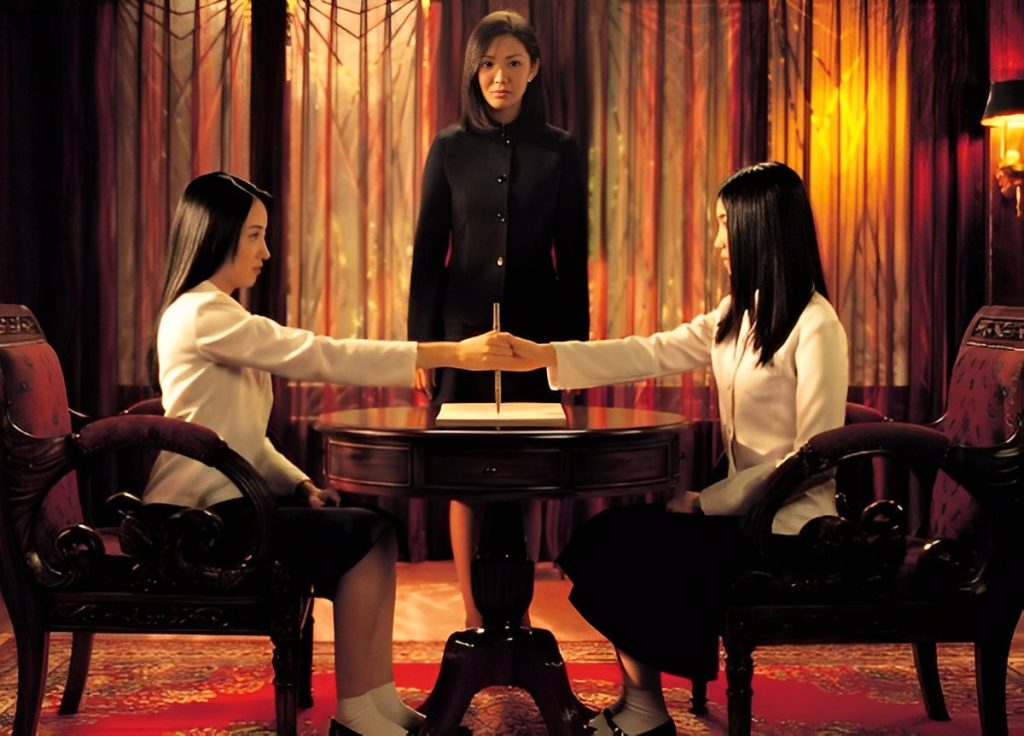
The Korean horror film Bunshinsaba has a scene like this: two girls cross their hands around a pen, place its tip on a sheet of paper, and finish reciting a spell. The pen fairy takes possession of them, and a mysterious force tugs at their hands, making the pen write words on the paper. The two girls had meant to ask the pen fairy to curse the classmate who bullied them, but they end up bringing disaster on themselves and becoming victims of possession.
The Japanese horror film KOKKURI こっくりさん: three middle-school girls write all the hiragana and katakana on a sheet of paper, then simultaneously touch a copper coin placed on the paper with their fingers. Once the spell is finished, the summoned coin spirit possesses the coin and moves it across the hiragana and katakana, forming words that foretell good or bad fortune.
The Hong Kong horror film Ouija: several people turn a small saucer upside down on a sheet of paper covered with commonly used Chinese characters and place their fingers on it. Once the spell is finished, the saucer spirit drags the saucer around the paper. If you ask it a question, it stops on certain characters one after another, and the resulting phrase is its answer.
The American horror film Paranormal Activity: the homeowners leave a Ouija board at home while they are out, and a vengeful spirit moves the planchette across it to reveal the homeowners’ fate.

Pen fairy, pen fairy, come out of your cave
Don’t assume that inviting pen fairies, coin spirits, and saucer spirits in these scenes is merely a horror-movie invention. In fact, all of them are real-life “summoning a ghost” games. They have a long history, and they remain remarkably popular today. The game of “inviting the pen fairy,” for example, is practically a required course for Chinese female college students.
On Chinese college campuses, the game of “inviting the pen fairy” generally follows a procedure like this (I have summoned one myself more than once, so the description below is absolutely accurate. The process looks pretty eerie, but I promise I will give a scientific explanation):
First, since you are inviting a “ghost,” the ritual needs a sufficiently heavy yin energy. Generally speaking, girls have heavier yin energy, so it usually takes two girls to invite the pen fairy; quite a few boys simply cannot summon one. Then you need to choose a time with especially heavy yin energy. The Ghost Festival is naturally ideal; if you cannot wait for a date like that, summon it around midnight, the time when yin energy is heaviest during the day. Next, it is best to find a room with heavy yin energy. One where a ghost has supposedly appeared is ideal; if there is none, a north-facing room that gets little light will do. When inviting the pen fairy, it is best to dim the lights a little.
Once the right time, place, and people are all in place, take a pencil and a sheet of A4 paper. Draw the following markings and words on the A4 paper:

The circle in the upper right corner is the “spirit cave,” the passage through which the pen fairy travels between the worlds of yin and yang. The numbers and words in the middle are what the pen fairy uses to answer questions. The two people inviting the pen fairy must first agree on a spell to summon it, such as “Pen fairy, pen fairy, come out of your cave.” Then sit facing each other and hold the pen as shown below (you can also use the hands on the same side), placing the pen tip on the “spirit cave”:

Keep your grip natural and relaxed; don’t press too hard. Then one of you recites the spell. If luck is on your side, the instant you finish the last word, you will experience something genuinely uncanny: a force will pull your hand into motion. It will tug your hand and make the pen tip draw irregular lines on the paper. Strangely, before you recite the spell, you cannot feel this force at all. You may suspect that your partner is fooling around, but you soon notice that their expression is even more astonished than yours.
Now you can start asking the pen fairy questions. Begin with the “past”—things that have already become facts—such as, “Am I a girl?” As soon as you ask, the pen, which had been wandering randomly, may suddenly move toward the character meaning “yes” and circle it. You can also ask about your birthday, and the pen fairy will circle the numbers to answer you. What is astonishing is that, for these questions about the past, the pen fairy’s answers are often correct, even when they concern things you yourself can barely remember.
That is not even the eerie part. The really eerie part is that you can next ask about the “future,” such as, “Will I pass tomorrow’s C-language exam?” If the pen fairy circles “no,” you had better watch out. For questions like whether you will pass an exam, the pen fairy’s answer is also right eight or nine times out of ten.
But even that is not the eeriest part. If a third person is present, you can ask the pen fairy questions about that person, who is not holding the pen. This is the strangest part: sometimes the pen fairy can answer questions about the third person—even correctly when the people holding the pen do not know that person at all.
After all the questions have been asked, one of the people holding the pen can recite a prearranged spell, such as “Pen fairy, pen fairy, return to your cave.” The moment the words are spoken, the pen goes straight to the spirit cave, and the force pushing it suddenly disappears. Everything returns to normal, showing that the possessing pen fairy has left. The game is over.
The process of inviting the pen fairy contains roughly these mysterious phenomena:
1. It can be summoned only when yin energy is heavy;
2. A “ghost” possesses you and controls the movement of your arm;
3. It knows your past;
4. It predicts your future;
5. It knows the past of an onlooker.
Faced with such supernatural-seeming phenomena, believers in the supernatural will treat them as ironclad proof that ghosts and gods exist, while skeptics will scoff: “What’s so complicated? One of the people holding the pen must be faking it.” But the truth is that both sides are wrong. The pen fairy is not supernatural, but neither is anyone faking it. The truth is that the two people holding the pen have actually been hypnotized: possession by the pen fairy is a special hypnotic state.
Consciousness/Unconsciousness: The Mind’s Dual Structure
To explain the hypnotic state, we have to start with Freud, one of the founding fathers of psychology. Friends who have seen David Cronenberg’s A Dangerous Method may know something about Freudian theory. In the film, Freud and Jung use hypnosis to help a patient with hysteria recall childhood memories and trace her mental illness to its roots. The reason the psychotherapists in the film look for the roots of mental illness this way is that, according to Freud, mental illness is caused by certain childhood desires being repressed in the unconscious in an abnormal form. And the “unconscious” is the central concept of Freudian psychology.

In Freud’s view, the human mind is like an iceberg floating in the sea. Our consciousness is the part above the surface, merely the tip of the iceberg. Hidden below the surface is the iceberg’s enormous main body: the “unconscious.” The unconscious is so vast that it is actually the main body of the mind. Paradoxically, it is also difficult for our own consciousness to perceive it clearly. The unconscious contains mostly irrational emotions, desires, and instinctive needs (such as cravings for food and sex), yet these are the main forces driving human behavior [1]. Much of the time, consciousness can do little more than stand aside. In Freud’s view, the unconscious is an invisible, intangible ghost in the human mind, and people are slaves to it.

In the years that followed, many details of Freud’s theories were abandoned by the empirical psychology that flourished later, because they lacked reliable empirical support [2]. But the core concept of the “unconscious” has shone ever more brightly with the passing years. Modern psychology has accumulated abundant reliable evidence that many human behaviors are driven by psychological forces resembling the unconscious. A leading figure here is the psychologist Daniel Kahneman, who won the Nobel Prize in Economics for studying irrational decision-making. In his magnum opus Thinking, Fast and Slow, Kahneman divides the human mind into two systems [3]:

System 1—the irrational system, governed by the unconscious, easily influenced by suggestion, and reliant on intuitive judgments—corresponds almost perfectly to Freud’s unconscious. When we talk about “instinct,” “intuition,” or acting “subconsciously,” what we really mean is System 1. In modern psychology, we prefer using unconsciousness instead of subconsciousness. The word “unconscious” better highlights the fact that System 1 lacks clear awareness.
System 2—the rational system, with clear consciousness and faith in its own rational and logical judgments—corresponds almost perfectly to “consciousness.” When we talk about “will,” “rationality,” or “reason,” what we really mean is System 2.
Even when we say the word “I,” we are actually referring to System 2. When you think, “How should I…?” that “I” is really the sum of the thoughts you can currently sense and be conscious of. So, putting it a bit dramatically, what we usually call a person’s “thoughts,” “subjective world,” or “soul” is really System 2. System 2 stands out so strongly that we assume it is everything in the mind. Yet the results of extensive psychological research point in exactly the opposite direction from common sense—as far as consciousness is concerned, “un” is far more powerful than “con.” The essence of consciousness is actually its absence.

The power of the unconscious shows itself in at least two situations. First, in certain special physiological states, the unconscious appears in an astonishing form. Second, a great deal of human knowledge actually operates through the unconscious; the unconscious is everywhere. In this article, we will first look at how the unconscious manifests itself in certain special physiological states.
The Unconscious Takes Over the Body
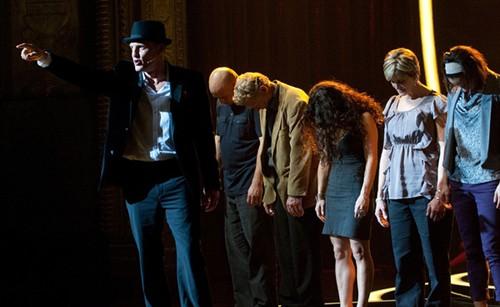
Among the special physiological states that can activate the unconscious, the most representative is the hypnotic state. Hypnosis here does not mean making someone fall asleep; it means using certain methods to induce a special state of mental trance. In Now You See Me, Woody Harrelson’s “mentalist” is actually a master hypnotist. For example, in the film he can make someone instantly enter a trance by striking their body hard. This is a real hypnotic induction technique [4].

In a person’s normal waking state, system 2 acts like a firewall. Our rational thinking infers and analyzes other people’s intentions. Once we realize that someone is trying to understand what’s going on inside us, and we don’t want to expose ourselves to them, we raise this firewall and reject their suggestions. A hypnotist, however, can use certain guiding techniques to make system 2 crash. At that point, clear consciousness is dismantled, and the mind is taken over by system 1, which is ruled by the unconscious. Since rational thinking is asleep, our psychological defenses are lowered along with it, making us especially receptive to all kinds of suggestions. In a hypnotic state, a magician or hypnotist can issue all sorts of instructions and, to some extent, manipulate the other person’s thoughts and emotions—for example, “I’m going to start counting now. As the numbers get higher, you’ll become angrier and angrier.” Some people in a hypnotic state really do feel a nameless rage rising as the numbers increase.
A magician or hypnotist can also plant certain “signals” in a hypnotized person’s consciousness, and these signals may continue to work even after the hypnotic state has ended. For example, Now You See Me has a scene like this: during a magic performance, a mentalist hypnotizes a group of spectators and plants an instruction in their minds: as soon as they hear anyone say the words “Don’t move,” they should all tackle that person like a rugby quarterback. He then brings the spectators out of the hypnotic state. Afterward, they can no longer remember the instruction, but when they hear someone shout “Don’t move,” they still involuntarily tackle that person. This scene from the film isn’t actually all that exaggerated. In real life, experienced hypnotists really can do something similar. The fourth episode of the second season of the American documentary series Curiosity once demonstrated a brainwashing experiment. The hypnotist in the program successfully brainwashed an ordinary law-abiding person into becoming a killer, using exactly this kind of suggestion that continues to work after waking.
Dreams are actually very similar to a hypnotic state. In the film Inception, there is a basic premise: to implant an idea, you have to do it in a dream. This premise makes some sense. A dream is also a state in which consciousness and rational thinking are suppressed. The unconscious becomes relatively active in a dream, making people more susceptible to suggestion.
In the 1980s and 1990s, China went through a period of nationwide qigong fever. At the time, many so-called qigong masters who were popular across the country would go on tour giving so-called “qigong power demonstrations.” In these demonstrations, the qigong master would “send power” to everyone in the audience, and some spectators would involuntarily wave their arms and dance around, or become wildly elated. This incredible phenomenon was really just a group hypnotic state. Many counselors and hypnotists trained in hypnosis can give “qigong power demonstrations” too; they can also hypnotize students collectively in a classroom. Those so-called qigong masters were simply skilled hypnotists.

The First Secret of the Pen Fairy
Let’s return to the pen fairy. The pen fairy’s most important secret is this: being possessed by the pen fairy is a hypnotic state.
First, let’s look at how people playing the pen fairy game enter a hypnotic state. Different people vary in how easily they enter a hypnotic state, and those who enter it easily are precisely the people who are more susceptible to suggestion while awake (because their system 2 defenses are weaker to begin with). In formal hypnosis experiments, researchers use various techniques to test people’s suggestibility. For example, a hypnotist might give you two glasses of water and tell you that one contains a tiny bit of sugar. You compare them and see whether you can taste which one is a little sweeter. After tasting them repeatedly, some highly suggestible people really do decide that one glass is sweeter. In fact, both glasses are just plain water; thinking one is sweeter is entirely the result of autosuggestion. Generally speaking, women are more likely to be fooled by this little test, because women are usually more suggestible than men[5]. This is why it is usually girls who can summon the pen fairy. Having “strong yin energy” really just means being highly suggestible.
As for my earlier claim that the pen fairy can only be summoned when there is strong yin energy, that was actually a form of hypnotic induction—in other words, suggestion. The more mysterious and bizarre the description, the more it arouses the other person’s curiosity; the more they believe what I’m saying, the stronger the induction becomes. The saying that “sincerity makes it work” simply means that you’re more willing to accept suggestions than people whose “sincerity” isn’t quite strong enough.
Next, the incantation “Pen fairy, pen fairy, please come out of the fairy cave” is actually a signal that activates the hypnotic state. Its essential function is the same as the hypnotist in Now You See Me striking a spectator to make them enter a hypnotic state quickly. It works precisely because you expect something extraordinary to happen after you finish saying the incantation. Once again, it’s just that “sincerity makes it work.”
Those are the secrets of “yin energy.”
The Second Secret of the Pen Fairy
Once the incantation is finished, the two people holding the pen enter a hypnotic state. A real hypnotic state isn’t simply what certain movies about psychological counseling portray: lying on a sofa with your eyes closed and babbling nonsense. Hypnotic states actually come in many different levels and types. In many hypnotic states, although part of the hypnotized person’s consciousness is suppressed, they can keep their eyes open, walk around, and talk—rather like someone who’s drunk.
The hypnotic state involved in the pen fairy game is called “automatic writing” in academic terms. We can understand “automatic writing” simply as a separation between the brain region that controls movement and the brain region that senses this movement. In other words, although you are controlling your hand’s movements yourself, you don’t perceive yourself as controlling them. This is one of the common forms of psychological dissociation in hypnosis. For some highly suggestible people, this state can even be induced on their own (and people who are less suggestible can do it too if they spend a little more time).
For example, try finding a 10~20-centimeter piece of string, hanging a weight from its lower end and pinching its upper end between your fingers. Then command your hand not to move, and use your mind to command the weight to swing from side to side. If you’re highly suggestible, it won’t take long before you see the weight begin to swing in response to your mental commands. Tell it to stop and it stops; tell it to rotate clockwise or swing back and forth, and it obediently does what you say—all without you feeling that your hand is moving. This is the real-life version of telekinesis.
The ultimate use of “automatic writing” is that some people can even use it to write novels. For example, the American writer Emily Hutchings once claimed that she was possessed by the ghost of Mark Twain, who guided her hand to create the novel Jap Herron. In reality, however, the writer had simply hypnotized herself by some method, entered a state of automatic writing, and completed the work[6].
When summoning the pen fairy, it may be that the uncertainty of hand movements is far greater when two people’s hands are touching than when one person is alone, making it especially easy to enter a state of “automatic writing.” As a result, you feel that the pen fairy has possessed the pen and started pulling your hand around. So there is no such thing as a “ghost possession” at all; from beginning to end, it is just the two of you moving the pen.
The incantation used to make the pen fairy leave before the game ends is an instruction to end the hypnotic state. If the unconscious minds of both people holding the pen accept this instruction, then as soon as the pen returns to the fairy cave, they will immediately feel the force dragging their hands disappear. But if one of them starts thinking something like, “What if the pen fairy gets stuck inside me and refuses to leave?” their body may well resist the instruction and remain in the hypnotic state. Then you get a situation in which the pen fairy is possessed but refuses to leave. The more you worry that “it’s easy to invite a ghost but hard to send it away,” the more likely this situation is to occur. Naturally, this too is just that “sincerity makes it work.” If the pen fairy refuses to leave, just forcibly pull your hand back. There is absolutely no need to worry that the ghost will haunt you because of it.
The Third Secret of the Pen Fairy
After the ghost possession is complete, all the questions you ask the pen fairy are actually suggestions and instructions received in a hypnotic state. The answers given by the pen fairy are really answers produced when the unconscious minds of the people holding the pen manipulate it. It’s not hard to understand, then, why the pen fairy knows about things you’ve experienced in the past. Also, memory in a hypnotic state can display certain traits that differ from memory in a waking state, so sometimes the pen fairy can even answer questions about experiences you thought you’d already forgotten. Of course, quite a bit of your own imagination is mixed in too, so they aren’t necessarily all facts. For example, you can even ask the pen fairy about its sex, its date of birth, and its identity, and it will give you answers that sound perfectly convincing. But these are really just the imaginations of the two of you at work. Once, for example, I summoned a pen fairy that claimed to be a eunuch from the Qing dynasty. That may have been my reaction to watching too much Empresses in the Palace around that time.

The Fourth Secret of the Pen Fairy
So why can the pen fairy even guess whether you’ll pass tomorrow’s exam? This is still the result of autosuggestion. For example, the fact that you ask whether you’ll pass an exam often means that you aren’t confident about it; what you’re worried about is precisely failing. This anxiety in your unconscious is reflected in the answer given by the pen fairy. When you take the exam the next day, if you keep thinking that a ghost said last night that you wouldn’t pass, you’ll very likely perform even worse. Failing is then completely understandable. This is called a “self-fulfilling prophecy”: when you unconsciously expect a certain outcome to happen, and you are also a participant in the prophecy, you unknowingly push events in the direction of that prophecy, and the prophecy often comes true.
People’s expectations have tremendous power. They can often distort the course of events and bring it closer to the predicted result. Scientists and doctors discovered long ago that medicine has something called the “placebo effect.” As long as patients believe they have taken medicine, their condition may improve even if what they actually swallowed was a completely ineffective lump of flour. In fact, simply being admitted to a hospital, seeing doctors in white coats gathered around them, and feeling that they are being treated can also make their condition improve. Clearly, patients’ expectation that they will get better really can cause them to get better. This is why, when testing a drug’s efficacy, you can’t compare a group of patients who took the drug with another group who didn’t: even if the patients who took it really do improve, it may not be because the drug worked, but because the “placebo effect” was at work.
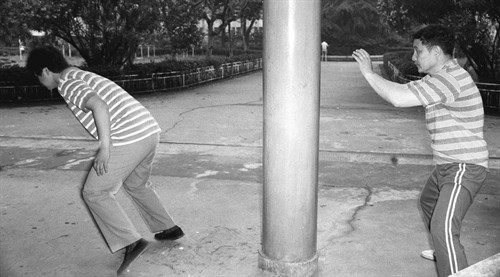
Those qigong masters also often used people’s expectations to put on a show. For example, some qigong practitioners claimed they could use their qi to knock over people standing several meters away, without touching them, while those who fell insisted that they really had been knocked down by some force. After obtaining a practitioner’s consent, one group of scientists hung an opaque curtain between the practitioner and the people being pushed, so the latter could not see what the practitioner was doing, and then asked him to perform his feat. The result was quite amusing: the people being pushed still fell, but the timing of their falls was random. Some fell before the practitioner had even started and claimed they had been pushed down. Others simply refused to fall, even after the practitioner had been pushing for ages. This makes it clear that being “pushed down” was really just the result of people’s expectations influencing them. When they saw the practitioner using his qi, they expected themselves to fall—and so they really did. When they could not see what he was doing, they had to make a wild guess about when they were supposed to fall [7].
In short, although the pen fairy looks extremely eerie at first glance, in reality it is nothing more than the unconscious manifesting itself and taking control of the body in a hypnotic state. It gives us a rare window through which, while our conscious mind is basically awake, we can witness the extraordinary power of the unconscious. In the chapters that follow in this book, we will continue to experience just how powerful the unconscious can be.
As for the most unbelievable thing about consulting the pen fairy—why it can sometimes answer questions from a third person who is not holding the pen—let me keep you in suspense. I will give you the answer in the chapter called “Illusion.”
References
[1] Sigmund Freud, ed. Che Wenbo. (2004). The Collected Works of Sigmund Freud, Vol. 1: Studies on Hysteria. Changchun Publishing House.
[2] Freud had a formidable ability to construct theories, but was not good at (or perhaps not interested in) gathering empirical evidence. Most of his theories were built on observations of cases of mental illness, many of them single cases. From the perspective of modern empirical science, Freud’s theories lack reliable empirical support.
[3] Daniel Kahneman. (2012). Thinking, Fast and Slow. CITIC Press.
[4] Ormond McGill. (2010). The Encyclopedia of Genuine Hypnotism. Jilin Literature and History Publishing House.
[5] Roger A. Pagea & Joseph P. Green. (2012). An Update on Age, Hypnotic Suggestibility, and
Gender: A Brief Report. American Journal of Clinical Hypnosis. American Journal of Clinical
Hypnosis, 49(4), 283-287.
[6] Richard Wiseman. (2012). Paranormality: Why We See What Isn’t There (pp. 123). Hunan Literature and Art Publishing House.
[7] Zoltan Dienes. (2005). How to catch a cricket ball. Lecture notes from a 2005 talk given by the Department of Psychology at East China Normal University.
Filed under
- This article is Chapter Three of The Alluring Illusion: The Secrets of Psychology in Film.
Leave a Reply