
Disclaimer: The following text is excerpted from my book The Alluring Illusion: Psychological Secrets in Light and Shadow, from the chapter “Wonderland: Sleepwalking.” This chapter examines, from a psychological perspective, whether the dream rules in Inception have a scientific basis and whether they could actually happen. For copyright reasons, I can only reproduce part of it here. I’ve also made a few changes to the wording.
Wonderland: Sleepwalking: Nine Questions and Answers About Inception (Excerpt)
How much truth is there, and how much fiction, in Inception’s seemingly wild ideas about dreams? Which ones are just myths? And which ones are quietly edging closer to reality thanks to scientists’ efforts? Here are my nine questions and answers about Inception.
Q1: Can we enter someone else’s dream?
(Omitted)
Q2: Can dreams leak our secrets?
(Omitted)
Q3: Can you remember your dreams?
(Omitted)
Q4: Why implant an idea in a dream?
(Omitted)
Q5: Can losing your balance jolt you awake from a dream?
(Omitted)
Q6: Can we move with superhuman speed in dreams?
Inception has plenty of action scenes. One after another, its protagonists move with astonishing agility in their dreams; hand-to-hand fights and gunfights are all in a day’s work. Isn’t that very different from our real dreams? In most people’s dreams, we do feel a kind of movement particular to dreams: perhaps the helplessness of being trapped and unable to escape danger, or the sense that our movements are painfully sluggish. Even in the rare dream where we fly, it doesn’t feel like floating lightly on the wind; there’s a very noticeable drag to it. What’s going on?
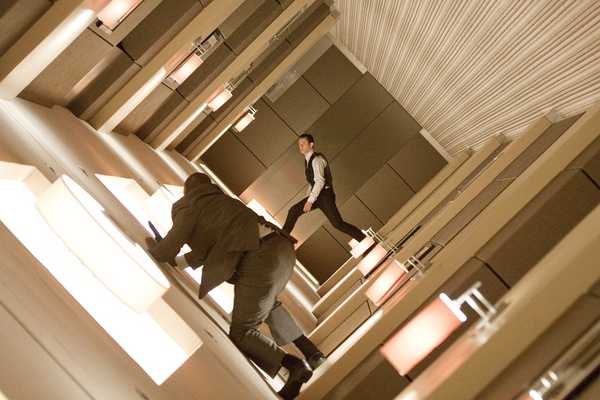
Except in a very small number of cases (see Q8 in this chapter, on lucid dreaming), we can’t tell whether we’re in a dream or reality while dreaming. The brain therefore mistakes the dream for a real situation, and the body tries to respond with real physical actions. But without some counteracting mechanism, we’d all be sleepwalkers—and that would obviously be extremely dangerous. Imagine our ancestors living in a cave not far from a cliff. One night, someone dreams that a tiger is chasing them, so their body actually gets up and runs out of the cave. Naturally, they’d go over the cliff after only a few steps.
Fortunately, our bodies have evolved a countermeasure. Once we enter sleep, the spinal cord sends signals that keep the body paralyzed and still, so we don’t produce physical movements in response to the surrounding environment. That way, even if we’re being chased and killed in a dream, our legs can’t actually run in the real world. Some scientists speculate that this may be where the slow, clumsy feeling of movement in dreams comes from[1]. Our torso is paralyzed, but one organ is an exception: the eyes. In dreams, although we can’t move our hands and feet, we try hard to move our eyeballs to look at whatever we’re seeing in the dream[2]. That’s why dreams are always accompanied by rapid eye movement.
Scientists have continued to speculate that if bodily paralysis protects us during sleep, then the existence of dreams themselves may also be a protective mechanism. During certain stages of sleep, the brain receives a relatively intense concentration of messy signals from its own nervous system. If it didn’t process those signals in a plausible way, we would wake up. And so dreams appear. The brain integrates those disordered neural signals into dreams that are just coherent enough to be acceptable, rationalizing the signals so we don’t have to jolt awake[3].
Neural signals from the body can become the raw material of dreams, and Inception shows this more than once. In the opening sequence, for example, just before the male lead wakes from a “dream within a dream,” his companions submerge his body in a bathtub. The moment water touches him, he sees the room in the “dream within a dream” being flooded. Later, the chemist drinks too much water and desperately needs to pee, so it starts raining heavily in his dream.

So dreams may be a kind of cage that keeps our bodies imprisoned in sleep. Want to run at full speed and walk freely inside that cage? It doesn’t seem very likely.
Q7: Does time pass more slowly in dreams?
The most interesting premise in Inception is probably that time passes more slowly in dreams. Much of the gripping dramatic tension in the second half of the film owes itself to this idea.
Does time really pass more slowly in real dreams? In terms of subjective experience, it does. Plenty of people have had this experience: they doze off during an afternoon nap and have a dream that feels at least an hour or two long and packed with events, only to wake up, look at the clock, and discover they’ve slept for barely ten minutes. Some states of consciousness resembling dreams show the same striking mismatch between subjective and actual time. One example is the “death game”[4], which became briefly popular around 2004 in many Chinese primary and secondary schools and some entertainment venues. The basic procedure was to hold your breath until your chest was full, press your back against a wall, and have someone else shove hard against your chest. You would instantly pass out, then wake up after the other person slapped your face a few times. The uncanny part was that in those few seconds of unconsciousness, everyone experienced an extraordinarily long dream. Some felt they had taken a trip to the underworld; some even felt they had lived an entire lifetime in the dream.

Inception explains the slowing of dream time by saying that the brain’s potential is released during sleep and its operations speed up, making dream time feel longer. There is indirect scientific evidence for this idea. Scientists first let mice play in an amusement park for 50 minutes, recording the wave patterns of their cerebral-cortex activity with electrodes as they played. Then they let the mice sleep. They found that the cortical activity from the animals’ waking play was replayed during sleep. This suggested that the mice were dreaming about playing—and, even more remarkably, the replayed cortical activity moved at 6-7 times the speed of the waking activity[5].
My own speculation about why time seems to slow in dreams is different (and currently has no research to support it): perhaps it isn’t because the brain is working faster, but precisely the opposite. The human brain may actually be running more slowly during sleep, especially with consciousness itself largely offline. As a result, events in dreams struggle to form a coherent, precise chain of logic. They’re short on detail and full of jumps. For example, going from one street to another in a dream may take only a second, because the brain simply doesn’t have enough resources to organize all the details and links involved in completing that action. In the dream, you essentially “jump” there. After waking, though, we use the waking-world standard for the same action to experience the dream sequence, turning the “jump” into a “walk,” and in the process stretching out dream time. So the apparent slowing of time in dreams may simply be an illusion produced by experiencing dream events according to our waking sense of time.
In other words, a dream is really just a trailer containing the best bits, but after waking up we convince ourselves we watched the whole movie.

Q8: Can we control our dreams?
One feature clearly distinguishing the dreams in Inception from reality is that the dream thieves can carry their fully lucid consciousness into a dream, with no difference from their waking state. That’s nothing like real dreams, in which our consciousness is severely weakened.
In the film, the most immediate consequence is that the dream thieves know clearly that they’re dreaming. And once they realize the world they’re seeing isn’t real, they can play god in it, reshaping the world through sheer will. The architect curls a city with her mind and creates a magnificent corridor out of several mirrors. They become the controllers of the dream. If that were possible, what an astonishing experience it would be. Can we control dreams this way in real life?

The answer is yes. This special kind of dream, in which you realize that you’re dreaming, is called lucid dreaming. For most people, though, it’s a rare and unpredictable treat. I probably have one such experience per year on average. In one dream, for instance, someone chased me to the edge of a cliff. Suddenly I realized I was dreaming—and people don’t die from falling in dreams. So I jumped off the cliff with considerable pleasure and escaped the danger. Sadly, such a cool experience is incredibly rare. Wouldn’t it be great to enter this state regularly? Then you could do anything you wanted in a dream: fly, see people you want to see, play Superman, play God, “have dinner with Ai Iijima.” For creative people, lucid dreaming can also help them remember ideas from dreams. Many of us have felt that our imaginations can be astonishingly powerful in dreams. For creative people, those visions can be important sources of inspiration. The German chemist August Kekulé, for example, dreamed of a snake biting its own tail and had an insight into the structure of the benzene ring. Imagine a painter seeing a highly creative pattern in a dream. In an ordinary dream, the pattern might vanish in an instant, and after waking it would be hard to recall its details. In a lucid dream, however, the painter could make themselves stay in front of the pattern and study it carefully, making it much more likely they would still remember it after waking.

So, can we deliberately increase the frequency of lucid dreams? With certain methods and techniques, yes.
The first technique is to develop a habit in daily life of frequently asking yourself, “Am I dreaming?” When you’re just starting to practice, you can set reminders and reflect on the question several times a day at fixed times. After reflecting, perform a few actions to check whether you’re dreaming. Look at a clock, for example: in reality, the second hand moves regularly, but in a dream it may not. You can also look in a mirror. In reality, the mirror shows an accurate image of you; in a dream, you may see something bizarre. And if you’re feeling particularly reckless, you can try banging your head against a wall. In reality it will hurt; in a dream, nine times out of ten you’ll pass straight through it. Once this habit is established, the thought “Am I dreaming?” may pop up in your dream from time to time as well. In fact, the moment that thought appears, the lucid dream is practically a success. Next, you’ll instinctively look at clocks, mirrors, and walls as you normally do. When you see something strange, you’ll know for sure that you’re dreaming.[6]
The second technology is much more energy-efficient. A few American tech companies used crowdfunding to develop a device called Remee [7]. As long as you wear it while sleeping, it guides you into lucid dreams (though it may not work for everyone; and even more advanced lucid-dream induction devices have already entered the market, such as the Aurora Dream Headband: a wearable device for freely exploring lucid dreams). Its working principle is as follows: inside the eye mask is a row of small lights that can flash in any sequence you set. After you have been in bed for a few hours, the lights begin emitting light at a certain brightness in the sequence you chose. The brightness cannot be too high: light that is too bright will wake you up directly, but it cannot be so dim that you cannot sense it at all with your eyes closed. Thus, when the light flashes at just the right brightness, you are quite likely to notice it in your dream, which reminds you that you are dreaming. In one of my own experiments, I set the light signal to flash first from left to right, then from right to left, and finally have all the lights flash together. The signal entered my dream in a rather hilarious way—I dreamed I was playing the arcade version of Street Fighter, fighting the final boss. The Boss Vega I controlled threw punches first from left to right, then from right to left, and then my character suddenly turned into a gourd doll and fired a super-sized, full-screen flash that KO’d my opponent.

Actually, if you want to dream about exactly the dream setting you have in mind, you do not necessarily need lucid dreaming. There is also a roundabout way to get there. It exploits a weak spot in human psychology—the rebound effect. One rather ridiculous psychological feature is that the more you demand that you do something, the more your body moves in the opposite direction. The more you tell yourself to relax, the more tense you become; the more you tell your hand to hold still, the harder it trembles. Using this effect, the more you tell yourself before sleep not to dream about something, the more likely you are to dream about it [8].
So, if you want to have dinner in a dream with your goddess or god, your method is to silently pray for five minutes before falling asleep: “Whatever you do, don’t dream about her/him, absolutely don’t dream about her/him…”

Q9: Could reality be a dream?
At the end of the last century, riding the wave created by The Matrix, a famous philosophical thought experiment—the “brain in a vat”—became a popular theme in quite a few films. The “brain in a vat” says that, supposing a mad scientist removes a person’s brain from their body, keeps it biologically alive in a vat of nutrient solution, connects its nerve endings to a supercomputer, and has the computer transmit all the same neural and electrical signals to the brain as the body would, while providing appropriate feedback to the signals sent out by the brain, could that brain realize that it was living in a false reality? [9]
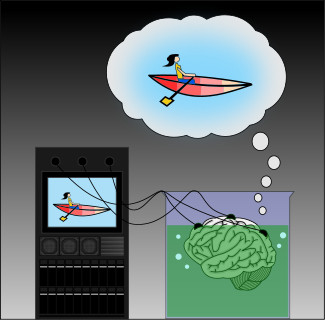
Let me quote one more thought experiment: “How can you be sure that you are not in such a predicament?” Descartes had considered this question long ago: Can we be certain that the world we see really exists? Descartes’ conclusion was that we cannot determine whether an external world exists, but there is one thing that must truly exist: the “I” that is questioning this world’s reality. A thinking “I” is the only thing whose existence can be established for certain. That is the meaning of “I think, therefore I am” (please, please don’t treat this sentence as a motivational slogan again).
For example, Neo in The Matrix begins in precisely this state of uncertainty. The computer-generated virtual reality of the Matrix is so realistic that at first he has trouble accepting that it is only a virtual world. There is a scene in The Matrix where the bald man with sunglasses sits in the Matrix, pokes a piece of steak with a fork, and says: “I know this steak doesn’t really exist. When I put it in my mouth, the Matrix sends an instruction to my brain telling me that this steak is juicy and delicious.” This is the predicament of the brain in a vat.

Dreams are actually another form of the brain-in-a-vat situation. So Inception inevitably has to touch on the “brain in a vat” question too, which is also what happens after the male and female protagonists fall into the deepest dream realm, “limbo.” The female protagonist takes limbo to be reality and is unwilling to wake up. Between the dream world and reality, which one is real and which one is false?

Does this strange idea in the film have any real-world significance? Is it possible that our real world is truly nothing more than a dream? Could there come a day when we suddenly wake up in shock and discover that life was only a long, hazy dream?
Let’s carry out a theoretical extrapolation. If I were merely someone in a dream, how high would my IQ be if we converted everything I experience in this dream into intelligence? There is far, far too much knowledge in our world. With my IQ, if I wanted to understand all the knowledge in this world, then by the most conservative estimate it would probably take at least 10,000 lifetimes. Even if I lived 10,000 times and eventually understood all that knowledge, I estimate I would need another 5 times as long to master it all. In other words, I would have to live 50,000 lifetimes before I could more or less get a handle on this world. Using the crudest possible calculation, the amount of intelligence displayed by this world is at least 50,000 times my IQ.
And as Q2 explained, in dreams our logical reasoning ability is taking a nosedive, which means our IQ also takes a serious haircut in dreams. A mathematics professor who teaches introductory calculus at a university in the real world might not be able to do two-digit multiplication in a dream. Let’s make a conservative estimate and say that IQ in a dream is 10% of what it is while awake. If our world is a dream and I am someone in that dream, then the IQ of the “person” from that dream who created our world must be at least 500,000 times mine!
I suppose Einstein was probably only 100 times smarter than me, “that’s all,” right? So who could a person 500,000 times smarter than me be… other than God?
References
[1] Allan, H. J., & Robert, M. (1977). The brain as a dream state generator: an activation-synthesis hypothesis of the dream process. Am J Psychiatry, 134(12): 1335-1348.
[2] Leclair-Visonneau, L., Oudiette, D., Gaymard, B., Leu-Semenescu, S., & Arnulf, I. (2010). Do the eyes scan dream images during rapid eye movement sleep? Evidence from the rapid eye movement sleep behaviour disorder model. Brain, 133(6), 1737-1746.
[3] Allan, H. J., & Robert, M. (1977). The brain as a dream state generator: an activation-synthesis hypothesis of the dream process. Am J Psychiatry, 134(12): 1335-1348.
[4] Elementary school student plays a pirated version of the death game “Squid Game”—Squid Girl faints. 39 Health Network. Elementary school student plays a pirated version of the death game “Squid Game”—Squid Girl faints (with images)
[5] Euston, D. R., Tatsuno, M., & McNaughton, B. L. (2007). Fast-forward playback of recent memory sequences in prefrontal cortex during sleep. Science, 318(5853), 1147-1150.
[6] LaBerge, S. (2009). Lucid dreaming: A concise guide to awakening in your dreams and in your life. ReadHowYouWant. com.
[7] http://sleepwithremee.com/
[8] Wegner, D. M., Wenzlaff, R. M., & Kozak, M. (2004). Dream Rebound: The Return of Suppressed Thoughts in Dreams. Psychological Science, 15(4), 232-236.
[9] Putnam, H. (1981). Reason, truth and history (Vol. 3). Cambridge University Press.
Archive
- This article is excerpted from my book The Alluring Illusion: Psychological Secrets in Light and Shadow.

Leave a Reply