
[Zhihu question] Why can I not get through reading the same book, but can get through listening to it?
Thanks for the invitation.
That’s because understanding language through reading is actually a very “unnatural” way of doing it. The brain circuits involved in reading aren’t something we’re born with; they are “repurposed” from brain regions that were originally responsible for other functions.
This idea is called the neuronal recycling hypothesis, proposed by French neuroscience big shot Stanislas Dehaene. He explains in Reading in the Brain how this hypothesis can help us understand the human ability to read.
I’ll give a simplified version here, based on my own understanding.
The central idea of the neuronal recycling hypothesis is this: after birth, people acquire all kinds of new skills through education and learning. At the neural level, that basically means forming neural connections in certain brain regions that are responsible for carrying out those skills.
For example, after years of learning to recognize written symbols and acquiring the ability to “read,” what happens at the neural level is that repeated reinforcement leads certain neurons in the brain to form structures different from those they had before learning. These neural structures can extract speech sounds and meaning from visual signals.
At first glance, there is nothing surprising about this: learning a skill corresponds to forming a new neural structure.
But there is a key problem in the details. Although the number of neurons in the brain is enormous, the brain doesn’t actually contain some untouched frontier waiting to be developed. None of its neurons are idle; there is no blank-sheet-of-paper neuron just sitting around with “nothing to do” and “waiting to be developed.”
So learning and training aren’t about drawing on a blank sheet of paper. They are about making alterations to a picture that is already full of things. In other words, learning and training modify neurons originally used to carry out Function A so that they can carry out Function B. This is neuronal recycling (although I think a more accurate term would actually be neural repurposing).
So there is a limitation here: Function A and the newly developed Function B have to share some similarity. They can’t be worlds apart.
You might be able to alter an illustration of Doraemon into Tom Cat, but you can’t alter the Mona Lisa into Tom Cat.
So “neuronal recycling” doesn’t mean randomly finding some neurons in the brain and modifying them. It can only modify neurons whose original functions are connected to the goal of learning.
In other words, learning isn’t a case of “anything is possible.” It can happen only when the brain’s own structure makes it possible.
Learning to read is exactly this kind of case. The reason humans can learn to read is that the brain already happens to contain neural structures whose functions are very close to “recognizing visual forms.” Dehaene puts it this way in How We Learn:
Before children learn to read, they already have a sophisticated visual system that lets them recognize objects, animals, and people, and name them. They can recognize images regardless of their size, position, or orientation in three-dimensional space, and they know how to connect names with those three-dimensional images. Neuronal recycling related to reading makes use of some of the neural circuits previously involved in naming pictures.
In other words, part of the neural structure in the brain’s visual cortex originally exists to recognize all kinds of objects, bodies, faces, plants, and orientations. Through years of learning, these neural structures are “repurposed” and transformed into neural structures used for reading and understanding written language.
Dehaene and his colleagues demonstrated this phenomenon with a series of very elegant brain-imaging experiments. They compared the brains of children before they began learning to read, children after they had learned to read, and adults who had never learned to read. The broad result is shown in the diagram below: the brain region responding to written words “invaded” the region used to recognize faces.
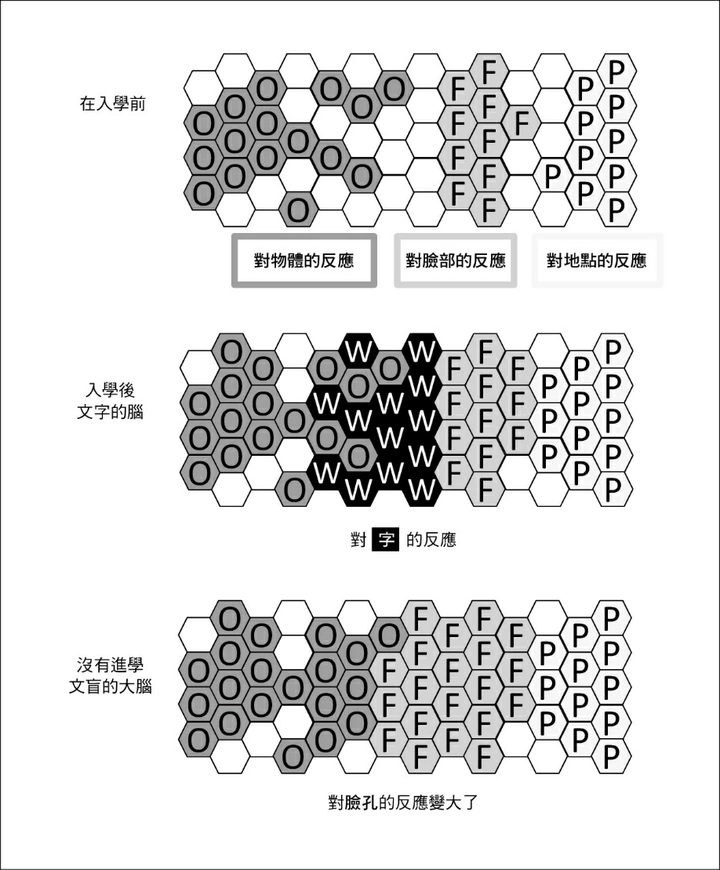
Returning to the questioner’s point, the reason “looking” is so difficult is that the ability to “look” (read) is achieved through extensive training after birth, by commandeering neural structures originally used for other purposes. It’s a “melon forced to ripen.”
“Listening,” by contrast, may be a more natural response. I looked through Dehaene’s works and couldn’t find any claim that the neural circuits involved in understanding spoken language undergo “neuronal recycling.” Understanding spoken language may be handled by more innate neural structures—a “naturally grown, sweet melon that ripens on the vine.” (I’m no expert in this area, so I welcome additions from other readers.)
A “melon forced to ripen” doesn’t taste sweet, and abilities acquired through training after birth are hard to use effortlessly. That’s why “reading words” takes more effort than “listening to words.”
Of course, another obvious reason “looking” is more effortful than “listening” is that looking requires active attention, whereas listening requires only passive attention. The latter is obviously easier. The principle is simple and doesn’t need much explanation. But I think the questioner’s description fits the situation above better.
That’s all.
By: Zhichao Wei
Leave a Reply