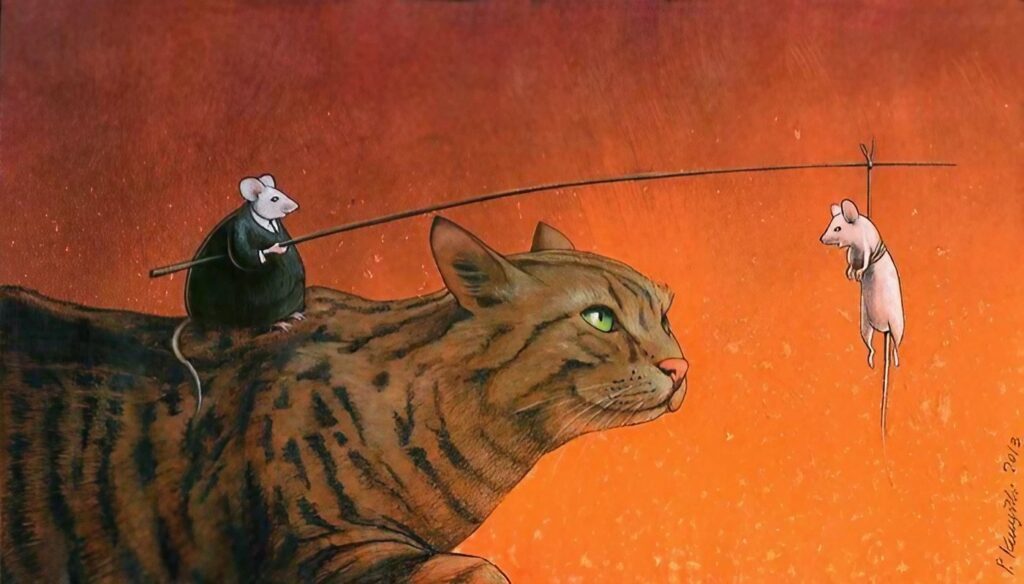
问「是不是」的门道。
In the few months since our show, Psychopunk, went live, many of the twenty-plus episodes we’ve released have been recommended by major media outlets and popular public accounts. Those episodes naturally received pretty impressive numbers of reads and listens.
But among the episodes that spread on their own—that is, the ones that got little media promotion and traveled mostly by word of mouth—the two on psychological methodology unexpectedly turned out to have the highest numbers of reads and shares: Episode 18, “How Can You Tell Whether a Psychology Pop-Science Book Is Trustworthy?,” and Episode 19, “Why Can’t We Live a Good Life Even After Hearing So Many Psychological Truths?”
This took us completely by surprise. Who knew you were all such eager learners!
The Thinking Methods Psychology Taught Me
Since that’s the case, let’s talk a little more about this. Starting with this episode, we’ve planned a short series called “The Thinking Methods Psychology Taught Me.”
This little series is a collection of experience-based takeaways. It’s about some thinking skills and habits I’ve picked up since entering the field of psychology. These thinking methods were originally meant to help with doing scientific research, but I think they’re also valuable in everyday thinking. Some everyday questions may be hard to make sense of on your own, but these methods can help you think them through—and suddenly, the fog lifts.
In fact, none of the thinking methods we’re introducing belong exclusively to psychology. A good way of thinking should work across fields and situations. Precisely because they’re broadly useful, these episodes can help you no matter what kind of work you do.
Ask Whether It Is So Before Asking Why
Today we’re talking about the first thinking method psychology taught me: “Ask whether it is so before asking why.”
You might be thinking: isn’t that an unwritten rule on Zhihu?
Exactly.
On Zhihu, if you open with “Why does this happen?” or “How does this work?” people will often remind you that you have to ask “Is it actually so?” first.
I came to understand this myself while studying psychology back then—well before this rule became popular on Zhihu. I discovered that this way of thinking was extremely useful for working through the academic questions I encountered.
For example, when we conduct psychology research, our starting point is often a “why” that grows out of everyday life:
“Why do Chinese people get angry so easily while driving?”
“Why do so many people become fans of pretty young male celebrities?”
But after asking this “why,” we don’t immediately start doing surveys and experiments, because it may not be a question genuinely worth researching.
Only after we follow up with a series of “is it so?” questions does the truly valuable question begin to emerge.
So let’s talk concretely about how to ask “is it so?” and what subtle points are involved.
Why Is Asking “Is It So?” First So Difficult?
Asking “is it so?” first is, of course, an excellent thinking habit. If the “is it so?” part doesn’t hold, then there’s no “why” to ask.
The logic is especially simple, right? But actually developing the habit of asking “is it so?” first isn’t that easy.
For example, I often see people online ask:
“Why do so many scientists believe in religion?”
You can pause for a moment and think about it: why?
Of course, you’re not going to fall for it now. You’re surely thinking: “Is it actually so?”
Back when I was still a naive little innocent, a question like this would hook me every time. My first reaction would absolutely be: “Oh, right! Why is that?”
I’d remember that when I was in the United States as an exchange student, quite a few university teachers I met did indeed have religious beliefs—and they were also first-rate scientists. What was going on? How strange.
—See? Even though you wouldn’t fall for it at this moment, don’t you feel that reacting like I did—simply following the questioner’s train of thought and thinking about “why”—is actually incredibly natural?
So why is it so natural?
Because that’s human nature.
What kind of nature? The compulsive kind.
If I say “Hoe the grain beneath the midday sun—,” don’t you feel an almost irresistible urge to say “sun”?
If I draw a circle on the blackboard and throw away the chalk just before closing the last tiny gap, don’t you desperately want to pick up the chalk and finish the circle?
It’s the same principle: when a questioner throws out a suspenseful hook, our first reaction is to solve the mystery and find out how it ends.
A suspenseful gap may contain danger, so instinctively we want to eliminate it. In psychology, this is called the “need for cognitive closure.”
Closure means shutting something. A “problem” is an open door, and as soon as the door is open, your first reaction is to figure out how to shut it.
That’s why we so naturally follow the frame the questioner has set up, instead of stepping outside it to consider whether the information built into the question is necessarily true.
So the habit of asking “is it so?” before asking “why?” takes a period of deliberate practice before it slowly becomes automatic.
Okay. Once you’ve developed that habit, the next question is: how exactly should we ask “is it so?”
I think we can do it in two steps.
How to Ask “Is It So?” Step One: Guess the Intent
The first step is guessing the intent. This method should be completely familiar to you after all those battles in the exam hall: senior-year teachers drilled you every day on how to guess what the test-maker was getting at. You may simply not have used the same trick outside exams.
Why guess the intent? Because the first “is it so?” question you need to ask may not be stated in the question at all; it may be hidden in the questioner’s intent.
Take the earlier example again: “Why do so many scientists believe in religion?”
Think about it: why does the questioner want to ask this? What is driving them to have this question?
It seems obvious to me that the questioner believes science and religion are mutually contradictory and mutually exclusive. If science and religion supposedly shouldn’t be compatible in the first place, then scientists believing in religion seems especially unreasonable. That is the questioner’s intent.
So the first “is it so?” we should ask is: “Are science and religion really mutually exclusive and incompatible?”
If you find yourself genuinely interested in this “is it so?” question, you can start doing some research. Look for books on the history of science and the history of religion; investigate the details of the conflicts between religion and science in the past; and see just how incompatible they really were, in which respects they clashed, and in which respects they actually got along quite well.
Maybe once you’ve asked this “is it so?” question, you’ll have an answer to the original one, because you may discover that religion and science can coexist harmoniously in many ways—so scientists believing in religion isn’t all that hard to understand. Of course, it’s even more likely that you’ll end up with more questions.
At that point, alongside the original “why,” more “whys” will appear in your head:
“What factors make the balance of power between religion and science wax and wane?”
“Why are they compatible here but incompatible there?”
And so on, and so on.
That’s step one: guess the intent and ask the first “is it so?” question. This step digs out the hidden information inside the question.
How to Ask “Is It So?” Step Two: The Word-by-Word Breakdown
For the second step, we can take a careful look at the question itself.
How do we examine a question carefully? My own method is: break the question apart and analyze it word by word.
In other words, ask “is it so?” about one word at a time.
First word: so many
“Why do so many scientists believe in religion?”—the first phrase we pull out is “so many.”
We ask:
“Are there really that many?”
“How many counts as ‘many’?”
If this “is it so?” question interests you, you can start researching again. Check whether anyone has collected statistics on the proportion of scientists who believe in religion.
Second word: scientists
In “Why do so many scientists…,” the second word we pull out is “scientists.”
There are far too many “is it so?” questions we can ask about this word.
For example:
“Is the proportion of believers the same among scientists in different disciplines?”
Which scientists are more likely to believe in religion: social scientists or natural scientists? If there are more social scientists, why? If there are more natural scientists, then why?
Another example:
“Is the proportion of believers also the same among scientists of different levels of achievement?”
Is the proportion the same for lecturers, associate professors, and professors? If lecturers have a higher proportion of believers, why? If professors have a higher proportion, what does that tell us?
Third word: believe
In “Why do so many scientists believe…,” the third word we pull out is “believe.”
“What does ‘believe’ actually look like?”
“Does going to church every Sunday count as believing, or do you have to mention God at every turn?”
“For the same religion, is the way scientists believe really the same as the way non-scientists believe?”
Fourth word: religion
In “Why do so many scientists believe in religion,” the final word we pull out is “religion.”
“Do scientists believe in the same religions ordinary people believe in?”
“Do they have any distinctive tastes or particular preferences?”
“Do the religions they believe in share any common features in their doctrines?”
All right. At this point, we’ve broken the question down word by word.
In Summary
See? With this word-by-word breakdown, asking “is it so?” step by step turns one seemingly simple question into a series of much more detailed and richly textured subquestions.
Those subquestions lead to new “is it so?” questions and new “whys.”
Every time you ask one more question, your understanding of the issue deepens. You’re no longer being led around by the questioner; you’re thinking about the issue independently.
That’s the useful thinking method I’ve taken away from my own studies and research. I hope it helps you think through the questions of everyday life.
If this way of thinking interests you, why not practice with the two examples mentioned on the show but left unexplored:
“Why do Chinese people get angry so easily while driving?”
“Why do so many people become fans of pretty young male celebrities?”
For these two “whys,” how would you ask “is it so?”
Feel free to leave us a message and tell us what you think. See you next time!
Leave a Reply