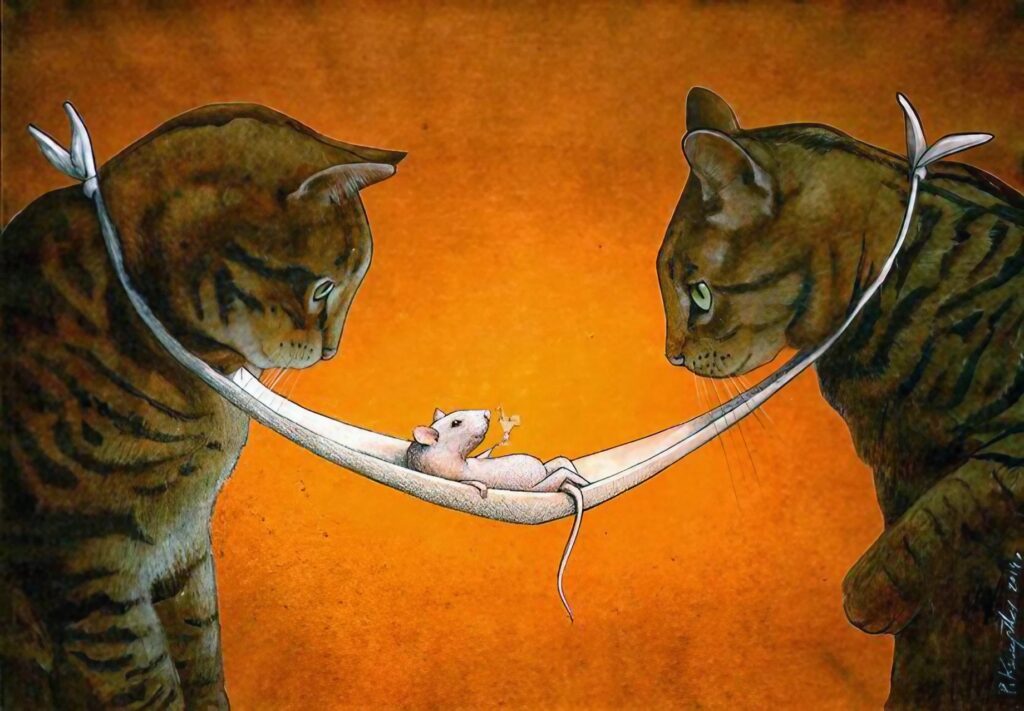
最小变化平行宇宙对照法。
Hi everyone. This episode, we’re continuing our conversation about “the thinking methods psychology taught me.”
Today’s thinking method is called “comparative thinking.”
Students of psychology, medicine, biology, and related fields will all be familiar with this. It’s basic training for experiments in the life sciences. Here, we’ll talk about the plain-English version that anyone can easily follow.
Like the “ask whether it is true first, then ask why” method we discussed last time, comparative thinking is a tool widely used in scientific research, but it also works across fields. It can be very helpful for thinking through everyday problems too. At the end of the episode, we’ll look at an example of using it in daily life.
The Parallel Universe of Minimal Change
So what does “comparative thinking” mean? It means that when we judge whether the “effect” of something is good or whether it really works, we’re actually comparing it with a control condition.
Compared with what control condition? The parallel universe of minimal change.
Sounds pretty sci-fi, doesn’t it? Well, yes—it’s something I made up myself…
What is “the parallel universe of minimal change”? Let me tell you about a movie and you’ll get it.
The movie is It’s a Wonderful Life, a classic from Hollywood’s Golden Age. It still ranks in the top 30 of IMDb’s top 250.

There’s a scene in it that goes like this:
The male protagonist has made a complete mess of his life and is about to kill himself. At that moment, his guardian angel comes down to Earth and saves him.
The angel asks him:
“Do you think everyone would be happier if you died?”
The man says:
“Yeah. I really wish I had never existed.”
The angel has an idea and says:
“Then I’ll grant you that wish.”
The angel casts a spell and takes the protagonist to a parallel universe where he has been erased from the world. His family and friends are all there, but he himself has never existed, and nobody remembers him.
The protagonist discovers that in this parallel universe, his family and friends are actually worse off because he doesn’t exist. Suddenly, he understands the value of his existence and rediscovers the beauty of life.
That’s where I got the inspiration for “the parallel universe of minimal change.”

How can we prove that the protagonist’s existence makes the world a better place?
The best way is to use the angel’s trick: put “the universe where the protagonist exists” next to a “parallel universe of minimal change”—that is, a universe in which we remove only the factor we want to test, the protagonist’s existence, while keeping everything else unchanged—and compare them.
If things get better in the parallel universe of minimal change, then the protagonist really is a menace and deserves to die; if things get worse there, that shows his existence actually makes the world a better place.
Keyword: Minimal Change
The most important part here is those two words: “minimal change.”
If you want to prove that the protagonist’s existence makes the world better, the parallel universe you create can make only the smallest possible change. You can erase the protagonist, but you can’t erase his wife at the same time. That wouldn’t be minimal change anymore. Even if that parallel universe got worse, it might simply be because the protagonist’s wife was a good person.
—The principle itself is pretty simple, right? But once you actually use it, there are plenty of traps, and it’s easy to get confused.
The Three Parallel Universes of Old Wei’s Happy Hypnosis Method
Let’s look at an example.
Suppose that a few days ago I impulsively invented a psychotherapy technique called “Old Wei’s Happy Hypnosis Method.” Now I’m promoting it everywhere, telling anyone who’ll listen:
“My Old Wei’s Happy Hypnosis Method works miracles for depression. Depressed patients come in for a session and their symptoms improve immediately.”
So here’s the question: how do I get people to believe that Old Wei’s Happy Hypnosis Method really works for depression?
I have a few possible arguments. You tell me which one would convince you.
Parallel Universe Version 1
For my first argument, I say:
“Look, a week ago I had 10 depressed patients. They received treatment here for a week, and now 8 of them have improved. An 80% improvement rate! Doesn’t that prove my happy hypnosis method is highly effective?”
Would that argument convince you?
To judge how persuasive it is, we have to see whether the comparison hidden inside it is the parallel universe of minimal change.
The original universe here is—the universe after the patients have received Old Wei’s Happy Hypnosis Method for a week.
And the parallel universe is—the universe before the patients received treatment.
Is that a parallel universe of minimal change?
Obviously not.
Besides whether they received Old Wei’s Happy Hypnosis Method, plenty of other factors have changed in this universe.
The most obvious one is that time has changed too. In one universe, time has passed; in the other, it hasn’t.
A lot can happen over the course of that week, and it may not be Old Wei’s Happy Hypnosis Method doing the work.
For example, even without any treatment, some patients would naturally improve during that week. It’s like a cold: even if you don’t take medicine, you’ll recover on your own after a while. Time itself can be a treatment. So universes at two different points in time can’t be directly compared.

Parallel Universe Version 2
All right. Next, I’ll upgrade my argument. For my second argument, I say:
“I have 20 depressed patients. Ten received treatment for a week, and 8 improved;
“The other 10 came to my office every day to read newspapers and fold little paper airplanes. Only 3 of those 10 improved.
“Eight versus three—doesn’t that prove my happy hypnosis method works?”
Whether it works still depends on whether this is a universe of minimal change. In this upgraded argument:
The original universe is still—the universe after the patients have received Old Wei’s Happy Hypnosis Method for a week.
The parallel universe has become—the universe after the patients have spent a week reading newspapers and folding little paper airplanes.
The timing has now been made consistent in the two universes.
So, apart from whether Old Wei’s Happy Hypnosis Method is present, is there any other difference between the two universes?
At least one: the patients’ expectations are different.
In the original universe, the patients feel that they’re being treated, so they expect to be cured. The effect of that expectation is extremely powerful. Medicine calls this the placebo effect: patients can improve simply because they believe they’re being treated.

In the parallel universe, the patients come to the office to read newspapers. They know they aren’t being treated, so the placebo effect doesn’t exist.
So in the original universe, Old Wei’s Happy Hypnosis Method exists, and the placebo effect exists too, while in the parallel universe, neither of these two factors exists. So this still isn’t a universe of minimal change.
Parallel Universe Version 3
With no other option, I have to upgrade my argument again. I say:
“This time, I still have 20 depressed patients. Ten received treatment for a week, and 8 improved;
“The other 10 also came to my office every day, but they received my fake treatment.
“In other words, over the same treatment period, I chatted with them and sprinkled some psychology terms into the conversation, but didn’t use any genuinely effective psychotherapy strategies. I let the patients believe they were being treated. In the end, 5 of these 10 improved.
“Eight versus five. This time, you can believe my method works, right?”
This time, the original universe is still—the universe after the patients have received Old Wei’s Happy Hypnosis Method for a week.
The parallel universe has become—the universe after the patients have received a week of Old Wei’s fake treatment.
Not only is the timing the same in these two universes, but the placebo effect exists in both as well. The only remaining difference seems to be Old Wei’s Happy Hypnosis Method.
At this point, I’ve finally created a basically acceptable “parallel universe of minimal change.” If Old Wei’s Happy Hypnosis Method is still effective by comparison, I might finally breathe a sigh of relief and get people to believe I’m not just bluffing.
“Minimal Change” Is Something You Work Out
See? The principle is simple, but finding true minimal change often means feeling your way forward step by step, just as in this example.
And this process may never end. In the example we just saw, can we really say there are no other differences between the final two universes? Probably not. All you can do is get as close to minimal change as possible.
The idea of “the parallel universe of minimal change” runs through almost every experiment in psychology, medicine, and biology. When actual scientific research is being done, though, we use a less sci-fi name for it: the “control group.”
When we want to know whether a newly invented drug or psychotherapy technique is effective, or whether a newly developed teaching method can help students improve their grades, the key is always to create a control group with the smallest possible change and compare it with the experimental group.
Example from Life: Should Games Be Banned?
Of course, we can use this way of thinking in our everyday lives too.
Here’s an example—
A lot of experts nowadays really dislike children playing games. They’ll say:
Look at how many elementary and middle-school students have been ruined by Honor of Kings. We should confiscate all children’s phones and pass laws banning Tencent from letting minors register for any games. Then those kids addicted to games, with nothing left to play, would go and study hard. Wouldn’t that be wonderful!

Do you think the experts’ reasoning is reliable?
Let’s examine it using the parallel universe of minimal change.
The original universe now is—a world with games, where some children play games and neglect their studies.
And the parallel universe of minimal change is—a world without games.
Pay attention: in this parallel universe of minimal change, apart from games disappearing, nothing else changes at all.
That means the children in the original universe who don’t like studying still don’t like studying here—they just have no Honor of Kings to play, so they still need to find something to do.
They might therefore go from harmless little troublemakers who play games into juvenile delinquents who pick fights and cause trouble.
Things may well not get better. They may get worse.
The wonderful scenario the experts imagine can happen only in another universe. In that universe, besides having no games, the school system is also better, and the lessons are more engaging, so more children can learn to love studying.
So the crucial issue probably isn’t banning games. It’s reforming the school system and the content being taught.
This example shows that the “parallel universe of minimal change” is especially useful for reasoning about what statements like “ban XX” or “promote XX” might actually cause in the real world.
In real life, some experts, when promoting A, intentionally or unintentionally add B, C, D, and E, then tell you that A is great.
I think you now have the ability to spot this kind of argument.
The next time you run into one, you’ll be able to say to these so-called experts:
“Hey, don’t secretly turn this into a whole drama in your head. Can we just change one thing at a time?”
That’s all for this way of thinking—the “minimal-change parallel universes” idea.
This is the second way of thinking psychology has taught me. I hope it helps.
Feel free to leave us a message and share your thoughts. See you next time!
Leave a Reply