[Zhihu Question] What Is Self-Actualization—and What Does It Mean?
A New Definition of Self-Actualization—and Why It Matters
In recent years, a psychologist named Scott Barry Kaufman has done some research and worked out a new, 21st-century definition of the old concept of self-actualization.
After sorting through the work of Maslow, who came up with the concept of self-actualization, he found that 10 of the traits Maslow proposed can withstand scientific scrutiny. Here are the Ten Characteristics of Self-Actualization as organized by Kaufman.
Ten Characteristics of Self-Actualization
- Continued Freshness of Appreciation
(For example: “I can appreciate the basic things in life again and again, with fresh eyes and childlike innocence—with awe, joy, wonder, and even ecstasy—even though these experiences may have grown stale for other people.”) - Self-AcceptanceAcceptance
(For example: “I accept all my quirks and desires, and I don’t feel ashamed or apologetic about them.”) - Authenticity
(For example: “Even in undignified environments and situations, I can maintain my dignity and integrity.”) - Equanimity
(For example: “I tend to face life’s unavoidable ups and downs with grace, acceptance, and calm.”) - Purpose
(For example: “I have a strong sense of responsibility and duty to fulfill a certain mission in life.”) - Efficient Perception of Reality
(For example: “I am always trying to understand the truth about people and nature.”) - Humanitarianism
(For example: “I have a sincere desire to help other people.”) - Peak Experiences
(For example: “I often have experiences like this—experiences in which I feel that both I and other people have gained new perspectives and possibilities.”) - Good Moral Intuition
(For example: “When I do something wrong, I can immediately tell, deep down inside.”) - Creative Spirit
(For example: I generally have a creative spirit, and it influences everything I do.)
If you fit most of these characteristics, you’re self-actualized.
The Value of Self-Actualization
So what does self-actualization mean?
According to Kaufman’s research, self-actualization brings optimal health and personal growth (optimal health and growth).
More specifically, self-actualized people have the following advantages:
1. More stable emotions and goals: People with higher levels of self-actualization also have greater emotional stability, and are better able to protect their highest goals from interference by redirecting impulses and distracting thoughts.
2. Less mental drain: People with higher levels of self-actualization have fewer destructive impulses (feelings like losing control or self-destruction), fewer unconstructive thoughts (such as pessimism about the future), and are less likely to feel a lack of authenticity or meaning.
3. Happier: People with higher levels of self-actualization score higher on measures related to happiness, including life satisfaction, curiosity, self-acceptance, and interpersonal relationships.
4. More creativity and ability at work: People with higher levels of self-actualization show greater creativity, job satisfaction, and work performance across different fields.
5. A stronger sense of transcendence: People with higher levels of self-actualization have more of a “sense of transcendence”—that is, a feeling of letting go of the boundaries of the self and becoming one with the world. This feeling has two sides: one is that the self feels less salient; the other is that the feeling of connection with the world grows stronger. Interestingly, among people with higher levels of self-actualization, it is the latter that becomes stronger, while the former does not diminish. This means that self-actualized people will gladly put their strength at the service of others, but may not sacrifice themselves in order to serve them.
(Which of these qualities are causes and which are effects of self-actualization? I don’t think it’s easy to say. Kaufman didn’t provide evidence for the direction of causality either.)
Historical Gossip: Maslow’s Understanding of Self-Actualization
While we’re on the subject, let’s talk about what this concept of self-actualization was all about in the beginning.
When it came to defining self-actualization, things were actually a complete muddle at first. More than 70 years ago, this was how Maslow argued for self-actualization—
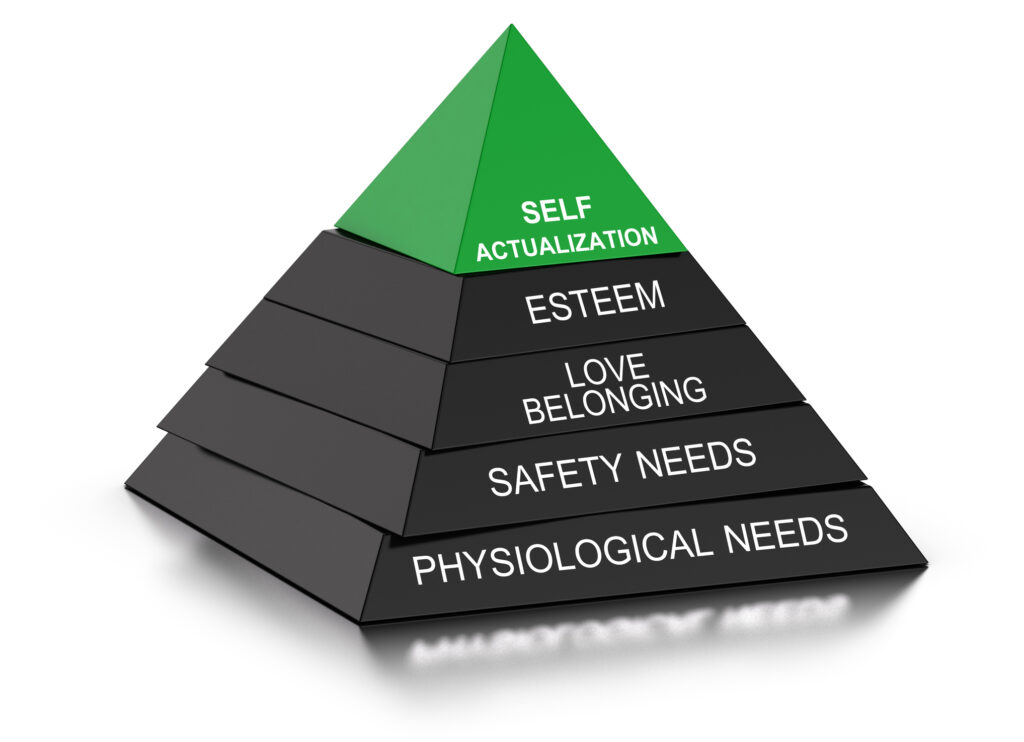
Maslow first proposed that human needs come in levels: at the bottom are physiological needs like eating, drinking, and using the bathroom; in the middle are social needs like being loved and respected; and at the highest level is self-actualization. Self-actualization, roughly speaking, means that people long to transcend themselves and realize their potential.
So how do you prove that self-actualization is humanity’s highest-level need? Maslow’s method was to observe and interview several hundred famous people, including successful figures like Albert Einstein. He summed up these people’s personality traits and said that those traits were what self-actualization meant: enjoying solving problems, having an open mind and selfless love, being free of prejudice, daring to make fun of yourself, having firm convictions, and so on. You see, these people at the top of the pyramid were self-actualized, so self-actualization must be humanity’s highest-level need. It sounds pretty convincing at first.
But Maslow’s student, Elliott Aronson—who later became one of the great masters of social psychology—very perceptively noticed that this was actually circular reasoning: How do we know that people like Einstein were pursuing self-actualization? Because they had the traits of self-actualized people. And what are the traits of self-actualized people? They are the traits displayed by Einstein and people like him.
Any scientific theory has to be capable of being supported or falsified by empirical data. But Maslow’s theory couldn’t be tested at all, because even the concepts within the theory were vague.
Maslow was a great thinker, but he only concerned himself with publishing ideas and almost never seriously tested his own views.
That’s all.
References:
Scott Barry Kaufman. What Does It Mean to Be Self-Actualized in the 21st Century?
Leave a Reply