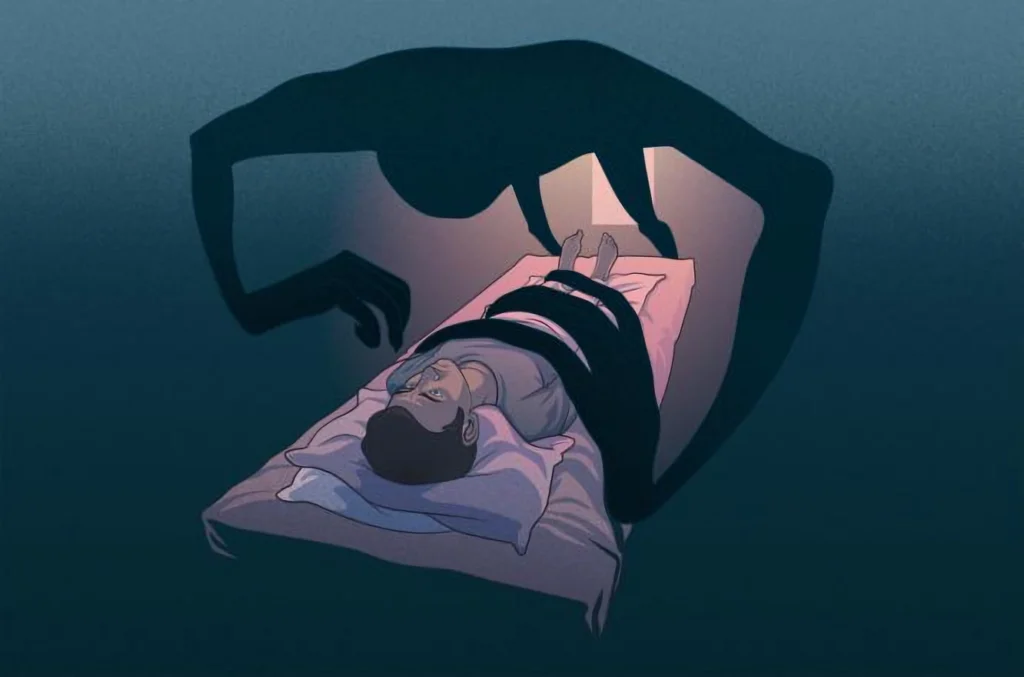
[Zhihu question] What Is the Mechanism Behind "Ghost Pressing the Bed" (Sleep Paralysis, Sleep Paralysis, and Nightmare)?
Vivid hallucinations: What exactly is the “ghost” you see during “ghost pressing the bed”?
People who have never experienced “ghost pressing the bed” may misunderstand the phenomenon, assuming its key word is “pressing“—the feeling that something is pressing you down onto the bed, leaving you unable to move.
But in reality, the key word is “ghost“. While feeling as if you are carrying a thousand-kilogram weight, you also go through an intense hallucination: you may see a person-shaped shadow, a monster, or something similar standing beside you. You may even have a brief or prolonged interaction with this “ghost”—and the whole thing feels unbelievably real! That is the most baffling, and most frightening, part of “ghost pressing the bed”.
Let me start with my own experience, then we can look at the neural mechanism.
My own experience
I have experienced “ghost pressing the bed” once myself, and it really was utterly bizarre. I can still remember it vividly—
I had only recently started working and was living alone in a rented place near my workplace. One night, shortly after I got into bed, I suddenly saw someone standing at the foot of my bed. They lifted my quilt a little, and I immediately felt a chill coming from the direction of my feet. I was scared out of my wits, but I had to summon every ounce of strength just to stand up. Then I slowly, painfully shuffled toward the door, never daring to look in that person’s direction. Just as I finally managed to open the door and put one foot outside, the scene vanished in an instant. I found myself lying in bed, with everything around me exactly as usual. There was no one in my room, and the door was still locked securely.
Even though my rational mind recovered quickly, emotionally it was hard to believe that what had just happened was a hallucination. It had been so incredibly lifelike!
If I had been an ancient person who believed in ghosts and spirits, I would have been one hundred percent certain that I had “seen a ghost”. The thing standing at the foot of my bed could only have been a demon come to snatch away my soul;
If I were a conspiracy theorist who firmly believed that aliens were secretly monitoring Earth, I would likewise have been one hundred percent certain that the dark figure at the foot of my bed was an alien trying to abduct me.
In fact, many scientists believe that so-called “alien abduction” incidents are, in reality, nothing more than “ghost pressing the bed”. People who claim that aliens abducted them to a flying saucer for experiments are not necessarily making up stories to deceive anyone. They were actually experiencing vivid hallucinations during “ghost pressing the bed”. They mistook hallucinations for real experiences and sincerely believed that they had been abducted by aliens.
Before experiencing “ghost pressing the bed” myself, I was somewhat skeptical of this explanation. How could a sane person possibly fail to tell fantasy from reality? But after that firsthand experience, I was convinced—the hallucination really was that realistic.
So how exactly do these super-realistic hallucinations arise?
Dreams: hallucinations generated by the brainstem
As far as I know, because “ghost pressing the bed” is an occasional phenomenon, it is difficult for scientists to study it systematically. So there is still no complete scientific consensus on its precise neural mechanism.
But there is a very good chance that the hallucination of “ghost pressing the bed” originates in neural signals sent out by the brainstem.
The brainstem is the structure connecting the brain and spinal cord. It has many jobs, but one of its functions is actually to generate the hallucination we know best: dreams.
Scientists have found that when people dream, a brain wave called the PGO wave appears simultaneously in the brainstem, thalamus, and occipital lobe of the cerebral cortex. The latter two are key brain regions for processing vision: the thalamus relays visual signals, while the occipital lobe is the visual cortex, responsible for giving us the experience of visual scenes. The brainstem, thalamus, and occipital lobe seem to form a visual pathway for dreams.
Harvard Medical School psychiatrist John Allan Hobson proposed a hypothesis based on this. He believed that dreams are actually caused by random neural activation—or firing—in the brainstem. The random nerve impulses generated by the brainstem are transmitted to the thalamus. The thalamus is merely a relay station; it cannot tell whether a neural signal came from the eyes or from the brainstem. It simply passes all those signals along to the visual cortex.
And how does the visual cortex process these signals? It still tries, just as it does when we are awake, to make sense of the jumble. Using the knowledge and memories stored in the brain, the visual cortex works hard to string a pile of fragments together into a complete story or a coherent visual image—that is the dream we experience.
“Making up a story at all costs” is actually one of the brain’s important quirks. Our brains cannot tolerate gaps in meaning. They are always looking for patterns and extracting meaning from what we see and hear. Dreams make this even more interesting: the signals the brain receives are objectively meaningless, but the brain gets creative and forces meaning into them anyway.
During normal sleep, the brain turns the random signals sent by the brainstem into dreams. So what happens when the normal sleep pattern is disrupted and goes haywire?
We may experience “ghost pressing the bed”.
Ghost pressing the bed: dreaming while half-awake
We know that the most vivid dreams occur during REM sleep. Under normal circumstances, we do not enter our first REM period until 60-75 minutes after falling asleep.
But on some occasions, we enter REM sleep directly as we fall asleep, and scientists have found that this is precisely when “ghost pressing the bed” is most likely to occur.
So we have good reason to suspect that “ghost pressing the bed” is a highly unusual kind of dream: perhaps because it happens so close to wakefulness, part of the brain is still near an awake state when it suddenly enters a dream.
“Ghost pressing the bed” means dreaming while in a state close to wakefulness—which is why its hallucinations are so incredibly lifelike.
(The state of dream theft in the movie Inception is actually more like “ghost pressing the bed” than “lucid dreaming”.)
Now let us look at the details. When we are “dreaming while half-awake”, what exactly is happening to our bodies and our consciousness?
Scientists discovered long ago that during REM sleep, our bodies undergo complete muscle paralysis. We cannot move while dreaming. This is probably a protective mechanism: with our muscles paralyzed, we do not actually start throwing punches and kicks in response to our dreams. We can even sense this in dreams—think back: don’t you often feel as if your movements are sluggish in dreams?
In ordinary dreams, our rational thinking is mostly shut down, so we do not pay much attention to this. But during “ghost pressing the bed”, we are half-awake. We realize that our whole body is unable to move, and that makes us extremely frightened and anxious.
At the same time, we are still dreaming. Our eyes remain shut, while the visual cortex continues receiving neural impulses from the brainstem. The brain still does everything it can to turn those impulses into meaningful images, just as it does in a dream. So it weaves together the sensation of a rigid body, our fearful emotions, and the visual signals from the brainstem into a terrifying plot: “a vicious ghost has come to claim our life”, or “aliens have come to abduct us”, while our body is sluggish and we cannot get away.
That is why “ghost pressing the bed” is both so incredibly lifelike and so consistently terrifying;
That is why almost everyone who has been abducted by aliens later recalls that they became completely unable to move the moment the aliens entered their room;
And that is why, during my own episode of “ghost pressing the bed”, I could not move my body no matter how hard I tried.
In short, the hallucination of “ghost pressing the bed” is probably a special kind of dream. Ultimately, it is the brain processing visual signals generated by the brainstem into a vivid hallucination.
Hallucinations in people with brainstem damage
There is also some supporting evidence for this idea: some patients with brainstem damage can experience vivid hallucinations while completely awake.
This condition was first identified in 1922 by neurologist Jean L’hermitte. After one of his female patients suffered a brainstem stroke, she often saw a group of brightly dressed children marching in formation. In 2008, several Italian psychiatrists reported a similar case: after a fever, an 11-year-old boy saw Voldemort and even picked up a helmet and sword to fight him. Later examination found inflammation in the boy’s brainstem. Once the inflammation subsided, Voldemort disappeared.
Psychiatrists later discovered two things these patients with brainstem damage and hallucinations had in common. First, they all complained that their dreams were unusually vivid. Second, their hallucinations tended to appear only when the surroundings were dark. As soon as the lights were turned on, the hallucinations disappeared.
Why do the hallucinations appear only in the dark? Neurologist Eliezer Sternberg writes in his book The Logic of the Nervous System (Shenjing de luoji):
The source of dreams is the brainstem, which contains the dream switch. Normally, this switch opens only during REM sleep, but brainstem damage lowers the threshold for starting a dream. The injured brainstem does not need to wait for sleep; as soon as it senses darkness descending, it switches the dream on early.
In other words, people who hallucinate because of brainstem damage are actually dreaming while awake—or, you could say, experiencing “ghost pressing the bed” while fully awake.
That’s all.
References:
Editors of Scientific American. Ask the Brains(Part 2): 62 Answers to Common Questions on the Mind. Scientific American. ISBN:9781250121530
Eliezer Sternberg. The Logic of the Nervous System (Shenjing de luoji). Guangxi Normal University Press, 2018
Leave a Reply